




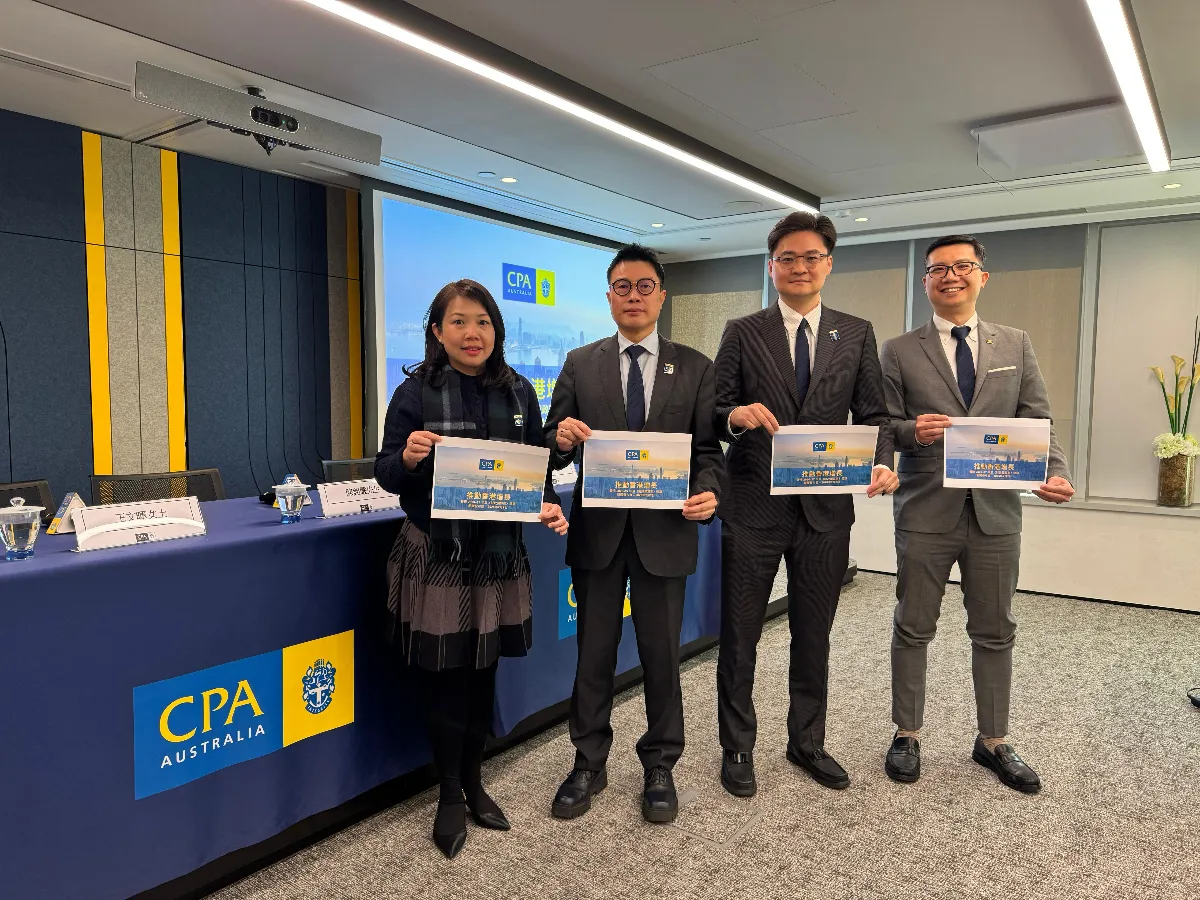
HONG KONG SAR – Media OutReach Newswire – 2 February 2026 – CPA Australia has today submitted a set of forward-looking recommendations for consideration in the Hong Kong SAR Government’s 2026-27 Budget. With an estimated HK$0.9 billion fiscal deficit for 2025–26 and solid fiscal reserves of HK$653 billion, CPA Australia propose a series of policy measures under the theme of “Power Hong Kong’s Growth” focusing on four pillars:
- Connecting China and global markets to power growth
- Strengthening Hong Kong as a global trade and wealth hub
- Diversifying the economy and boosting workforce competitiveness
- Raising living standards for a healthier and liveable city
Connecting China with global markets and powering Hong Kong’s future economic engine
CPA Australia emphasises that Hong Kong must reinforce its position as the premier gateway connecting China with global markets. As China’s 15th Five Year Plan places greater focus on high-quality opening up, Hong Kong is uniquely positioned to help Chinese enterprises expand overseas while attracting foreign direct investment into the Mainland through Hong Kong. Strengthening this gateway function will be critical to driving the city’s next phase of economic growth.
Mr Anthony Lau, Co-Chair of CPA Australia’s Greater China Taxation Committee stated,
“Developing a unified and coherent tax incentive framework for Corporate Treasury Centres (CTC) and regional headquarters (RHQ) would further strengthen Hong Kong’s appeal as a base for multinational operations. In addition, the effectiveness of re-domiciliation has attracted many overseas companies to move their legal domicile to Hong Kong. As there is no clear guidance on whether re-domiciliation will trigger Mainland tax liabilities and tax reporting obligations, we recommend the Hong Kong Government engages with the Mainland tax authorities to clarify that no actual transfer of assets occurs during the process, and therefore no Mainland tax should arise.”
“We also recommend advancing market connectivity measures such as allowing a tax deduction specifically for IPO-related expenses for companies that list on the Main Board of the HKEX, and continuing to enhance existing cross boundary financial mechanisms such as introducing an IPO Connect scheme.”
A streamlined approach would reduce complexity, improve tax certainty and encourage overseas and Mainland enterprises to centralise management, financing and strategic functions in Hong Kong.
CPA Australia also highlights the importance of positioning the Northern Metropolis as a flagship cross‑border innovation zone that will drive Hong Kong’s future growth. Mr Lau said, “To support the infrastructure development, we suggest the Government adopts forward‑looking financing tools that ease pressure on public finances. These may include issuing bonds targeted at with an estimate amount for example USD2 billion at different maturity to international investors, and providing a tax exemption for bond holders on interest income and trading profits derived from bonds issued for Northern Metropolis infrastructure projects, whether issued by the government or the private sector.
“To attract leading innovation and technology enterprises to the zone, we further recommend broadening the scope of qualifying R&D expenditures to include activities outsourced to related parties based and operating in other cities within Greater Bay Area. This reflects the increasingly integrated nature of cross boundary innovation and supply chains.”
Strengthening Hong Kong as a global trade centre and a hub for wealth retention
Hong Kong’s long‑standing role as a free, open and trusted trading and financial gateway remains central to its international relevance.
Ms Karina Wong, Deputy Chair of the Greater China Taxation Committee said, “Hong Kong should build on its unique status as a global trading centre by strengthening the free trade port regime and expanding support for high-value commodity trading, which would help diversify the city’s economic base and enhance market depth. Qualifying commodity items such as silver and rare-earth materials remain outside the current scope, the qualifying list needs to be reviewed regularly, with sufficient legislative flexibility, to ensure timely updates in response to market developments. The Government could also consider whether the scope should extend beyond physical trades and incidental income to cover derivative driven transactions, which form a significant part of global commodities activity.”
A stronger family office ecosystem is central to reinforcing Hong Kong’s role as Asia’s preferred hub for wealth management and succession planning. “We recommend introducing a preferential 8.25 per cent profits tax rate for Single Family Office, Multi Family Offices (MFOs) and fund managers to enhance Hong Kong’s competitiveness relative to other regional wealth management centres.
“Aligning the permissible investment asset classes under the family office tax concession regime with those under the Capital Investment Entrant Scheme (CIES) would also streamline operations, provide greater investment flexibility and further strengthen Hong Kong’s appeal among global wealth owners managing long term capital,” added Ms Wong.
Modernising Hong Kong’s philanthropy framework would encourage a more caring and compassionate community and strengthen the city’s appeal to long-term capital. “The generous donations supporting residents and the reconstruction of Wang Fuk Court show that Hong Kong is a caring city. To encourage greater philanthropic participation, we suggestremoving the current 35 per cent cap on cash donation deductions and allowing a full 100 per cent deduction, while introducing a 300 per cent enhanced deduction for contributions to designated funds, such as the Community Care Fund and Disaster Relief Fund. This would direct more resources toward areas of social need.
“These reforms will strengthen Hong Kong’s ecosystem for trade, wealth management and philanthropy, helping the city attract and retain long term capital and strengthen Hong Kong’s competitive edge,” Ms Wong said.
Diversifying the economy and enhancing workforce competitiveness
As advanced economies accelerate digital transformation and adopt emerging technologies, Hong Kong’s long-term competitiveness will depend on the city’s ability to scale innovation, raise productivity and strengthen the capacity of its workforce and enterprises.
“We propose to relaunch a revamped Technology Voucher Programme to help businesses, in particular SMEs, accelerate digitalisation and adopt artificial intelligence (AI) solutions that enhance efficiency and competitiveness.
“Strengthening R&D related tax incentives is equally important in driving innovation, therefore we propose increasing the cap for the highest rate of the R&D super tax deduction by raising the threshold for the 300 per cent deduction on qualifying R&D expenditure from HK$2 million to HK$4 million.” said Mr Janssen Chan, Co‑Chairperson of CPA Australia’s Greater China Taxation Committee.
SMEs remain the backbone of Hong Kong’s economy, yet many continue to face cost pressures and increasing competition.
“We recommend raising the cap under the two-tier profits tax regime for concessional 8.25 per cent half-rate from HK$2 million to HK$4 million of assessable profits. Extending the SME Financing Guarantee Scheme beyond March 2026 is another move that would ease operating pressures for smaller businesses and encourage reinvestment,” added Mr Chan.
By raising the two-tier profits tax cap, extending financing support and retooling tech programmes for AI adoption, the Government can give SMEs the room to grow and strengthen their long-term resilience.
Raising living standards and building a healthier and more liveable city
Mr Adam Chiu, member of the Greater China Taxation Committee, said the Budget should introduce targeted tax and subsidy measures that deliver practical support to households while encouraging healthier and more productive lifestyles.
“To provide direct relief to taxpayers, we recommend maintaining the 100 per cent salaries tax rebate on the 2025/26 final salaries tax, capped at HK$6,000. This would help offset rising living costs and support disposable income, particularly for middle‑income earners. We also propose introducing a tax deduction of up to HK$60,000 for working families who employ domestic helpers specifically to care for children, elderly family members or persons with special care needs. This would help ease caregiving pressures, support labour‑force participation.” Mr Chiu said.
He added that lifelong learning and skills upgrading are increasingly important in a rapidly evolving economy. “To enable individuals to undertake more advanced or specialised training, including in emerging areas such as AI, we recommend increasing the subsidy ceiling under the Continuing Education Fund to HK$30,000 per eligible applicant, and increasing the cap on the self-education tax deduction to HK$150,000 per year. To promote physical wellbeing, we also propose a tax deduction of up to HK$2,000 for sports‑related expenses.”
“By supporting working families, encouraging lifelong learning and promoting healthier lifestyles, these measures can collectively enhance quality of life and help build a more resilient and inclusive Hong Kong,” Mr Chiu said.
CPA Australia believes these recommendations will strengthen Hong Kong’s ability to engage more effectively with global markets, enhance its competitiveness as an international financial and business hub, and improve quality of life for residents. Taken together, these measures will help ensure Hong Kong is well positioned for a more sustainable, innovation driven and inclusive future.
Hashtag: #CPAAustralia
The issuer is solely responsible for the content of this announcement.



