




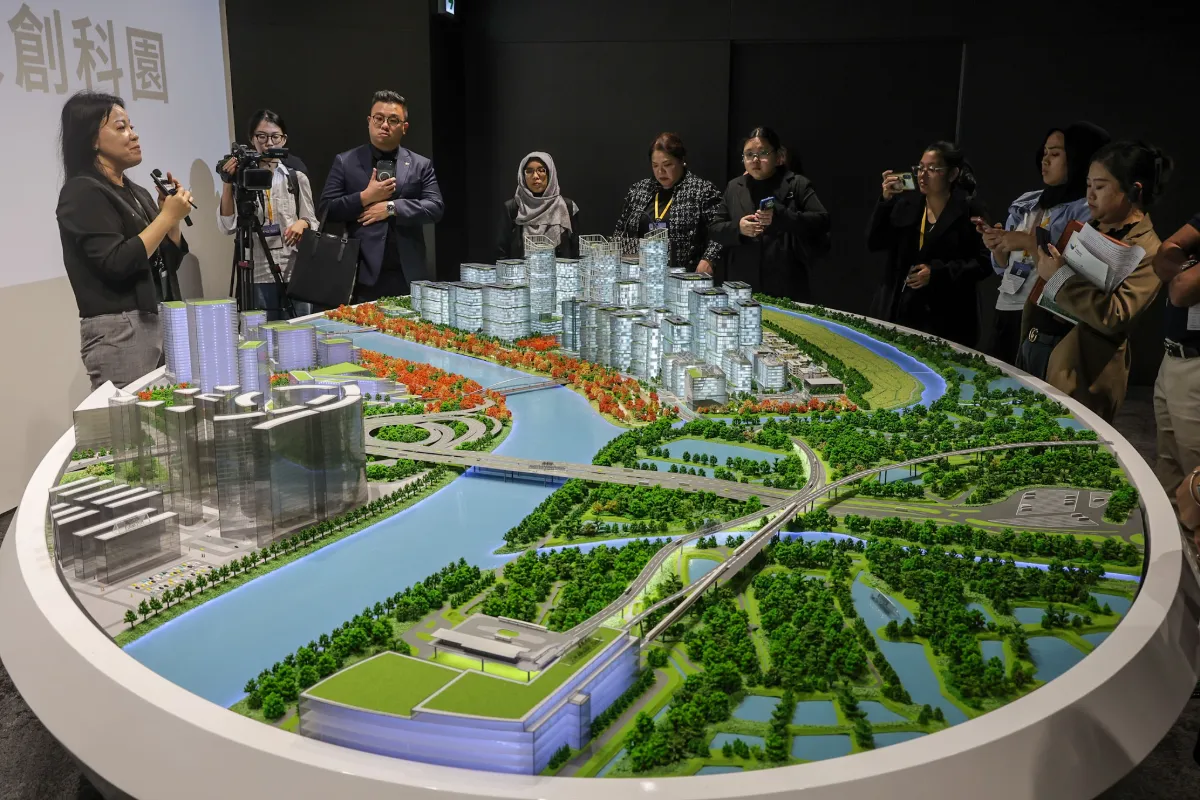
HONG KONG: On one side of the city, a 24-building science campus hums with more than 26,000 researchers, engineers and entrepreneurs. On the other, across the Shenzhen River, newly opened laboratories face mainland China as Hong Kong builds a second innovation engine designed to plug directly into the Greater Bay Area.
Together, the two ecosystems sit at the centre of Hong Kong’s pitch to Malaysia and wider Asean markets – use the city not only as a financial gateway, but as a launchpad into China’s technology supply chains.
At the established Hong Kong Science and Technology Parks Corporation (HKSTP) in Pak Shek Kok, chief ecosystem development officer Eric Or described the park as a vertically integrated innovation system linking universities, startups, investors and corporates.
Unlike many state-backed innovation hubs, HKSTP runs on a self-sustaining model.
“We are basically a property developer. We collect rent from tenants who lease our office space, and that revenue funds the entire operation,” he said during a delegation visit alongside the South China Morning Post’s Greater Bay Area-Asean Summit recently.
He added that HKSTP has not received government funding since 2018.
The ecosystem, however, extends far beyond real estate.
Startups are supported through a structured funding ladder, from HK$100,000 (RM52,000) ideation grants to as much as HK$21 million (RM10.9 million) in scale-up funding, alongside lab access, recruitment support and investor matchmaking.
“Our job is to help the tech ventures here be successful. The tech venture’s success is our success,” Or said.
More than 500 corporate partners, including banks, airlines and government-linked entities, serve as early customers for startups. Or said this demand-side access is critical given Hong Kong’s limited domestic market.
“We are constantly taking our companies overseas,” he said, citing recent engagements in Singapore, Indonesia, Europe and upcoming initiatives involving Malaysia.
“Hong Kong, as much as we like Hong Kong, the market is very small. So we take companies that are ready overseas.”
That outward push is central to Hong Kong’s Asean strategy.
“We support people from all over the world. As long as you register a Hong Kong company, we will support you.”
For Malaysia, the engagement aligns with its push to move up the value chain in semiconductors, AI and advanced manufacturing.
About 30km away, the Hong Kong-Shenzhen Innovation and Technology Park (HSITP) represents the second pillar of the city’s strategy, located along the Shenzhen River under the “one zone, two parks” model that links Hong Kong and Shenzhen into a single cross-border innovation ecosystem.
HSITP CEO Vincent Ma said the park is designed to bridge research, testing and commercialisation across the border.
“Our vision is to develop HSITP into a world-class IT hub which connects the mainland and the rest of the world,” he said.
Opened in December 2025, HSITP has already filled its first two wet laboratory buildings, hosting more than 90 tenants, with nearly 70% from mainland China or overseas markets. Its core sectors include artificial intelligence, life sciences, robotics, microelectronics, new materials and clean energy.
“We are building a world-class industry-academia-research platform and an internationally competitive R&D transformation and pilot production base,” Ma said.
He added that for Asean, including Malaysia, HSITP offers a strategic entry point into the GBA.
Together, HKSTP and HSITP reflect Hong Kong’s dual-track strategy: one ecosystem focused on startup commercialisation, the other embedding R&D directly into China’s industrial corridor.
For Malaysia and Asean, the implication is increasingly strategic. As regional economies compete to attract capital, talent and deep-tech investment, Hong Kong is positioning itself not as a rival hub, but as an intermediary platform linking Southeast Asia with China’s innovation system.
It also reflects a broader shift in Asia’s tech geography: competition is no longer just between national ecosystems, but between cross-border platforms competing to host the same startups, researchers and capital flows.



