




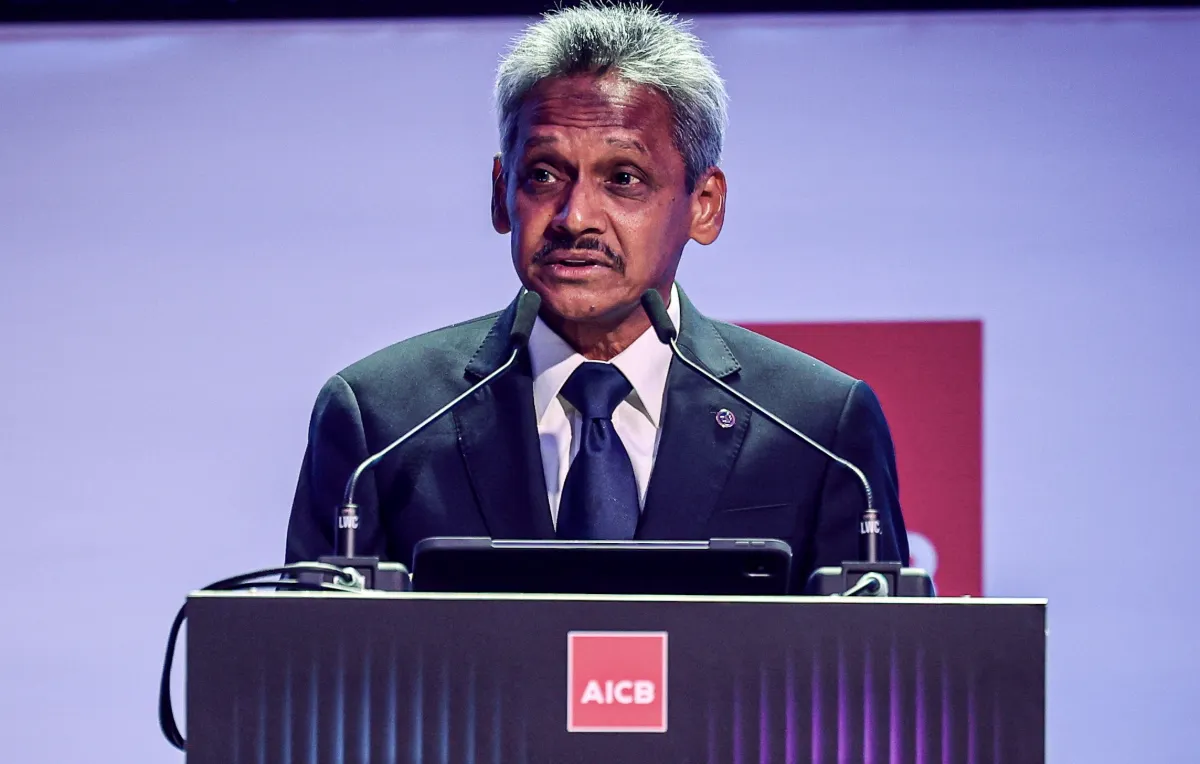
KUALA LUMPUR: Bank Negara Malaysia (BNM) is calling on financial institutions to place artificial intelligence (AI) firmly on the board agenda, not just as a technology project.
BNM governor Datuk Seri Abdul Rasheed Ghaffour said AI is rapidly reshaping financial services through fraud detection, credit and insurance assessments, compliance, risk management and customer service.
“AI should not sit at the margins as a technology project. It belongs firmly on the board agenda,” Abdul Rasheed said at the inaugural AICB Nexus 2026 conference today.
He added that it is a matter of capital allocation and governance, anchored in clear business outcomes, measurable value and a defined risk appetite.
He stressed that accountability for AI-driven decisions must remain with human leaders.
“While machines may generate insights and support decisions, accountability must remain with those entrusted to govern and lead,” he said, adding that responsibility cannot be delegated to an algorithm.
Abdul Rasheed said much of the discussion surrounding AI had focused on the speed of adoption, but argued that a more important question was whether institutions could maintain trust in the financial system.
“Can we ensure that AI strengthens trust, preserves accountability and reinforces public confidence in the financial system?” he asked.
The central bank governor said finance has always depended on public trust.
“Trust that savings will be safeguarded. Trust that capital will be allocated efficiently. And trust that the institutions, governance and rules underpinning the system remain credible and resilient. AI may transform finance. But trust will determine whether that transformation endures.”
Describing “innovation without trust is not progress” as principle that should guide AI adoption, Abdul Rasheed said, the issue extended beyond technology itself.
“This is not merely a statement about adoption of technology; it is about how we exercise leadership, how we uphold governance and ensure that the financial system we build remains trusted and firmly anchored in the needs of society,” Abdul Rasheed said.
He pointed out that more than 70% of Malaysian financial service providers have already implemented at least one AI application, with adoption accelerating as institutions pursue greater efficiency, productivity and risk management.
“Industry responses to our Discussion Paper on Artificial Intelligence in the Malaysian Financial Sector show that AI adoption is accelerating,” he said, adding that adoption is concentrating where there are opportunities for efficiency gains, productivity gains, and better risk management.
However, Abdul Rasheed urged institutions to move beyond using AI solely for internal efficiency gains.
“Thus far, financial institutions have focused on use cases that deliver internal value. The opportunity before us now is to move beyond this institution-centric lens,” he said.
“The next frontier is to use AI to solve problems that no institution can solve on its own.”
He cited scams, fraud and cyber threats as examples requiring collaboration among regulators, law enforcement agencies, banks and payment providers.
“Trust is not built by one institution, but by an ecosystem working as one. This is innovation with purpose. Institutions should compete where markets demand it and collaborate where public interest demands it.”
Abdul Rasheed said the greatest challenge surrounding AI is not technological capability but governance. “We often speak about trust in AI as a technical challenge. One of model accuracy, data quality or system reliability. But in reality, it is a governance challenge.”
As AI systems become increasingly sophisticated, financial institutions need to answer difficult questions surrounding accountability and fairness, he added.
“How do we preserve accountability when decisions become harder to explain? How do we ensure fairness when models continue to learn and evolve? How do we govern technologies whose capabilities are advancing faster than our traditional control frameworks?” he asked.
“These are not technology questions alone. They are leadership questions.”
Abdul Rasheed also called on institutions to prepare employees for the changing nature of work as AI adoption increases.
“The future of AI will be shaped less by technology than by talent. It is not only about technical skills, but governance capability, critical judgment and the ability to operate effectively where humans and machines interact. Preparing the workforce for this transition is not optional; it is a strategic imperative.”
The central bank governor stressed that institutions must invest in upskilling and reskilling, while supporting their workforce through transition to ensure no segment is left behind.
On regulatory approach, Abdul Rasheed said BNM will continue encouraging innovation while ensuring public confidence in the financial system remains intact.
“We neither constrain innovation prematurely nor leave it to unfold unchecked,” he said.
“Our stance is anchored in proportionality, parity and technology neutrality, ensuring innovation progresses responsibly and with confidence.”
He added that BNM’s Open Finance Framework will provide the foundation for secure and consent-based data sharing, with supporting infrastructure being developed with PayNet and industry players ahead of phased implementation beginning in 2027.
At the same time, he said, the central bank’s asset tokenisation roadmap is progressing into pilot projects through the Digital Assets Innovation Hub.
Looking ahead, Abdul Rasheed said BNM is developing the Financial Sector Blueprint 2027-2030 in collaboration with industry players, government agencies and other stakeholders.



