




Critic says debate ignores modern tax options and Malaysia’s experience
PETALING JAYA: Reintroducing the Goods and Services Tax (GST) after the 16th General Election (GE16) would be “a terrible policy” that risks repeating past mistakes and further burdening ordinary Malaysians, economist Prof Dr Geoffrey Williams has warned.
Williams was responding to Deputy Prime Minister Datuk Seri Dr Ahmad Zahid Hamidi who called GST the “best tax regime” and fairer than the current Sales and Services Tax (SST).
He said the renewed debate shows outdated thinking, ignoring how modern economies operate.
“This debate between GST and SST is a sterile argument rooted in 1970s tax theory. It ignores newer alternatives better suited to 21st-century economies driven by e-payments and e-commerce.”
Zahid had said BN would push for GST’s reinstatement after GE16, claiming it ensures fairness and strengthens national revenue, pointing to its global adoption.
But Williams warned Malaysia’s own GST experience from 2015 to 2018 proved the tax disproportionately burdened the rakyat while failing to fix structural fiscal problems.
“Companies like GST because they don’t pay it themselves – they reclaim it and pass the final bill to consumers.
“Political support often comes from business pressure and the perception that it generates higher revenue. But this higher revenue is not free money. It is raised at the rakyat’s expense.”
He said GST, introduced to finance rising government deficits and debt, did not achieve its purpose.
“It did nothing to cut debt or deficit. Instead, it fueled higher spending, plagued by wastage, leakages and corruption.”
He added that GST pushed up prices, raising the cost of living.
“It is a regressive tax, hitting poorer households hardest, especially when low-income groups already struggle with stagnant wages and rising costs. That’s why it sparked widespread public discontent.”
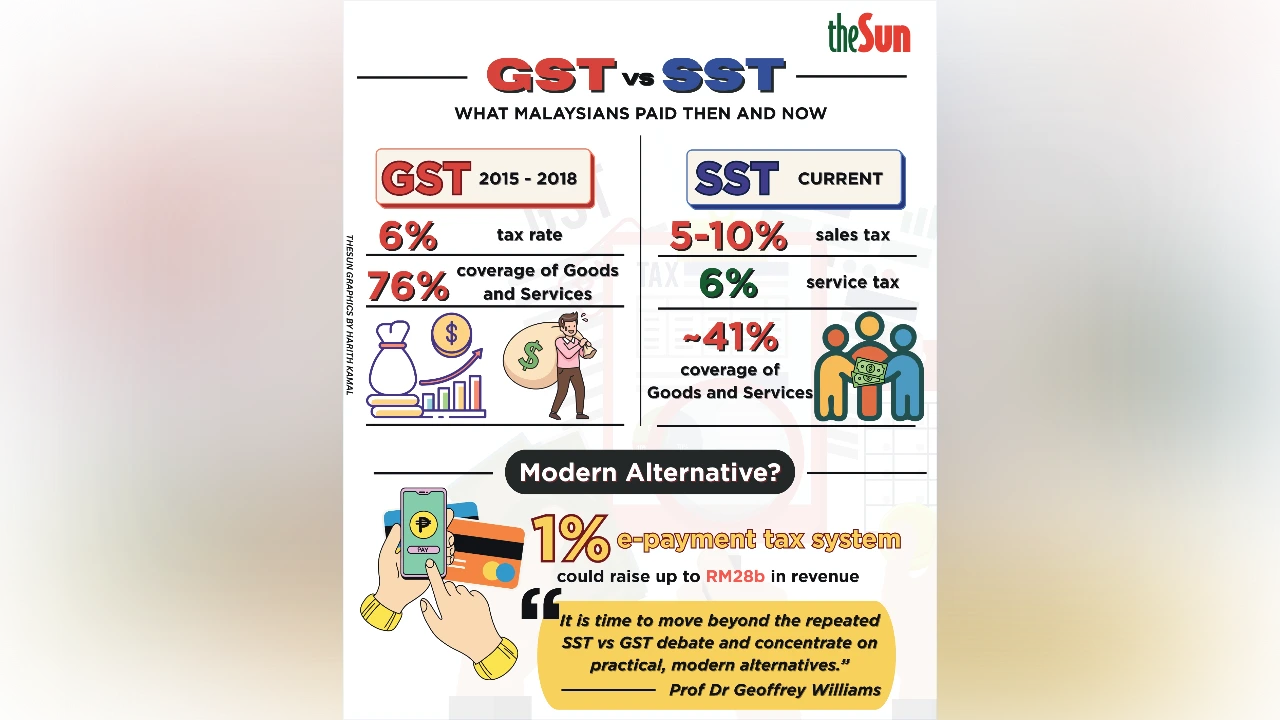
While proponents argue GST is more efficient, Williams cautioned that global GST rates are often much higher than the 6% Malaysians experienced.
“Around the world, GST is typically double digits, often 20% to 30%. That is when it really hurts low-income groups.”
On revenue, he challenged claims that GST is superior to SST. While GST raised more money, it applied to a wider base – 76% of products and services versus 41% under SST.
Under the current Unity government, SST has delivered steady revenue growth, projected at RM60 billion in 2026, up from RM53.4 billion this year. Fiscal pressures have eased through subsidy rationalisation and anti-corruption measures, saving at least RM15.5 billion annually.
“This shows there’s no urgency for tax changes when efficiency savings are prioritised. Rather than revisiting GST, policymakers should explore taxes aligned with the digital economy.
“It is time to move beyond the SST versus GST debate and focus on practical, modern options,” he said, highlighting an e-payments tax.
“A 1% tax on electronic payments including card swipes, QR payments, e-wallets and online transactions could raise RM28.8 billion without anyone even noticing.
“That’s a far better yield than either GST or SST at the same rate.”



