



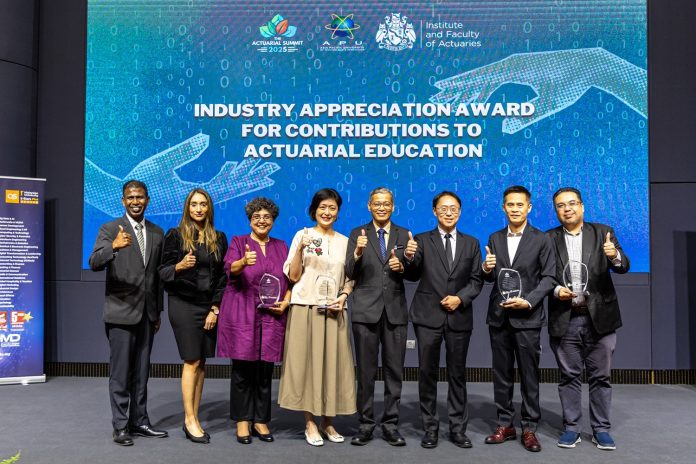
APU’s Actuarial Summit 2025 drew over 500 participants, highlighting the evolving role of actuaries in sustainability, fintech and data analytics.
ASIA Pacific University of Technology & Innovation (APU) recently hosted the Actuarial Summit 2025, jointly organised by APU and the Institute and Faculty of Actuaries (IFoA), UK. The overall success of the international summit and the engagement with local insurance companies, including the Ministry of Higher Education (MOHE), further cemented APU’s role as a leader in the region.
There were over 500 participants who attended the summit and the opening ceremony, including students, educators, alumni, industry leaders and professionals, from both private and public higher learning institutions, signifying strong support in the region for actuarial talent.
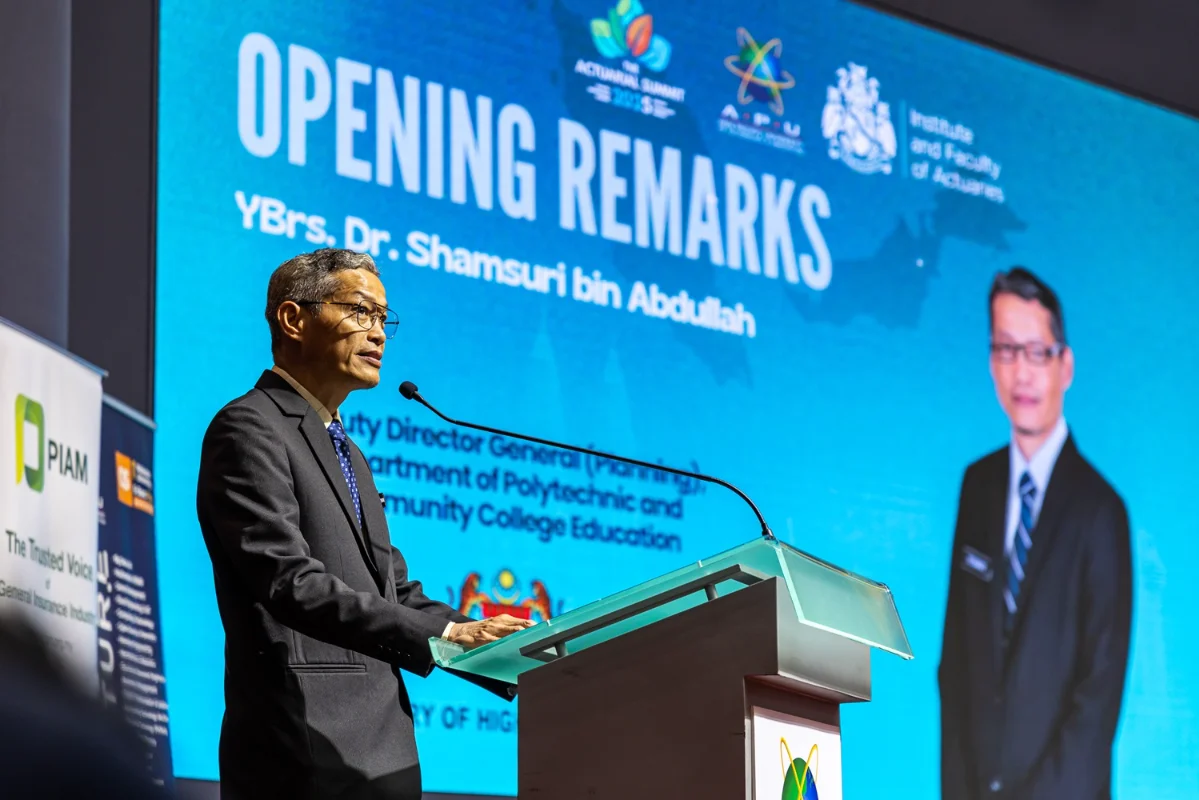
Dr Shamsuri Abdullah, Deputy Director-General of the Ministry of Higher Education, said: “The actuarial field today is no longer confined to insurance or traditional statistical calculations, but is a discipline that supports risk management in a much broader context – encompassing climate impact assessment, sustainable pension systems and alignment with global agendas such as sustainable development goals (SDGs).
Paul Sweeting, President of the Institute and Faculty of Actuaries (IFoA) said in a pre-recorded message from the UK, “This year’s theme, ‘Advancing actuarial excellence for a sustainable future’, reflects how actuaries can help build systems and communities that are resilient, balanced and responsible.”
Associate Professor Dr Rajasegeran Ramasamy, Head of School of Mathematics, Actuarial and Quantitative Studies (SoMAQS) emphasised that the BSc (Hons) in Actuarial Studies at APU is unique.
“There are two specialisms, data analytics and fintech. Why are these two specially chosen?
“The idea is to broaden the specialty of the student. By combining a strong foundation in actuarial science with future ready competencies in technology, data analytics and financial innovation, the APU actuarial student is better prepared.
“With these skills, the students can better navigate more accurate risk management and strategic decision-making. With these added on skills, actuaries can model and manage risks related to climate change, pandemics, financial crises, cybersecurity threats, while also analysing demographic and socio-economic data to inform pension schemes, insurance design and social risk solutions,” he said.
Dr Raja emphasised that the recent actuarial summit successfully achieved its core objectives of promoting professional knowledge, strengthening industry-academia collaboration and enhancing student career readiness.
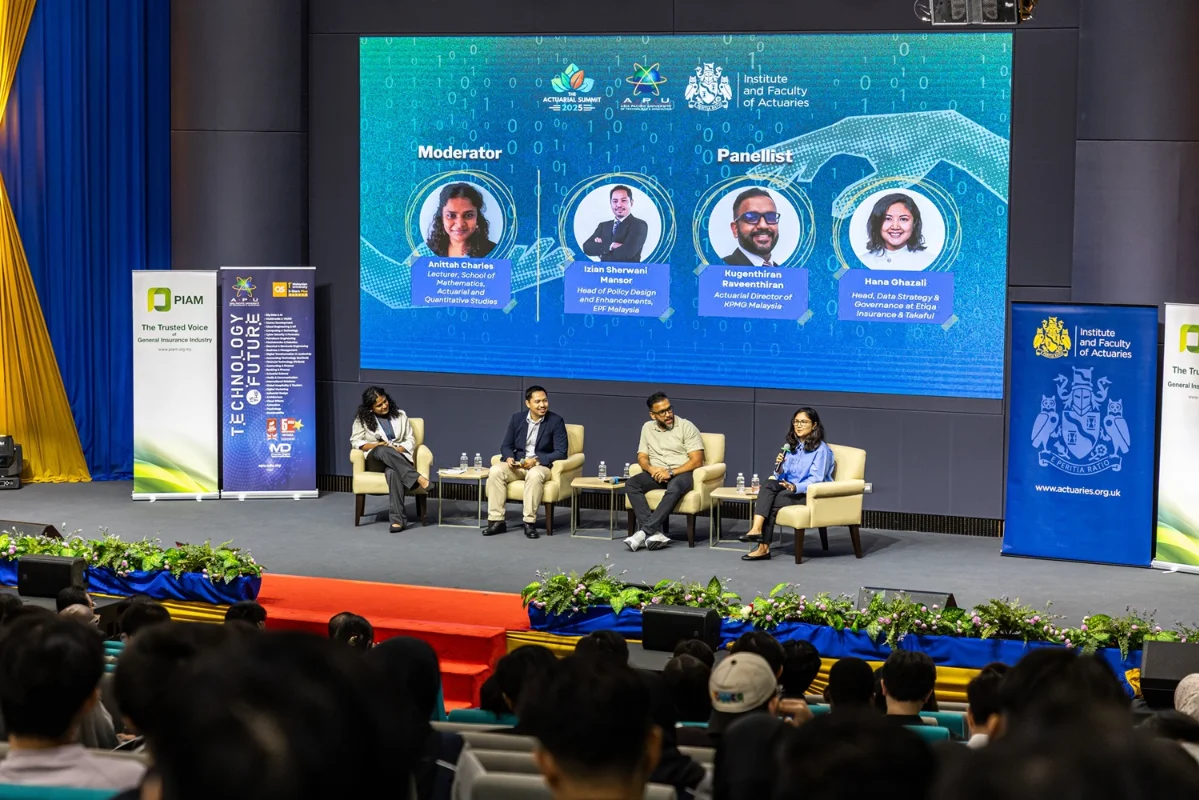
“Not only were there 500 participants, but also 6 CEO’s of major insurance companies in Malaysia, alongside many practising actuaries, who shared their vision and knowledge and participated in mentoring sessions in addition to panel discussions, “ he said.
For the summit, more than 25 industry booths were set up by leading financial and insurance institutions for the benefit of actuarial students.
“The Actuarial Summit 2025 underscores Malaysia’s national commitment to enhancing actuarial education through real-world learning, strengthening employability and leadership pathways, fostering innovation in sustainability-focused actuarial practices, and finally building a resilient, global connected actuarial ecosystem.”
Currently, according to Dr Raja, APU’s Master of Actuarial Science offers significant benefits to students who join with a non-actuarial undergraduate degree by providing a comprehensive foundation in core actuarial principles.

These include mathematics, statistics and financial risk management.
The current programme is designed to bridge knowledge gaps through foundational models, practical exercises, and industry aligned projects, enabling students to acquire the technical and analytical skills required by professional actuarial practice.
Students undergoing the master’s programme are also exposed to data analytics, fintech and applied modelling, which equips non-actuarial graduates with the competencies needed to adapt quickly to actuarial roles and pursue professional exam exemptions where applicable,” he explained.
One of the significant highlights of the summit was the MOU exchange between APU and Persatuan Insurans Am Malaysia (PIAM), which aims to foster joint research, curriculum co-development and a strong talent pipeline for Malaysia’s insurance and risk management sectors.
Datuk Paramjit Singh, CEO of APU, said:
“Our actuarial journey began in 2013 and reached a major milestone in 2018 with full IFoA accreditation.
Today APU stands among a select group of universities in Asia with IFoA accreditation – offering our students an accelerated pathway to becoming globally qualified actuaries.”



