



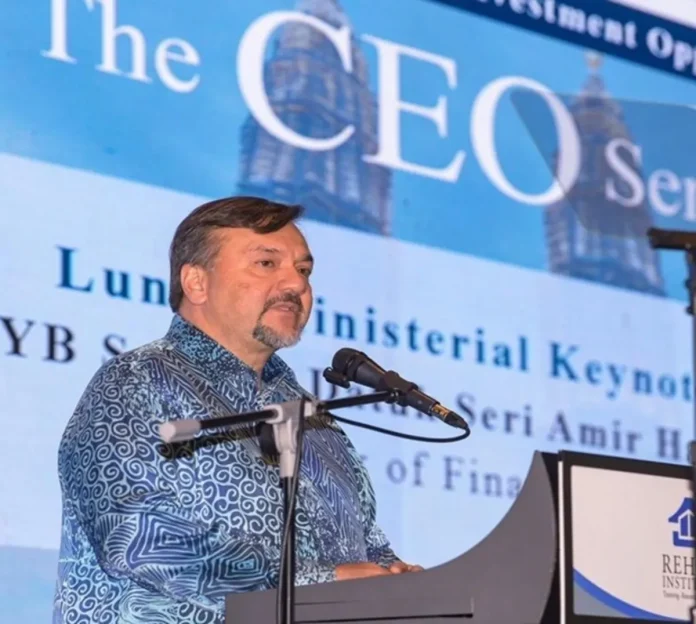
PETALING JAYA: Malaysia’s economic and real estate landscape is set for a transformative year, with policymakers and industry leaders emphasising coordinated action to boost investment, housing delivery and human capital.
The Rehda Institute CEO Series 2026 held today brought together more than 400 business leaders, government officials and international experts to discuss “Reinventing Growth: Innovation and Investment Opportunities in Asean and Malaysia”.
Finance Minister II Datuk Seri Amir Hamzah Azizan underscored the government’s commitment to translating policies into tangible outcomes for households and businesses, describing 2026 as a “year of execution” following two years of strategic planning.
Highlighting initiatives under the 13th Malaysia Plan and the Government-linked Enterprise Activation Reform Programme or GEAR-uP, he said the government aims to mobilise an additional RM120 billion in domestic investment over the next five years, targeting high-growth and high-value industries.
“Policy provides direction. Capital provides fuel. But in this year of execution, it is real assets that provide our nation,” Amir Hamzah said, citing examples such as the Johor-Singapore Special Economic Zone and international models like Korea’s Pangyu Technology Valley as blueprints for integrated, innovation-led ecosystems.
He added that Visit Malaysia 2026, targeting 47 million visitors and RM329 billion in tourism revenue, offers the property and hospitality sectors a platform for experience-driven development.
Echoing the minister, Rehda Institute chairman Datuk Jeffrey Ng highlighted the importance of public-private collaboration in driving sustainable economic growth.
He noted the resurgence of the Malaysia My Second Home Programme, which brought in RM840 million in inflows by mid-2025, including RM237 million in property investments, and urged a review of the proposed increase in stamp duty for foreign home purchases.
“A sudden doubling risks deterring investment and undermining Malaysia’s attractiveness to talent and FDI,” Ng said, advocating either maintaining the current rate or a gradual increase.
He said housing challenges are systemic, requiring a coordinated response across developers, banks, utility providers and government authorities to ensure delivery sustainability and ecosystem resilience.
Ng highlighted concerns over the expiry of the withholding tax (WHT) concession for Malaysian real estate investment trusts, which supported more than RM57 billion in market capitalisation. He suggested retaining the 10% final WHT for individual unitholders while introducing a progressive 2% tax on distributions exceeding RM100,000 to preserve investor confidence.
Both emphasised the importance of human capital.
Ng cited the launch of the Rehda Institute Youth Initiative as a key step in bridging skill gaps in high-growth sectors such as green technology, advanced manufacturing, and the digital economy.
Amir Hamzah noted that investing in education ensures Malaysia’s youth are prepared to contribute meaningfully to long-term national prosperity.
The event also featured insights from international speakers from Amro and Moody’s Analytics, and discussions on regional integration projects, including Johor-Singapore SEZ collaboration.
“Together, we are not only building Malaysia, we are shaping Malaysia’s future, confident, resilient and capable of delivering quality growth for our people,” Amir Hamzah said.
Ng called on the financial sector to take a more proactive role in housing delivery, including preferential financing for first-time homebuyers, flexible risk pricing and targeted risk-sharing mechanisms supported by policy incentives. He stressed that utility providers and local authorities must also contribute to ensure infrastructure and approvals keep pace with development needs.
“By openly addressing these practical challenges and opportunities, we can collectively build a more resilient, innovative and prosperous Malaysia. The private sector stands ready as your committed partner,” he said, reaffirming the need for sustained collaboration across all stakeholders.



