




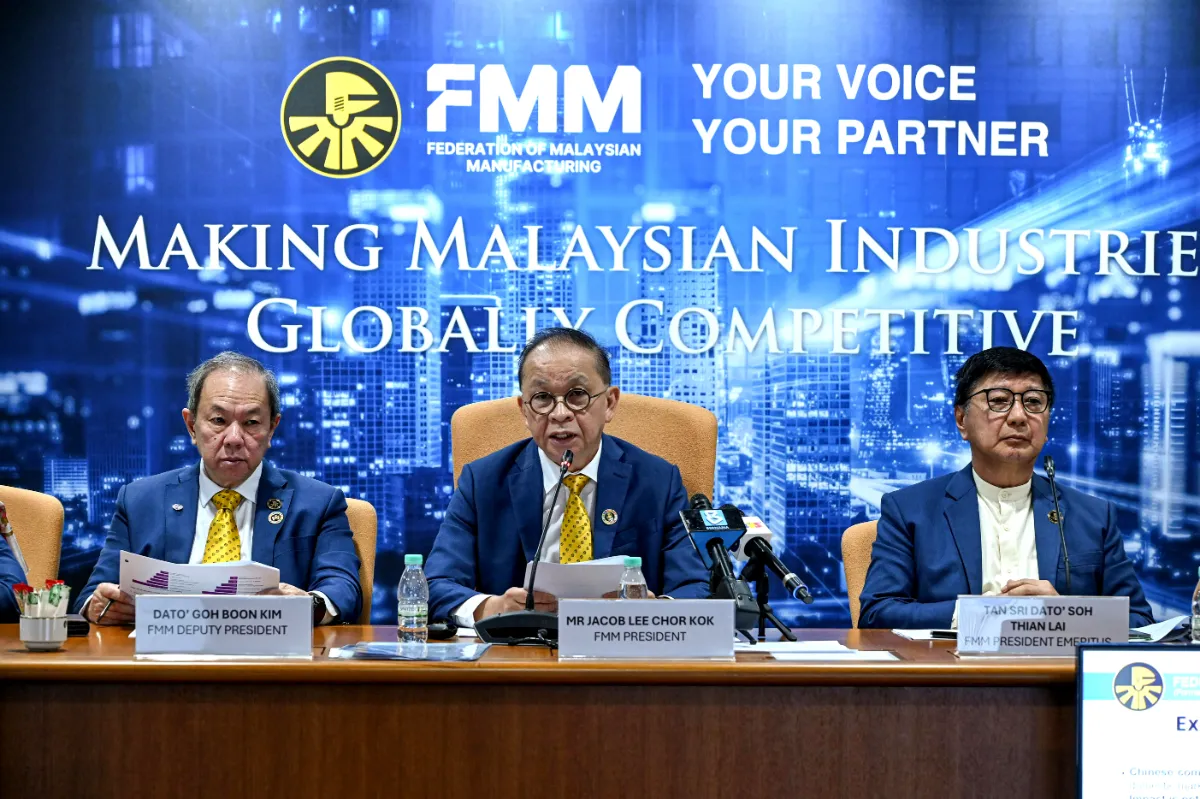
KUALA LUMPUR: Malaysia’s gross domestic product (GDP) growth is projected to moderate to between 3.8% and 4.2% this year should the Middle East conflict escalate and significantly disrupt global energy and shipping flows, according to the Federation of Malaysian Manufacturing (FMM).
FMM president Datuk Dr Jacob Lee Chor Kok said growth could be sustained at about 4.7% if the conflict remains contained. However, prolonged disruptions would introduce material downside risks.
“Under a contained scenario, GDP growth is expected at 4.7%. Should the conflict expand, growth may ease between 3.8% and 4.2%. In a more adverse scenario, Malaysia’s fiscal deficit could widen to 3.7% of GDP,” he said at the FMM Business Conditions Survey Second Half 2025 media briefing today.
Lee characterised the overall risk environment as moderate but manageable, noting that elevated energy prices, freight costs and supply chain disruptions are likely to increase production and logistics costs for manufacturers.
He added that the latest Purchasing Managers’ Index reading of 49.3 signals a mild contraction, with the index potentially softening further to the 48-49 range if logistical disruptions persist.
On the currency outlook, Lee said the ringgit is currently trading between 3.91 and 3.97 against the US dollar and is expected to remain within 3.85 to 4.10.
As for equities, he noted that Bursa Malaysia’s benchmark FBM KLCI has experienced only marginal declines.
Despite rising cost pressures, Lee said business activity has not been significantly disrupted, with manufacturers continuing to receive orders.
“While the impact has not been immediately apparent, cost pressures are increasing across logistics, insurance, freight and energy. As a result, firms are accelerating procurement and locking in contracts early to mitigate further price increases.”
He highlighted that the impact is more pronounced in sectors with high material exposure, particularly construction, where prices of steel, aluminium and copper are rising. Early cost pressures are also emerging in the electrical and electronics (E&E) and chemical sectors.
FMM president emeritus Tan Sri Soh Thian Lai said that while demand conditions remain relatively stable, industry sentiment has turned more cautious amid global uncertainties. “Industry players are increasingly concerned about potential volatility in energy and food prices, and the broader implications for global business activity.”
Soh said Malaysia’s reliance on Middle Eastern energy and fertiliser supplies could amplify cost pressures. The region accounts for a substantial share of global energy exports and supplies approximately one-third of the world’s seaborne fertiliser, much of which transits through the Strait of Hormuz.
“Any prolonged disruption could lead to significant increases in fertiliser prices, which would in turn raise domestic food production costs,” he said, adding that Malaysia imports close to RM80 billion worth of food annually.
He called for proactive policy support, particularly for micro, small and medium enterprises, and suggested that the National Economic Action Council assess the need for targeted measures, including a potential six-month loan moratorium.
However, Lee expressed a cautious stance on such interventions, noting that current conditions differ materially from the Covid-19 crisis. “During the pandemic, economic activity was largely halted, necessitating crisis-level interventions. At present, businesses remain operational, and income flows continue. The case for a moratorium is therefore less immediate.”
Such measures may be more appropriate in the event of a recession or a more severe economic downturn, rather than at the current stage, Lee said.



