



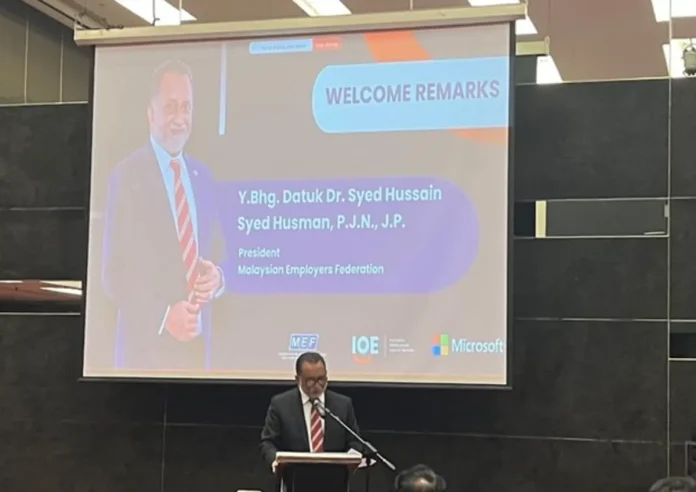
KUALA LUMPUR: The two-year moratorium is not enough for smaller SMEs and micro-SMEs to comply with the amended Employment Insurance System (EIS) Act requirement to report job vacancies within seven days, and the RM10,000 penalty for non-compliance … “is an overkill at this stage”, said Malaysian Employers Federation (MEF) president Datuk Dr Syed Hussain Syed Husman.
He said it is unrealistic to expect immediate compliance especially from smaller SMEs and micro-SMEs despite the moratorium on enforcement.
“I honestly think that two years is not enough, especially for smaller SMEs and micro-SMEs. It is not possible. You need a longer time. What is more concerning is the idea that if you do not meet it, you are going to be fined RM10,000. That is why MEF is strongly saying that introducing punitive action at this early stage is an overkill,” he told reporters at the AI Xcelerate Launch Event Malaysia, organised by MEF in collaboration with the International Organisation of Employers and Microsoft today.
He said MEF believes employers should be given education and support before any penalties are imposed.
“Employers are at different levels. Let us support them first. Give them a longer period of implementation. Obviously, after all the help and support, if they still do not meet the requirement, then you can take action.”
The amendments, passed in the Dewan Rakyat on Dec 2, introduced Section 45F, which requires employers to report all job vacancies to Perkeso (Social Security Organisation) within seven days of the vacancy arising. Failure to comply may result in a fine of up to RM10,000.
Perkeso has since clarified that a moratorium of up to two years will be implemented before penalties take effect.
Syed Hussain said MEF supports the government’s long-term goal of building more accurate national labour data.
“From MEF’s point of view, what the government is trying to do in the long run is the right thing, which is to have proper data in terms of employment. That is a good thing.”
He said a centralised database of vacancies, including job types and skills required, will help policymakers in national planning. “Because today, at a macro and national level, we do not have accurate data to conduct studies that can identify where the gaps are and how the government can address them.”
However, he added, implementation must reflect the diverse capacity of Malaysian employers.
“Employers come in different shapes and sizes. We have multinationals, GLCs and large Malaysian companies. But more than 90% are SMEs and many are micro-SMEs. We cannot have a system where everybody has to apply this at the same time. It is not realistic.”
Syed Hussain said MEF prefers a phased implementation, as different types of employers have different capacities.
“What we would prefer, and what we are saying to the government, is that while the objective is noble and good, it needs to be implemented in stages. You can tier this. Large companies that have the resources and the people can implement it immediately.”
“But SMEs and micro-SMEs need a longer time. They need hand-holding. That is why we are worried. If you simply say two years, will SMEs and micro-SMEs really be ready in two years?”
He added that the new requirements will affect employers’ administrative workload and operational costs.
“In an organisation where there are many vacancies, and where vacancies arise at different times, you need someone who is constantly monitoring this. You need to put in extra resources, and there will be costs. The bigger the organisation, the more vacancies will exist, so the impact will be greater.
“But I think that all employers, whether big, small or micro, could adapt to the changes if given sufficient time.”



