



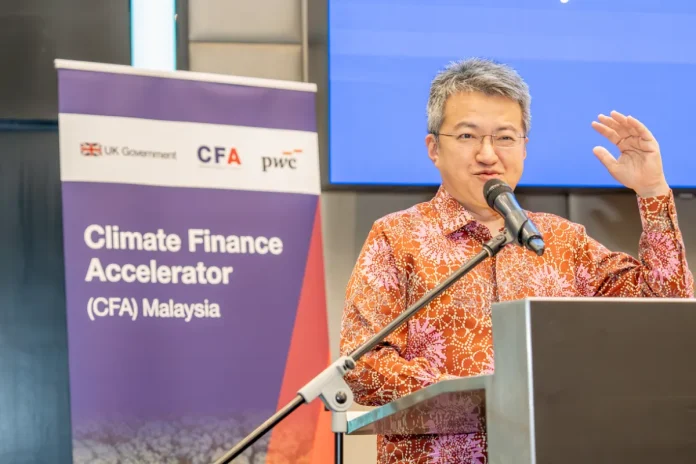
KUALA LUMPUR: The UK-backed Climate Finance Accelerator (CFA) is expected to help channel private capital into Malaysia’s low-carbon transition by making climate projects more attractive to investors, Deputy Finance Minister Liew Chin Tong said yesterday.
He said while there is no shortage of capital in Kuala Lumpur, the challenge lies in framing and articulating climate-related projects in a way that resonates with both domestic and global investors.
“There is no shortage of money in Kuala Lumpur. The challenge is how to channel capital into climate causes, how to frame it and articulate it, not just for domestic audiences, but also for global investors,” Liew said at the launch of the CFA Malaysia programme.
CFA Malaysia, funded by the UK government, was launched by Liew and British High Commissioner to Malaysia Ajay Sharma at an event attended by financiers, climate project developers and industry stakeholders.
Liew said the programme is timely as Malaysia enters a phase where it can “leapfrog” in climate-related development rather than grow in a linear manner. “To leapfrog, one of the many areas Malaysia can move fast in is climate-related projects to build Malaysia as a role model for delivering climate solutions.”
The accelerator aims to address one of the biggest bottlenecks in climate finance the gap between promising ideas and bankable projects. Since 2020, the CFA has supported more than 200 climate ventures globally and helped mobilise close to US$500 million in investment.
Liew outlined four areas where Malaysia could build local expertise and scalable climate solutions. These include accelerating energy transition through energy efficiency and renewable adoption, reimagining cities to reduce urban sprawl and carbon footprints, strengthening traceability systems to support circular economy and export competitiveness, and developing a coherent ecosystem for carbon pricing, emissions trading and emissions measurement.
“Once you have an emissions trading system, if there is no carbon tax, nobody will be interested to take part in it. The entire system needs to work in sync,” he said.
Sharma, meanwhile, said many climate projects struggle not because of weak ideas, but because they are not structured in a way investors can understand and act on.
“There is no shortage of promising climate solutions. The ideas are great, the innovation is there, but turning them into investment-ready propositions is not always easy.
“Too often, good projects struggle not because they lack potential, but because proposals aren’t ready for investors.”
He said the CFA was designed to bridge that gap by offering practical, tailored support to help entrepreneurs strengthen business models, articulate climate impact and connect with relevant investors.
“Finance is the fuel that turns ambition into action, and much of that fuel sits in the private sector,” Sharma said, adding that Malaysia’s strong economic fundamentals, dynamic startup ecosystem and commitment to net-zero emissions position it well to scale climate solutions.
CFA Malaysia’s call for proposals is open until March 6, with up to 15 businesses expected to be selected. Eligible companies must be at least at the pre-feasibility stage and seeking a minimum of US$5 million in investment.
Selected participants will receive three to four months of technical assistance from financial, technical and gender equality, disability and inclusion experts, before pitching to climate investors at an event in Kuala Lumpur in November.
PwC Malaysia managing partner Soo Hoo Khoon Yean said the accelerator provides a platform to bridge project developers, investors and public institutions, while helping businesses unlock opportunities in green growth.
The CFA builds on broader UK-Malaysia climate cooperation, including partnerships on energy transition, climate resilience and sustainable finance and is expected to run until November.



