




Large-scale plant feasible but has significant engineering, operational challenges: Academic
PETALING JAYA: Selangor’s move to explore seawater desalination is coming under scrutiny, with experts questioning the need for a costly and energy-intensive solution despite ample supply reserves and ongoing capacity expansion.
The state government recently said it is studying the feasibility of a desalination plant capable of producing about 300 million litres per day (MLD) to strengthen long-term water security.
The proposal comes as Selangor maintains a reserve margin above the national guideline and continues to boost conventional treatment capacity through several major projects in the pipeline, prompting concerns that the move may be premature.
Association of Water and Energy Research Malaysia president S. Piarapakaran described the plan as difficult to justify.
“It is puzzling why the state government resorts to expensive and unnecessary routes,” he said, adding that there is “no economic, engineering or scientific explanation for this announcement”.
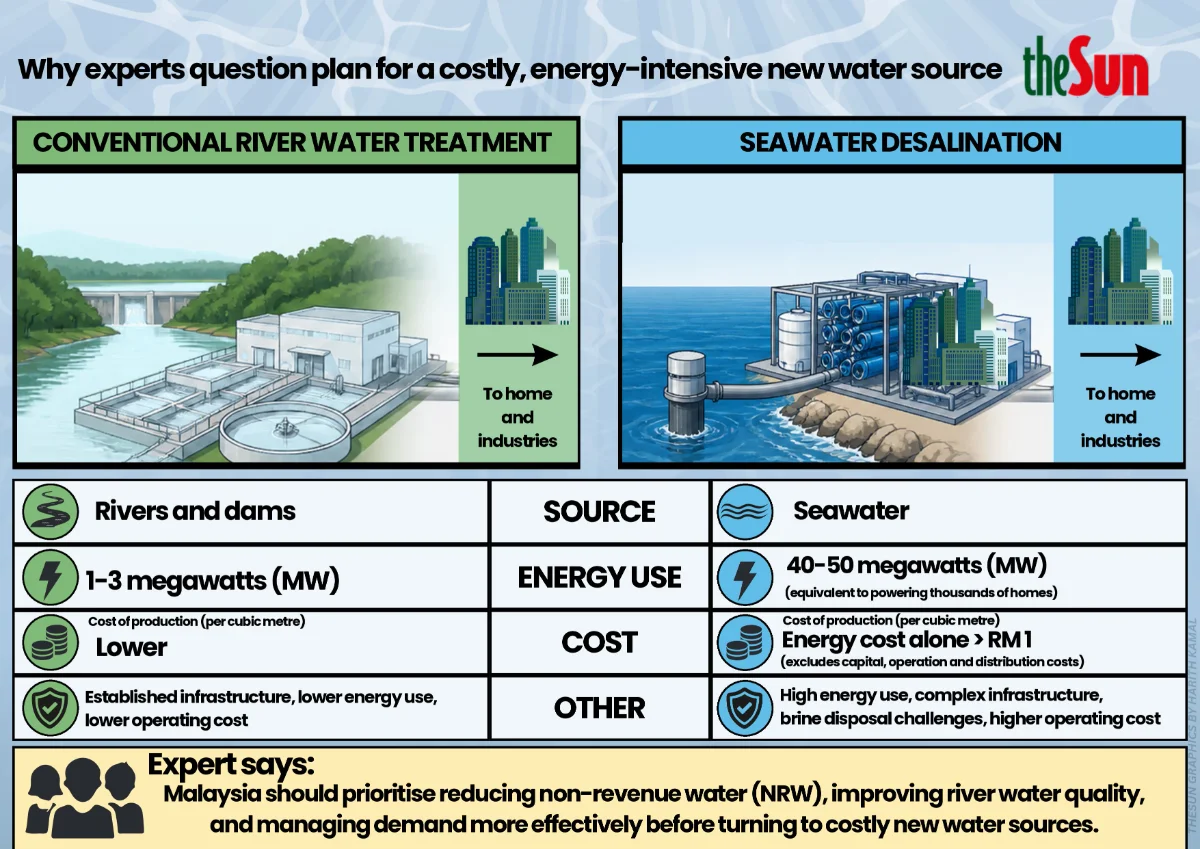
Piarapakaran said even conservative estimates suggest the energy cost alone could exceed RM1 per cubic metre, excluding capital and operating expenditure.
He said the overall cost would ultimately be passed on through higher tariffs for domestic and industrial users.
He also pointed to persistent inefficiencies in the existing system, particularly non-revenue water (NRW), which is treated water that is lost before reaching consumers.
Citing 2024 data, he said NRW stood at about 1,431 MLD, nearly five times the proposed desalination capacity, arguing that reducing system losses would yield faster and more cost-effective gains.
Piarapakaran said policy focus should instead prioritise improving raw water quality and supply through better river management.
“There is nothing to consider as the state government still has other cost-effective options to resolve its demand for water sustainably.
“Pollution reversal, reduction of NRW and demand-side management are much cheaper options with multiplier impact on the economy, people and environment.”
From a technical standpoint, Universiti Kebangsaan Malaysia Faculty of Engineering and Built Environment senior lecturer Dr Muhammad Ammirrul Atiqi Mohd Zainuri said a large-scale desalination plant is feasible but comes with significant engineering and operational challenges.
He said the process is highly energy-intensive, requiring a continuous power supply of between 40 and 50 megawatts.
“By comparison, a conventional river water treatment plant of similar capacity would require only between one and three megawatts.
“This means a single desalination plant would require the equivalent electricity needed to power tens of thousands of homes,” he said, adding that the high energy demand would significantly raise operating costs.
Muhammad Ammirrul said costs would be further compounded by the need for extensive supporting infrastructure, including coastal intake systems, inland transmission pipelines and specialised facilities to manage brine discharge.
Beyond cost and engineering complexity, he said the proposal raises broader concerns over energy use and long-term sustainability.
“Under current technological and grid constraints, building a plant of this scale risks locking the state into higher fossil fuel dependency.”
He added that desalination plants require a stable and continuous power supply while Malaysia’s renewable energy mix, still heavily reliant on solar, remains intermittent.
As a result of this, large-scale desalination would likely depend on the national grid, in which natural gas continues to play a key role in balancing supply.
“Unless Malaysia achieves major breakthroughs in long-duration energy storage or secures a dedicated firm renewable energy source, a large-scale desalination plant cannot currently run purely green. It will inevitably act as a heavy anchor on the fossil-fuel-driven portion of the grid.”
The Selangor government has said the project remains at the feasibility stage, with any decision subject to technical, strategic and cost considerations.
Experts say the key question is not whether desalination is possible but whether it is necessary.



