



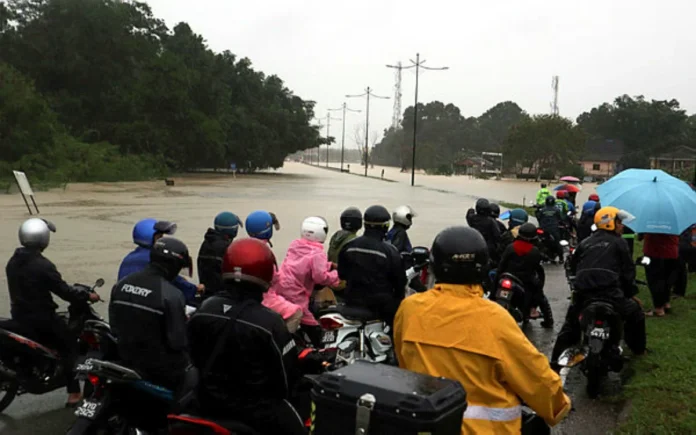
Experts warn reliance on engineering solutions allows construction to continue at riverine areas
PETALING JAYA: Universiti Teknologi Malaysia (UTM) experts have warned that flood risk at riverine areas continues to be treated as a technical issue rather than a constraint on development.
UTM housing policy expert Assoc Prof Dr Muhammad Najib Razali said property development in flood-prone areas persists largely because flood risk is viewed as a problem that can be managed through engineering solutions, rather than a factor that should limit development altogether.
“Property development continues in flood-prone areas as flood risk is treated as a manageable technical issue rather than a binding constraint on land development,” he told theSun, adding that river-adjacent and low-lying land remains relatively affordable, making it attractive for mass-market and affordable housing.
Muhammad Najib said planning approvals often allow developments at such locations on the condition that mitigation measures are put in place.
“Approvals frequently permit development on the basis that engineering measures such as raised platform levels, drainage upgrades or reliance on existing flood defences are implemented. An engineering-led flood management approach, combined with fragmented governance arrangements, contributes to continued development in hazard-prone areas.
“Flood risk is addressed primarily through structural mitigation rather than spatial avoidance, and there is no clear or enforceable flood-risk threshold at which development must be prohibited. As a result, property development in flood-prone areas remains administratively permissible and economically rational within Malaysia’s current planning and housing framework,” he said.
Citing a 2018 UTM study of the Langat River Basin, he said the findings showed that riverine settlements persist not because flood risks are unknown, but because housing markets and policy frameworks continue to accommodate those risks.
“The evidence underscores that flood hazards have yet to be fully internalised within property valuation and housing decision-making. Without stronger integration of flood-risk thresholds into housing policy, land-use planning and valuation standards, supported by a dedicated relocation and resettlement framework, engineering mitigation alone is likely to be stretched beyond its effective limits, particularly for lower-income communities living along rivers.”
Meanwhile, UTM environmental and climate systems researcher Prof Dr Mohd Fadhil Md Din said recent flooding in Kelantan and Pahang reflected a more complex risk pattern driven by basin-wide conditions rather than local rainfall alone.
“River flooding is not determined by local rain by itself, but by rainfall across the entire catchment, including upstream areas,” he explained.
When rainfall occurs intermittently across different sub-catchments, Mohd Fadhil said flow waves from upstream arrive in stages based on river travel time, causing water levels to rise progressively rather than in a single surge.
“In conditions where the soil is already saturated after several days of rain, almost all additional rainfall immediately becomes surface runoff. This accelerates the rise in river levels and prolongs the recession period, which is why flooding now tends to last longer,” he said.
Mohd Fadhil added that this explains why established flood hotspots experience more frequent and prolonged flooding, while areas previously unaffected may begin to see flood impacts when river capacity, drainage systems and floodplains can no longer absorb changes in flow volume.
“Structural mitigation alone is not sufficient when the underlying risk stems from settlement location and river catchment dynamics. River reserve areas and gazetted buffer zones must be respected.
“Settlements that are repeatedly affected should be evaluated for phased relocation, because relying solely on structural measures is inadequate when the fundamental risk is tied to where communities are located.
“Ultimately, flood risk reduction must prioritise proper management of river zones, location-based exposure and continuous monitoring of upstream and downstream water levels,” he added.



