




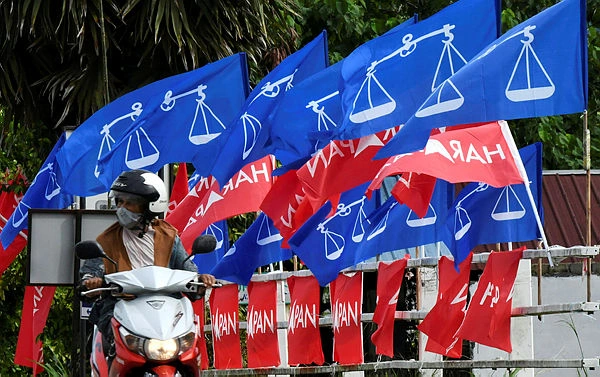
The clashes between Barisan Nasional and Pakatan Harapan in all 56 Johor state seats reflect democratic maturity and pose no threat to the Unity Government’s stability.
JOHOR BAHRU: The clashes between Barisan Nasional (BN) and Pakatan Harapan (PH) in all 56 State Legislative Assembly (DUN) seats in the 16th Johor State Election (PRN) will not threaten the stability and integrity of the Unity Government’s cooperation at the Federal level.
Political analysts generally believe that the competition should be viewed as a manifestation of democratic maturity at the local level, given that political maneuvers in a particular state do not necessarily reflect a rift in relationships at the central level.
Universiti Tun Hussein Onn Malaysia (UTHM) Department of Social Sciences Senior Lecturer Dr. Nazreena Mohammed Yasin said the competition is a space for each party to maintain their respective organisational identities rather than an indicator of a fragile relationship.
“We can see that the cooperation within the Unity Government is more related to the administration and governance aspects at the Federal level, while the state election provides room for parties to gauge their strength and maintain their respective political identities.
“Therefore, the ‘contest’ taking place is more appropriately viewed as part of the democratic process and electoral strategy, rather than an indication that relations within the Unity Government have been affected,” she told Bernama.
A similar sentiment was shared by psychological warfare expert and security as well as political analyst Dr. Noor Nirwandy Mat Noordin, who regarded the strategic differences as a common variation between central administration and local politics.
He said this situation has the potential to spark a fresh perspective among the public that elements of federalism can coexist with local political differences to support the welfare of voters in Johor.
“The cooperation at the Federal level cannot be disrupted based on issues that can lead to mutual interests,” said Noor Nirwandy.
Meanwhile, geostrategist Dr. Azmi Hassan said the clashes do not reflect any turmoil in the Putrajaya leadership; instead, they stem from the momentum of BN’s achievements at the state level previously.
The Senior Fellow of the Nusantara Strategic Research Academy (NASR) said that BN’s decision to go solo in Johor is a political reality taken into account since the coalition’s landslide victory in the 2022 state election.
“Taking into account what happened during the 15th General Election, that is why BN chose to go solo and such a decision does not hamper national-level relations between BN and PH.
“BN Chairman Datuk Seri Ahmad Zahid Hamidi has also stated that he will support the Unity Government coalition until the end of the end of the term,” he said.
Azmi opined that the 14 seats seeing straight fights will serve as a clean battleground to test the absolute influence of BN and PH, while the 27 three-cornered contests will act as the deciding factor for post-election cooperation.
“I see these 27 seats as the deciding factor on whether a coalition government between both sides will materialise,” he said.
In the meantime, Universiti Malaya (UM) Department of Administrative and Political Studies Senior Lecturer, Dr. Mohammad Tawfik Yaakub, said today’s Malaysian political reality allows Federal-level cooperation and conflicting state strategies to run concurrently.
He said that the action of contesting all seats shows that both parties want to ‘race’ to offer the best service to the people with the goal of bringing stability.
“I am confident that after the election, both coalitions will forge a stronger cooperation for the state of Johor,” he said.
Regarding “hot seats,” he predicted that Datuk Onn Hafiz Ghazi in the Machap seat and Dr. Maszlee Malik in the Puteri Wangsa seat hold the advantage to win, but incumbent Bukit Kepong assemblyman Datuk Dr. Sahruddin Jamal is expected to face a rocky road.
“A difficult path lies ahead for Dr. Sahruddin because he previously only won by a 700-vote majority in that seat,” he said.
A total of 56 seats are up for grabs in this state election, with 14 of them witnessing straight fights, 27 three-cornered contests, 12 areas featuring four-cornered fights, and three areas experiencing five-cornered battles.
The Election Commission (EC) has fixed the early voting date as July 7, while polling day for the 16th Johor State Election falls on July 11.
For the latest news on the 16th Johor State Election, visit https://prn.bernama.com/sabah/index.php.



