




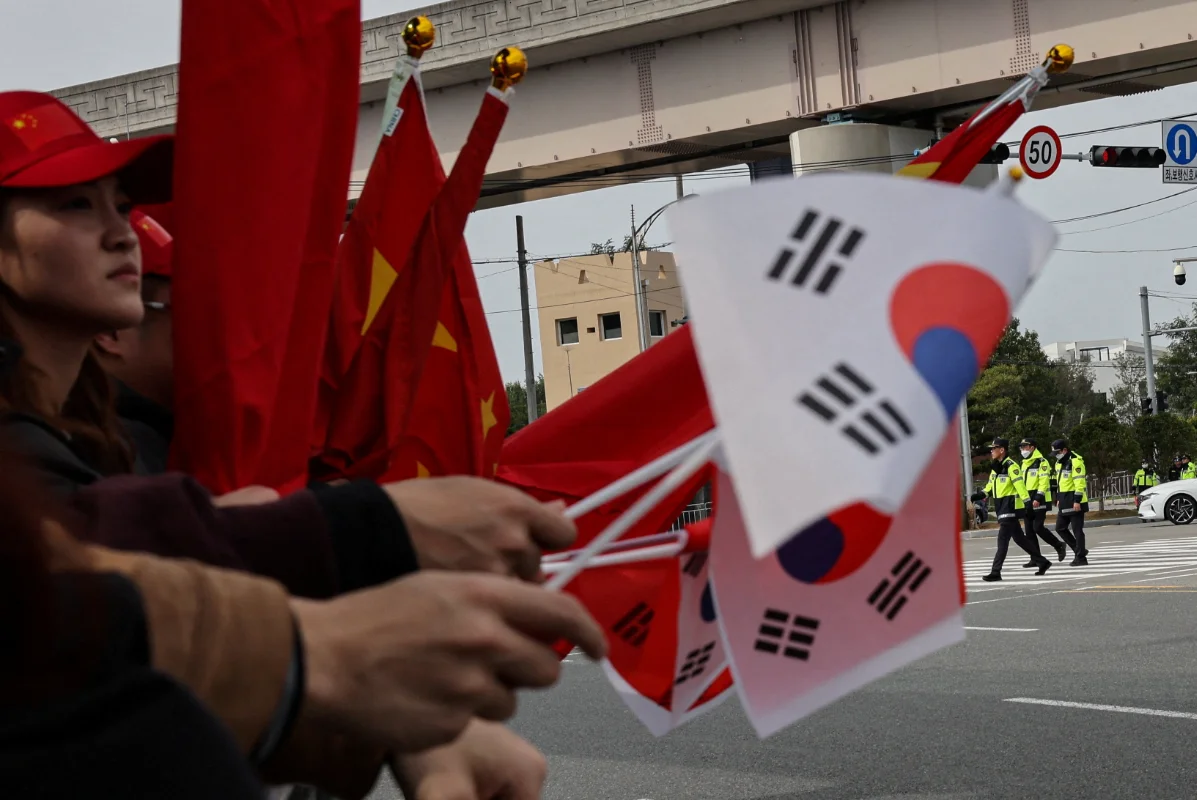
Chinese President Xi Jinping hosts South Korean leader Lee Jae Myung for a state visit, aiming to strengthen ties as Seoul balances relations with Japan and the US.
BEIJING: Chinese President Xi Jinping will host South Korean President Lee Jae Myung on a state visit starting on Sunday.
The visit signals Beijing’s intent to strengthen ties with Seoul amidst strained relations with Japan over Taiwan.
Analysts note the unusually short interval of two months between meetings signals China’s keen interest in reinforcing ties and boosting economic collaboration.
“China wants to emphasize South Korea’s importance slightly more than before,” said Kang Jun-young, a professor at Hankuk University of Foreign Studies.
He added that China strategically decided to host Lee before the South Korean leader holds another summit with Japan.
Lee’s top security adviser, Wi Sung-lac, said he expected the summit to open a “new chapter” in bilateral ties.
He added the two countries were preparing more than 10 deals on the economy, business and climate.
The Lee administration aims to “restore” ties with Beijing, acknowledging China is South Korea’s largest trading partner.
This pivot follows strained relations under Lee’s predecessor due to closer alignment with Washington and Tokyo.
Lee said in December he would not take sides in the diplomatic dispute between China and Japan.
Complex issues remain as China challenges the US, South Korea’s major ally, and nuclear-armed North Korea stays unpredictable.
Shin Beom-chul, a senior research fellow at the Sejong Institute, said Xi and Lee might discuss efforts to modernise the South Korea-US alliance.
About 28,500 US troops are based in South Korea to counter any threat from North Korea.
US officials have signalled a plan to make those forces more flexible to respond to other threats, such as defending Taiwan.
Wi said South Korea would also try to reassure China that its plans to build nuclear-powered submarines were aimed only at deterring North Korea.
Lee’s agenda includes persuading China to facilitate dialogue with North Korea, which has dismissed his outreach.
The visit is also expected to address cooperation in critical minerals, supply chains and green industries.
Seoul sources nearly half of its supply of rare earth minerals, critical to semiconductor manufacturing, from China.
Beijing also accounts for a third of Seoul’s annual chip exports, the largest market by far.
The visit may foster partnerships on artificial intelligence and advanced technologies.
China’s Huawei Technologies plans to roll out its Ascend 950 AI chips in South Korea this year.
The move aims to provide an alternative to Nvidia for Korean firms, according to Huawei’s South Korea CEO.



