




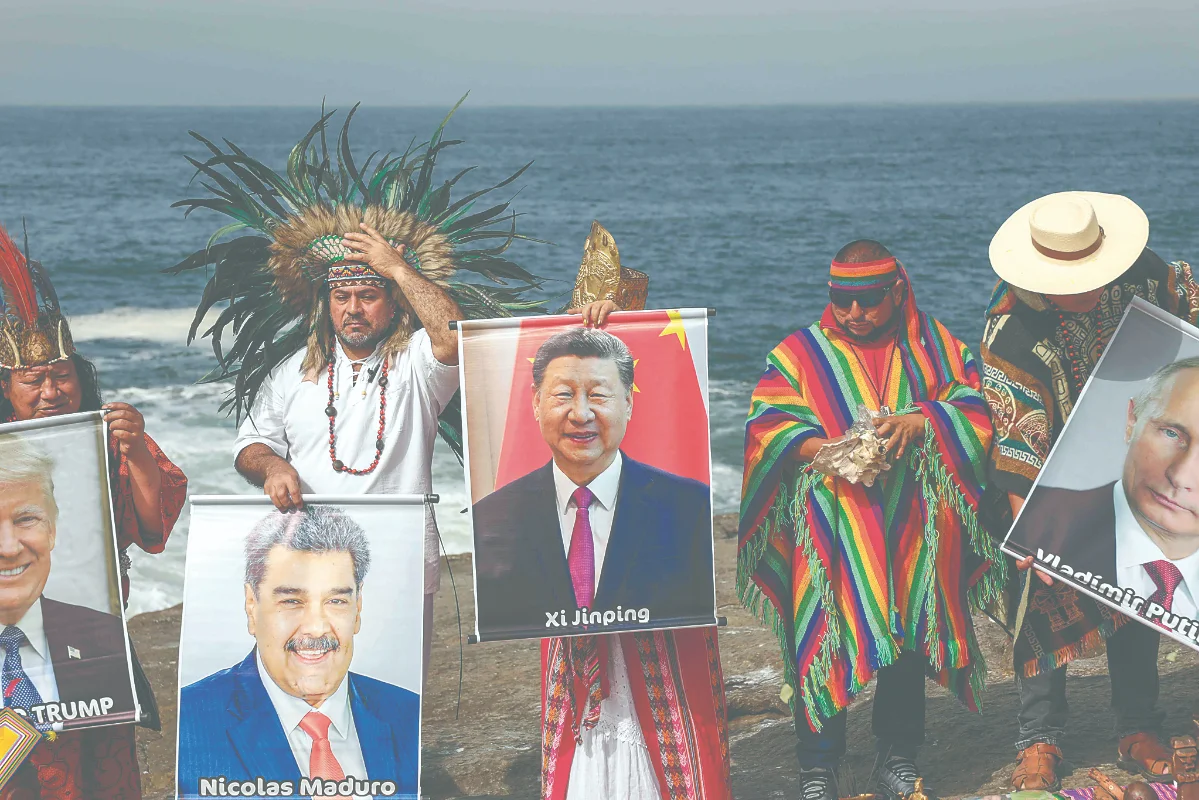
In 2026, the shock-and-awe phase of Trump’s administration will likely shift into a more complex one.
WHAT’S in store for the US in politics and economics in 2026 will almost certainly be more of the same.
This second (Donald) Trump administration is expected to operate on two distinct tracks. The first is a transactional “America First” foreign policy that prioritises leverage over traditional alliances but continues to pursue hegemonic control in the American region.
The second is a domestic “de” and “re” construction of the federal and state bureaucracies aimed at radical deregulation, immigration enforcement, tax cuts, “drill baby drill” energy-related policies as well as other key socioeconomic components of Trump’s “Maga” campaign.
Domestic policy: Reconstruction of the state
In 2026, the shock-and-awe phase of Trump’s administration will likely shift into a more complex one. It will more likely take on legal challenges and legislative negotiations ahead of the 2026 midterm elections, which are critical to the Republican Party remaining in power after Trump.
Historically, the president’s party almost always loses seats during midterms. This time, Trump is buffeted by multiple electoral challenges that are likely to see a less compliant Congress, especially in relation to his domestic policies.
Polls readings
Since independents are the “deciding” block in swing districts, this puts roughly 20 to 30 House seats, currently held by Republicans, at high risk.
Currently, voters favour a Democratic-controlled House by a five to nine-point margin. For context, a five-point lead in the generic ballot often correlates with a party gaining 20 or more seats.
Republicans’ traditional edge on the economy has evaporated. For the first time in recent years, registered voters are more likely to trust Democrats (40%) over Republicans (35%) on economic management. This will most probably be the election game-changer.
Energy and turnout: While Trump maintains a high support within his core base (89% of Republicans), “strong approval” among Maga supporters has dipped. Conversely, disapproval among Democrats is nearly universal (95%+), suggesting a highly motivated opposition turnout.
As of late December, Trump’s approval rating was approximately 43%, though individual polls show significant variation between 33% and 46%. His popularity has steadily declined since January, when he re-entered office with a net positive rating of roughly 47%.
Next year will see the Democrats attempt to undermine Trump further by drawing attention to affordability issues, especially over living and healthcare costs and growing economic uncertainty. It will be a year in which Trump’s proclamation of a “new golden age” through sweeping tax cuts, aggressive protectionism and massive deregulation will meet with market and geopolitical reality.
Foreign policy: Liquidation and leverage
Foreign policy in 2026 will see the further revival of the Monroe Doctrine, now codified as a modern extension, known as the “Trump Corollary”, sometimes colloquially called the “Donroe Doctrine”.
Unveiled in the December 2025 National Security Strategy, the Trump Corollary asserts that the US will maintain absolute control over the hemisphere’s political, economic and military environment.
This North and South America-focused strategy began with Trump’s assertion throughout 2025 that the US should acquire Greenland and potentially annex Canada, framing these ambitions as vital for “national security” and “economic stability”.
The strategy marks a shift from the globalist foreign policy of past presidents during the last two decades back to a 19th-century-style sphere of hegemony and influence model, where the Western Hemisphere is the US’s top priority.
The initial prong of this policy has been to “enlist” regional champions (like Argentine President Javier Milei) and “expand” alliances with like-minded, right-leaning governments – as has taken place in Honduras, El Salvador, Paraguay and Bolivia.
Action on the ground (for now confined to the sea and air) has concentrated on Venezuela. In the last few months, the Trump administration has significantly escalated military pressure on President Nicolás Maduro through a campaign of sea and air actions under the mission name “Operation Southern Spear” in a highly publicised effort to compel him to resign.
Although the public justification propagandised through Western media has been framed as an effort to cripple narco-terrorism, two factors are key to this unprecedented aggression. The first is because Venezuela holds the no.1 rank for the world’s largest proven oil reserves, estimated at over 300 billion barrels (around 18% of global total), ahead of Saudi Arabia and Canada. The second is to ensure US preeminence by aggressively excluding extra-hemispheric rivals (specifically China and Russia) and using coercive economic and military tools to enforce regional hegemony.
In response, Venezuela has taken its case to the United Nations with Maduro blasting Trump’s threats of military action as a “war-mongering and colonialist pretence” aimed at seizing Venezuela’s natural wealth.
During a public broadcast, Maduro indicated that he would not give in to the Trump administration, which he described as “imperialism and the Nazi fascist right-wing” seeking to turn Venezuela into a colony.
As for the rest of the world, US foreign policy, coupled with its continuing tariff war, will continue to be defined by “transactional realism”, where long-standing treaties are treated as negotiable assets and economic tools are used as primary weapons to counter the US economic and industrial decline.
This can be seen in current US policy towards Ukraine and Europe, as well as in the Middle East, where an exception has been made for Israel, whose influence on American politics stems from a complex combination of shared values and strategic interests, as well as significant lobbying efforts and campaign contributions.
Most resilient of all are the deeply rooted financial, cultural and religious ties between the Jewish diaspora in the West and the Israeli government, regardless of the leader or party in power.
Dealing with existential threat
In the Asia-Pacific region, we can expect a softening of rhetoric portraying China as an “existential threat”, in light of Trump’s planned visit to Beijing in April 2026.
This visit follows the de-escalation in tensions achieved during Trump’s face-to-face meeting with President Xi Jinping in October.
The potential accomplishments for both sides following the Beijing meeting may revolve around solidifying a “new equilibrium” in Trump’s transactional relationship strategy for 2026 and beyond.
However, this relatively recent development in US political and strategic discourse is unlikely to redefine American policy towards China, now firmly embedded in a new Cold War mindset and executed through technological containment, alliance fortification and military deterrence, and in which Trump has taken lessons from Joe Biden’s administration.
Hence, 2026 will likely see a deepening of China policies set in motion between 2018 and 2025, rather than a radical shift. While the US may agree to limited areas of cooperation, these will remain subordinate to broader policies aimed at slowing China’s progress, reducing dependency and ensuring US technological and economic dominance through “America First” protectionism and supply-chain resilience.
Lim Teck Ghee’s Another Take is aimed at demystifying social orthodoxy. Comments: [email protected]



