




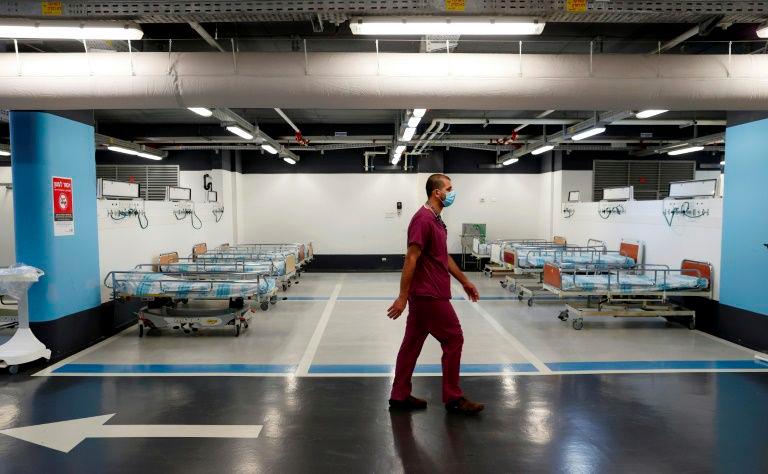
HAIFA: As Israeli doctors confront a surge in coronavirus cases, with some patients waiting for hours in ambulances, one hospital is tackling the crisis by transforming its car park into a ward.
Wearing a white face mask and gown, Michael Halberthal expressed his frustration that his hospital in the northern city of Haifa has been pushed to take such a dramatic step.
â(Itâs) extremely unfortunate that we have to get to this position,â said Halberthal, general director of the Rambam Health Care Campus.
Just days after management approved the decision, the underground car park has become a ward, complete with beds and wheelchairs.
The words âUnderground Emergency Hospitalâ greet arrivals, set to be among those rejected by a string of hospitals that have seen their coronavirus wards hit capacity since the government imposed the countryâs latest nationwide lockdown on Friday.
The car park can withstand war, having been earmarked as a possible shelter after Israelâs 2006 conflict with the Lebanese group Hezbollah.
âNow we understand that this is a strategic facility of Israel and we can use it for other solutions,â said Halberthal, as workers raced around installing medical equipment.
Parking spaces have been converted into patient bays, while different sections have been painted in bright colours.
The new ward will be ready to open on Thursday, according to hospital officials, and can accommodate 770 coronavirus patients.
For Khetam Hussein, Rambamâs head of infection control, the latest lockdown â Israelâs second since the start of the pandemic â came too late.
âAnd it has to be more strict,â she said at her desk, wearing blue hospital scrubs and a face mask. âWe are seeing a rise in severe cases.â
Israel has the worldâs highest coronavirus infection rate as a proportion of its population, according to an AFP tally of the past fortnight, and on Wednesday the health ministry announced nearly 7,000 positive cases over 24 hours.
The country has recorded more than 200,000 cases since the pandemic hit, with 1,317 deaths.
Israelâs second wave of cases has hit particularly hard in the countryâs north, home to much of the Arab minority that makes up around 20% of the population.
âAll the Israeli hospitals are very crowded and some of these hospitals reached 100% capacity,â said Hussein.
âWe donât have budgetâ
In recent days some hospitals have stopped accepting ambulances, according to an official from Magen David Adom, Israelâs emergency medical service.
âOur teams wait hours before being able to drop a patient off at the hospital, and this prevents them from taking care of other patients,â the official told AFP.
Coronavirus patients waiting in ambulances are not allowed to enter hospitals and are given a container to use as a toilet inside the ambulance, he added.
While Israel was praised for its initial handling of the pandemic, faith in Prime Minister Benjamin Netanyahuâs ability to handle the health crisis has plummeted.
Just 27% of Israelis trust their premier to manage coronavirus, down from 56% in late March, according to a survey published Wednesday by the Israel Democracy Institute.
While Rambam has succeeded in hugely expanding its capacity, in east Jerusalem one hospital is suffering from a lack of drugs and other medical supplies.
âYesterday, I had to refuse 10 patients,â said Jamil Kussa, director of Saint Josephâs Hospital, where a coronavirus ward opened in March.
A second ward is needed to cope with the spike in cases, he said.
âBut we donât have the necessary budget.â â AFP



