




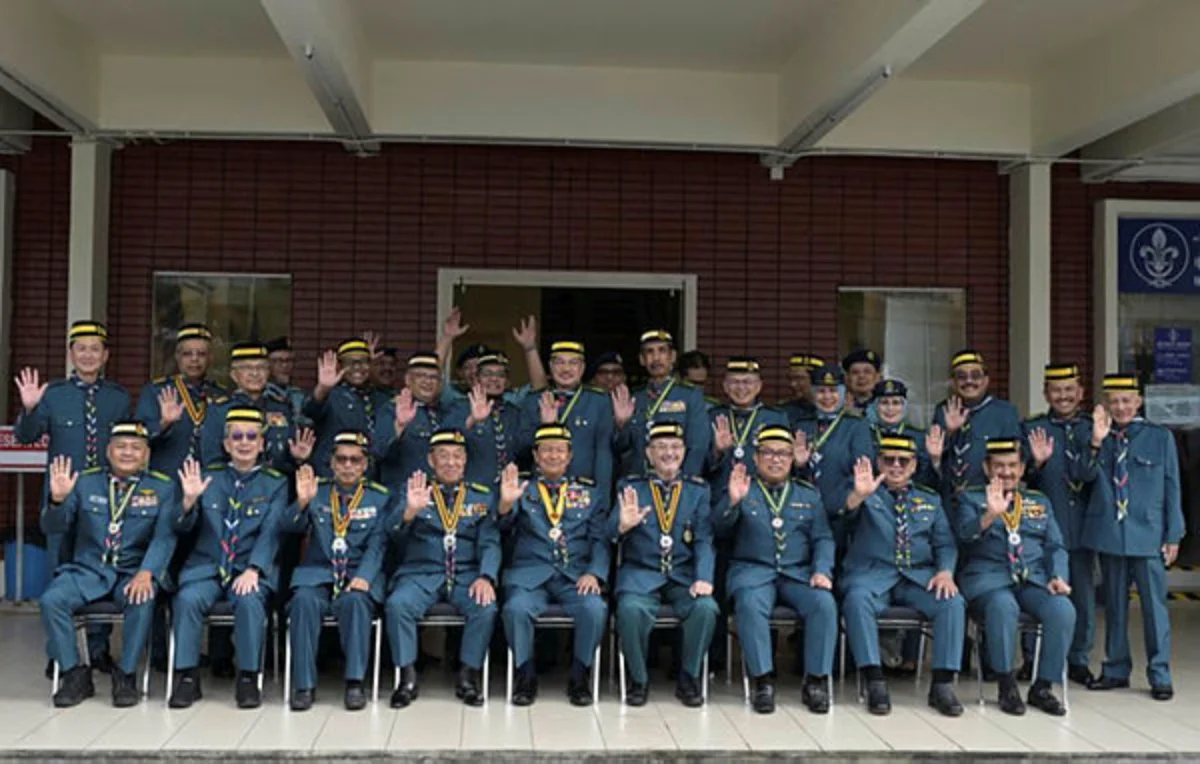
KUALA LUMPUR: First established under the British Boy Scouts Association, the movement eventually evolved into Malaysian Scouts Association (PPM).
With a 118-year history, PPM now has more than 600,000 members and is the largest non-governmental organisation in the country.
Although Tanah Melayu gained independence in 1957, the Scouts movement was only formally recognised by Parliament in 1968 and renamed Persekutuan Pengakap Malaysia.
Scouting in Malaysia began in 1908 in Penang as an experimental Young Men’s Christian Association troop before expanding regionally, making it one of the earliest scouting movements in Asia.
In 1910, the first official troop was formed by F.C. Sands, known as the “Father of Malayan Scouting”.
Although based in Singapore, he played a significant role in influencing the Malayan scouting movement.
The movement later expanded rapidly to Selangor (1909/1911), Pahang (1912), Sabah (1913) and Sarawak (1913).
Before 1941, it operated as a branch of the Boy Scouts Association of Great Britain.
After World War II, the organisation was restructured and following independence in 1957, the “Persekutuan Budak-Budak Pengakap Malaysia” was formed.
The Boy Scouts movement began in England on Jan 24, 1908 with the release of the first chapter of Lord Robert Baden-Powell’s book Scouting for Boys.
Originally intended as a manual for youths, the book became one of the 20th century’s best-selling publications.
It combined practical woodcraft, camping and self-discipline with patriotic Victorian-era values to promote good citizenship.
Baden-Powell’s name was already familiar to many English boys and thousands eagerly purchased the handbook.
By the end of April that year, the serialisation of Scouting for Boys was completed and spontaneous Boy Scouts groups had begun emerging throughout Britain.
In 1900, Baden-Powell became a national hero in Britain for his 217-day defence of Mafeking during the South African War.
Shortly after, Aids to Scouting, a military field manual he authored for British troops in 1899, gained popularity among younger readers.
Boys enjoyed the lessons on tracking and observation, often creating games based on the book. Recognising this interest, Baden-Powell decided to produce a non-military field guide for youths that emphasised ethics and altruism.
He initially tested several concepts with a group of boys.
On July 25, 1907, he brought 21 teenagers to Brownsea Island in Dorset, where they camped for two weeks. Assisted by other educators, he taught camping, observation, reasoning, woodcraft, boating, lifesaving, patriotism and chivalry.
Many of these lessons were delivered through creative games that proved popular. The first Boy Scouts camp was regarded as a success.
Following the publication of Scouting for Boys, Baden-Powell established a central office for the movement to register new Scouts and introduce a uniform. By the end of 1908, there were 60,000 Boy Scouts and groups began appearing across the British Commonwealth.
In September 1909, the first national gathering of Boy Scouts was held at the Crystal Palace in London, drawing more than 10,000 participants, including a group of uniformed girls who called themselves the Girl Scouts.
In 1910, Baden-Powell founded the Girl Guides as a separate organisation.



