



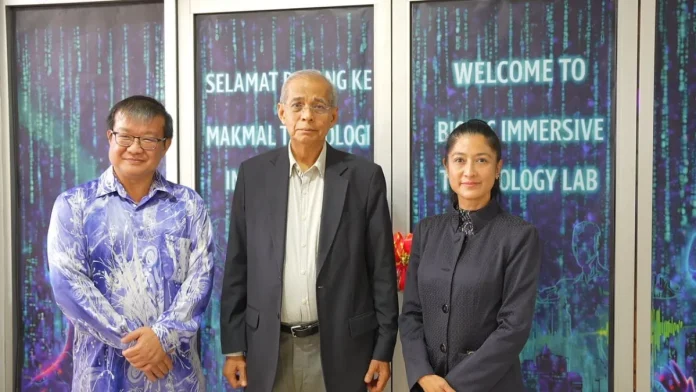
KUALA LUMPUR: G Plus Tech Sdn Bhd has sponsored the country’s first artificial intelligence-based virtual reality immersive learning laboratory, called Bionic Immersive Lab at Universiti Putra Malaysia’s (UPM) Faculty of Veterinary Medicine, marking a significant step in the commercialisation of immersive technology for higher education and professional training.
Bionic Immersive Lab, launched at the UPM campus, is a prototype facility that blends virtual reality, augmented reality, and artificial intelligence to simulate real-life veterinary and medical scenarios, reducing training risks, costs and logistical constraints associated with traditional field-based learning.
Faculty of Veterinary Medicine Dean Prof Dr Goh Yong Meng said the lab addresses long-standing operational challenges in veterinary education, particularly safety, disease prevention and access to real-world cases.
“This is just the beginning. It helps optimise learning so we don’t have to bring all students into the field,” he said, adding that veterinary students are required to master clinical knowledge across at least eight animal categories, ranging from livestock and horses to wildlife, aquatic and exotic species.
UPM operates multiple specialised animal hospitals, including large-animal, equine, avian, exotic and companion-animal facilities, which accept cases from the public as well as from agencies such as the police, military and public health departments.
However, transporting students to sites or handling high-risk animals remains costly and time-consuming.
“With immersive technology, students can practise procedures repeatedly without safety risks,” Goh said, noting that large animals such as cows and horses pose injury risks even to trained handlers. “Simulation allows them to make mistakes without real consequences.”
The lab also enables flexible learning during clinical rotations, allowing students not assigned to hospital duties to continue practising remotely.
“This diversifies learning without replacing traditional training,” Goh said.
UPM’s veterinary programme has 614 students enrolled across a five-year course, with about 120 students per intake annually.
Goh said the university views the facility not only as an internal teaching tool but also as a platform for outreach and professional upskilling.
“We see this as a bridge, for students, practising professionals, other faculties and even the public,” he said, citing interest from industry players and potential cross-application into medical and public health training.
G Plus Tech CEO Dr Nurliza Md Azzam said the facility marks the start of the company’s Bionic Immersive Lab concept, aimed at transforming education through gamification and self-directed learning.
“This is not only for veterinarians. We started with veterinary medicine because of our long-standing partnership with UPM, but the vision is for all institutions,” she said. “This is the new wave of education.”
Nurliza said the company has developed more than 100 medical simulations, allowing students and junior doctors to practise procedures multiple times in a virtual environment before treating real patients.
“Patient safety is now the priority, and the same applies to animals,” she said. “In VR, students can practise 10, 20 or 30 times until they’re confident.”
Beyond healthcare, she said the technology has strong potential in technical and vocational education and training, engineering, aviation, police, military and security, where physical equipment and live simulations are expensive.
“You cannot buy an aeroplane just to teach students. You build it in VR (virtual reality),” she said, adding that the system can be customised based on faculty syllabi and industry requirements.
The UPM lab, she said, is the first immersive learning prototype in Malaysia and is expected to serve as a proof of concept for policymakers and institutions.
“If people only hear about immersive labs, they won’t understand. They need to put on the headset and experience it,” she said, expressing hope for government support to scale similar labs nationwide.
Nurliza said G Plus Tech, which also operates in Australia, aims to bring advanced educational technology back to Malaysia and position the country as a regional hub for immersive learning solutions. “This is just the start.”



