




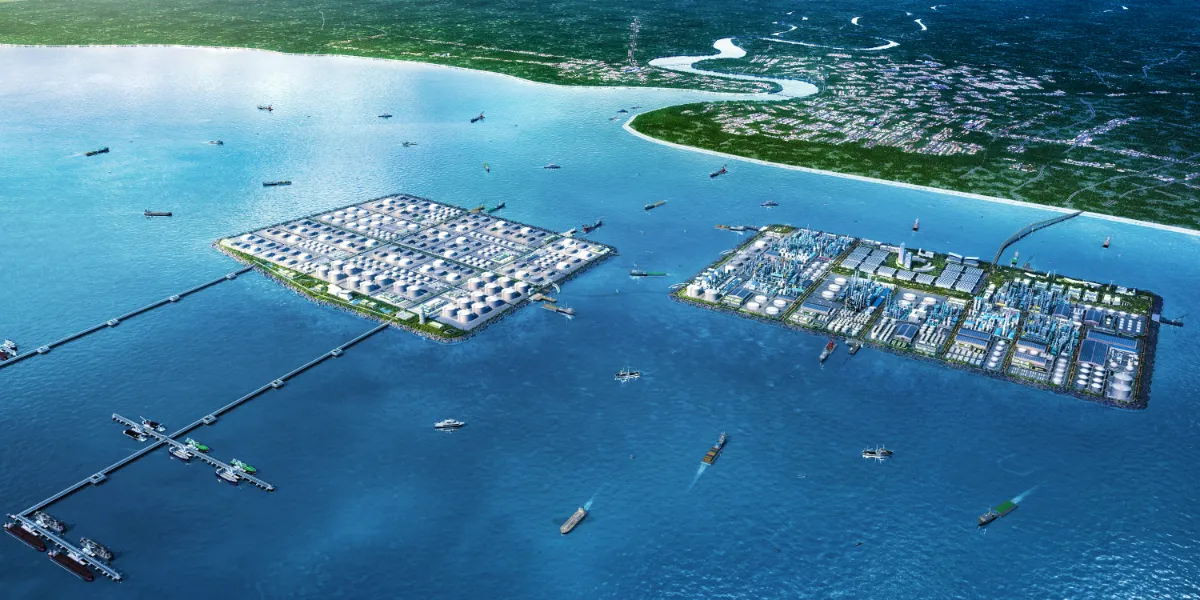
KUALA LUMPUR: The reclamation of 500 acres for the development of Maharani Freeport, Malaysia’s first duty-exempt energy freeport, is expected to be completed in under two years, according to Maharani Energy Gateway Sdn Bhd CEO Muaazam Mahmud.
“We have already reclaimed 50 acres. We can reclaim around 200 acres within 12 months, but completing 500 acres will take less than two years. The bigger task after that is allowing the land to settle before physical development begins,” he told SunBiz.
The development timeline, he said, is investor-driven. Once investors firm up their plans, reclamation and construction work will commence.
“Storage development is likely to begin very soon because demand is already strong.”
Muaazam said it already has confirmed clients for bio-LNG production, liquefied natural gas (LNG) storage and oil storage so physical development can begin as these early commitments provide sufficient demand to move forward.
“Most of the clients are foreign, although Malaysian companies are welcome to take part.”
He said storage will be one of the largest components of the freeport, while refinery facilities are also incorporated.
“One advantage for refinery operators is that locating the plant on the reclaimed island avoids the environmental and human-impact constraints typically faced on the mainland.
“The refinery has already been pre-approved because the island has no surrounding population and it is designated for heavy industry.”
While the port and storage facilities are still under development, ship-to-ship transfers will continue.
Muaazam highlighted that most of the cargo passing through the area comes from the Middle East and is destined for North Asian markets such as China, Vietnam, Japan and South Korea.
“But many Asean waters are too shallow for such large vessels, they need a deep-water transfer point before moving on to their final destinations.”
He said one of Maharani’s key strengths is its naturally deep water, which means the port can handle large vessels without needing dredging.
“Very large crude carriers (VLCC) often carry up to two million barrels of oil for multiple buyers in different countries. When a VLCC needs to split its cargo, it may come to Maharani’s waters, where smaller ships pick up their respective portions. This turns Maharani into a transhipment hub.”
Furthermore, Muaazam said, China is rapidly advancing in green fuels such as green methanol.
With the European Union requiring vessels entering Europe to use a certain share of green fuel, Maharani could serve as a bunkering point for container ships travelling from Singapore to Europe or the United States.
“Chinese producers of green methanol can store or supply their fuel from Maharani’s location.”
The project includes plans for a ship maintenance and repair (MRO) facility to allow vessels to store cargo, refuel and undergo repairs.
“The region lacks large MRO facilities and Singapore’s waiting period is long. Some shipowners even send vessels to China for repairs, which is far unless the ship has cargo to deliver. Maharani offers a convenient stop along the main shipping route,” Muaazam said.
A retail island will be developed next to the shipping area to save operators time and cost, he added.
Prime Minister Datuk Seri Anwar Ibrahim said that through Maharani Freeport, Malaysia aims to expand maritime capacity, enhancing logistics competitiveness and deepening Malaysia’s participation in global supply chains, as well as driving the nation closer to economic targets by creating high-value jobs, attracting billions of ringgit of foreign direct investment and encouraging the growth of industries that thrive on connectivity and innovation.
“The Maharani Freeport will serve as a critical node in this network, a logistics and investment gateway that connects East and West through the Strait of Malacca while improving supply reliability and reducing logistics costs,“ he said at the launch on Nov 29.
Anwar said the country’s first duty-exempted energy freeport designed to be the nation’s energy and maritime services hub will support greater supply chain resilience, encourage cross-border collaboration and make Malaysia an essential part of the new economic architecture taking shape across the Asia-Pacific.
“Recognising the Maharani Freeport’s potential as a catalytic force for local economic development, the Government has approved a suite of tax incentives to spur significant investments in the district of Muar.”
Through the Ministry of Finance, the prime minister said, incentives are extended to the master developer and to companies undertaking integrated energy hub activities, deep-sea port operations and trade-related services.
“In addition, tailored tax incentive packages are provided for supporting sectors, including data centres, infrastructure and utilities, green technology, medical tourism and hospitality.”



