




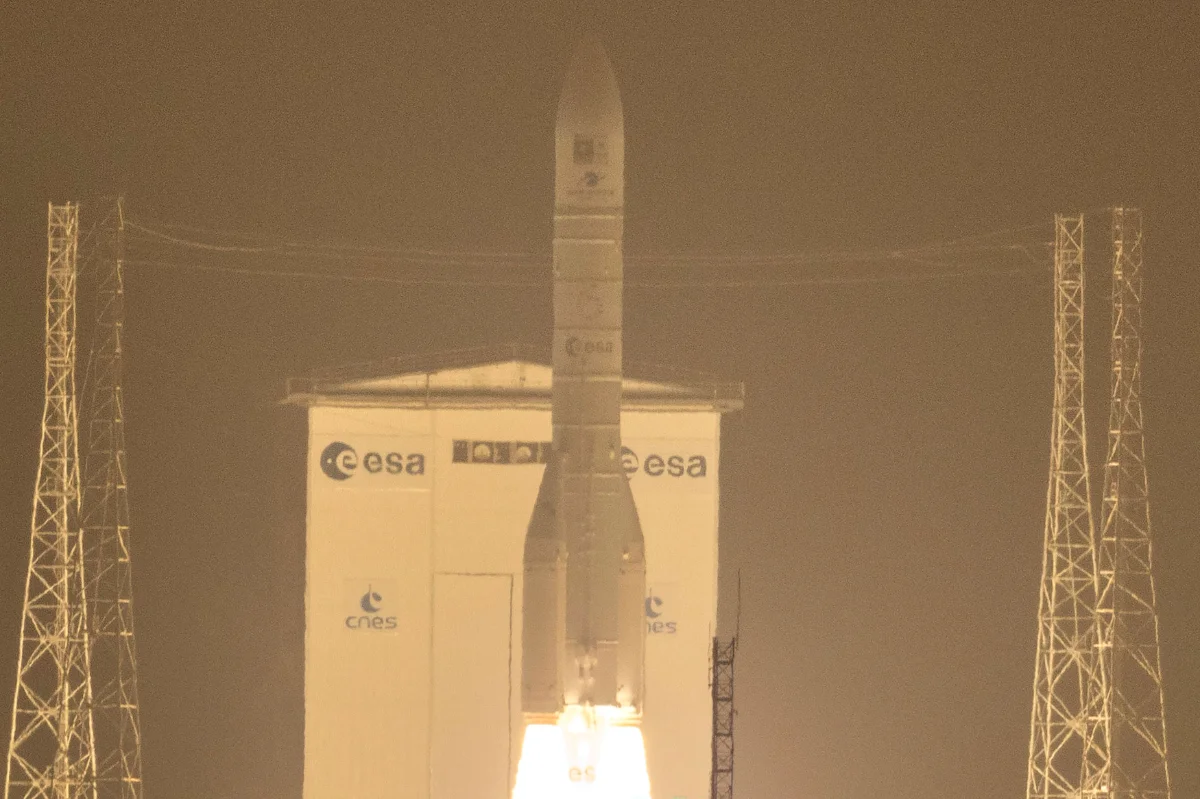
Europe’s Ariane 6 rocket successfully deploys two Galileo navigation satellites, boosting the EU’s independent satellite constellation to 34 operational units.
KOUROU: A European Ariane 6 rocket blasted off from France’s Kourou space base in French Guiana early on Wednesday.
It was carrying two satellites for the European Union’s Galileo global navigation programme.
Lift-off occurred at 2:01 am local time (0501 GMT) for the fourth commercial flight of the Ariane 6 system.
The expendable rockets entered service last year.
The two satellites were set to be placed in orbit nearly four hours after lift-off.
They will bring the total number of Galileo satellites in orbit to 34.
According to the European Space Agency (ESA), the new satellites “will improve the robustness of the Galileo system by adding spares to the constellation”. This guarantees the system can provide 24/7 navigation to billions of users.
The satellites will join the constellation in medium Earth orbit 23,222 km above Earth’s surface.
The Galileo programme aims to make the EU less dependent on the US’s Global Positioning System (GPS).
Previous Galileo satellites were primarily launched by Ariane 5 and Russian Soyuz rockets from Kourou.
Europe halted space cooperation with Moscow after Russia’s invasion of Ukraine.
Before the Ariane 6 entered service in July 2024, the EU contracted with Elon Musk’s SpaceX to launch two Galileo satellites.
Those were launched aboard Falcon 9 rockets from Florida in September 2024.



