the sun malaysia ipaper logo 150x150
Tuesday, July 7, 2026
29.7 C
Kuala Lumpur
the sun malaysia ipaper logo 150x150
Blog

Turkey hosts Nato summit, showcases defence industry growth

A view of the main press conference room a day before the start of the NATO summit in Ankara, Turkey, July 6, 2026. - REUTERS

Ankara uses Nato summit to push for deeper European security role as defence exports surge 48% in 2025.

ISTANBUL: Ankara hopes its hosting of an upcoming NATO summit will cement its rise as a key European security partner, building on the rapid growth of its defence industry despite resistance from some allies.

The two-day summit opens on Tuesday with the Defence Industry Forum — once a sideline event, now formally part of the programme — at which some 3,500 companies will be showcasing the best of Turkey’s burgeoning defence technologies.

“It is inconceivable to establish European security without Turkey,” President Recep Tayyip Erdogan has said while pushing relentlessly for Turkey’s “inclusion” in all of Europe’s defence and security structures, notably the EU’s 150-billion-euro ($176-billion) SAFE programme.

Turkey boasts NATO’s second-biggest army after the United States with 355,000 troops and another 378,000 reservists, with its defence industry notably booming over the past decade.

But its desire to switch from supplier to a strategic partner has been held in check.

“Turkey has been largely left out of Europe-wide programmes and projects. That is what Turkey wants to change… And to do that, it will use the summit to showcase its capabilities,” said Ozgur Unluhisarcikli, head of the German Marshall Fund in Ankara.

Turkey’s defence industry — which ranks 11th in the world, accounting for 1.8% of the global arms market, according to the Stockholm International Peace Research Institute (SIPRI) — saw exports grow by 48% in 2025, up from 29% a year earlier, officials said.

“We now achieve in one week what we used to achieve in one year,” Erdogan said last month of Turkey’s exports of drones, tanks, armoured vehicles and warships, one of which was delivered to Romania, becoming “the first export of a military ship to an EU and NATO member country”.

– ‘Detoxification’ –

“We do not want to be seen only as a supplier. We want to be regarded as a strategic partner.. (for) joint production and technology cooperation,” Haluk Gorgun, head of Turkey’s SSB Defence Industry Agency told Defence24 news website last month.

But allies are questioning Ankara’s long-term reliability with European technology.

“They are asking because of Turkey’s track record with Russia,” said Unluhisarcikli, referring to Ankara’s 2017 acquisition of a Russian S-400 air-defence system that alarmed its NATO partners.

“This is what Turkey needs to persuade France, Italy and Germany about.”

Ties soured in 2015 with Turkey’s military operations in Syria and Libya, then worsened over tensions with Greece and Cyprus in the eastern Mediterranean.

Although the relationship has entered a process of “detoxification”, helped by Turkey’s support for Kyiv, the S-400 issue has remained a stumbling block, notably with Washington, with Ankara struggling to find a way to offload the offending system.

Today Turkey’s relationship with the UK and a handful of European nations is working, but “it’s not working with the European Union as a whole because there are a couple of members who are blocking it,” explained Professor Mustafa Aydin, an international relations expert at Ankara’s TOBB University.

“Apparently it’s not for Germany and France, and these are the two countries that matter,” he told AFP.

– ‘Irrational to exclude Turkey’ –

Under SAFE, firms from non-EU countries like Turkey can only supply up to 35% of the component costs of weaponry funded by the scheme.

To tap a bigger part of the funds, Ankara must sign a security partnership with the EU and then negotiate special access with Brussels — requiring approval from all 27 members.

“The political issues blocking Ankara’s access to the SAFE programme are the dispute between Turkey, Greece and Cyprus, but also France’s ill will,” said Sinan Ulgen, a senior fellow with Carnegie Europe.

Given the difficult geopolitical context facing a Europe caught between the war in Ukraine and the diplomatic standoff with Washington, it was “irrational” not to let Turkey take part, he said.

Within the EU, Spain, Romania, Poland and notably Italy have forged deep defence ties with Turkey, with Turkish drone maker Baykar buying Italy’s Piaggio Aerospace and signing a partnership with defence giant Leonardo over the past 18 months.

Outside of the EU, Britain is cooperating with Turkey’s flagship KAAN project to build its own fifth-generation stealth fighter.

Ankara hopes Washington will unblock delivery of a batch of US-made jet engines that will be used in the project when US President Donald Trump flies in for next week’s NATO summit.

Advertisment

Japan urges China to reconsider missile test launch

Image for visual purposes - AFP filepic

Tokyo said it strongly urged China to rethink a ballistic missile test in the Pacific amid concerns over Japan’s airspace security.

TOKYO: Tokyo said on Monday it had strongly urged China to reconsider a test missile launch in the Pacific Ocean after the Japanese embassy in Beijing was informed by Chinese authorities before the event.

“We strongly called for a rethink of the ballistic missile test-firing, so that it won’t pose a threat to Japan’s security such as by passing through Japan’s airspace,” a joint government statement said.

“Through close coordination among relevant ministries, we will strive to ensure the safety of our airspace and maritime territory, with the ministry of defence fully prepared for surveillance and monitoring.”

“We expressed serious concerns over China’s increasing military activity,” the statement said.

China’s navy said it successfully conducted a test missile launch in the Pacific Ocean on Monday.

Advertisment

AC demand rises as heatwaves hit UK homes

An engineer from Springett Elite Services drill the wall as they install an air conditioning unit at a residential home in Croydon, south London, on July 1, 2026. - AFP

Britons increasingly turn to air conditioning amid record heatwaves, but experts warn against over-reliance due to environmental costs.

LONDON: Londoner Zainab Hussain once saw air conditioning as a luxury in Britain. Now, the 35-year-old “can’t see how we’ll survive without it”.

She and her husband are among a small but growing proportion of British households embracing AC to deal with increasingly hot summers.

But the trend has attracted criticism, particularly from sustainability experts who argue it should not be the “default answer”.

“It’s seen as a quick fix and it’s not actually, because it can cause a lot of damage,” Rajat Gupta, professor of sustainable architecture and climate change at Oxford Brookes University, told AFP.

He noted AC increases electricity demand, energy bills and carbon emissions, while worsening the so-called urban heat island effect by releasing hot air onto city streets.

However, after sweltering at night through the second heatwave of 2026 last month, the Hussain family were undeterred, opting to add AC upstairs at their semi-detached home in the south London suburb Selsdon.

“We realised that our summers were just getting more and more unbearable so it was something that we definitely needed to have for the downstairs area,” Hussain explained.

“But after last week’s heatwave, we realised that actually upstairs was really unbearable as well,” she added, as workers fitted the new appliance.

Wanted ‘now’

Only around 5% of British homes have AC while half overheat during the summer months, according to a 2025 report by the non-partisan Centre for British Progress think tank.

Urging more AC adoption, it cited the growing risks from heat-related deaths — which number in the low thousands each summer — and lost productivity.

Such calls have increased as UK temperature records tumble.

For the second successive year, England last month experienced its warmest June since records began in 1884.

Meanwhile all of Britain’s five warmest summers have occurred in the 21st century, with last year the hottest.

Scientists say human-induced climate change is making such weather more frequent and intense.

For AC installer Joe Springett, who has worked in the industry nearly two decades, the rising mercury has triggered a gradual shift in his business away from offices and retailers.

“I’m getting busier and busier domestically, where people want it in their houses,” the 35-year-old told AFP while fitting Hussain’s new unit.

“It happens every year. As soon as the [hot] weather comes, bang! The phone’s ringing … everyone wants it now.”

After the latest heatwave, Springett was booked up for several weeks and has been struggling to find stock.

Those without the outside space or budget — appliances can cost several thousand pounds, including installation — are instead ordering more basic, portable units.

Retailers’ websites are now showing such items as sold-out.

Home improvement store B&Q told AFP it has seen twice as many searches for portable AC units this year compared to 2025.

‘Only when necessary’

Gupta is dismayed at the “panic buying”, arguing “the most sustainable approach is to look at improving buildings to stay cool naturally”.

He advocates retrofitting buildings with exterior and interior shading, better ventilation and other “green-ing” measures, alongside improved heat-resilience design for new-builds.

AC should be reserved for the most vulnerable, such as those in care home and hospital settings.

“In homes, it hasn’t become widespread yet and it’s better to keep it that way,” Gupta said. “Use it only when necessary and where necessary.”

In the UK, AC running costs can vary widely depending on numerous factors, including the type and efficiency of the system and how often it is used.

But some estimates suggest more powerful units can add hundreds of pounds to monthly bills.

John Calautit, a sustainability lecturer at University College London (UCL), is another AC sceptic.

He noted most British buildings are designed to retain warmth and “cannot cope” with heatwave conditions.

“We need to look at more simple solutions such as adding shading … reflective materials and then moving on to natural ventilation,” he told AFP.

“If those solutions do not work, then we can start looking at mechanical cooling systems.”

Back in south London, Springett argues Britons have “got to move with the times, the climate” and adopt AC.

For Hussain’s family, whose home has south-facing windows exposed to direct sunlight throughout the day, it seemed the only option.

“We spend so much more time at home now, especially with remote working, it’s not just about it being comfortable. We need to be able to function in the house.”

Advertisment

Disabled man sues Austria over heatwave inaction

Austrian Mex Mullner, multiple sclerosis and Uhthoff’s syndrome patient, poses in his wheelchair in the shade of a tree in Lower Austria on July 02, 2026 during an interview with AFP journalists. - AFP

Disabled Austrian with multiple sclerosis sues Austria at European rights court, citing heatwave paralysis and climate inaction.

VIENNA: Sweating out the latest heatwave on his wheelchair, Austrian Mex Muellner was increasingly convinced he was right in suing his country for dragging its feet on climate change .

The forty-something suffers from multiple sclerosis and from Uhthoff’s syndrome, which worsens the neurological symptoms of his illness when his body temperature rises.

He filed a lawsuit against Austria at the European Court of Human Rights (EHCR) in 2021 in one of many climate justice cases handled by European courts and potentially one of the most consequential.

Seated in the shade of a tree, Muellner told AFP the latest heatwave rewriting record temperatures across the continent was “really serious” and boosted his resolve.

“The government should do more. It could have done more,” he said, adding the lawsuit would benefit other people grappling with similar difficulties.

When the mercury rises, Muellner’s life turns upside down.

At 25C, his mobility deteriorates and he can no longer walk, and above 30C he is almost paralysed and must use a power wheelchair.

In patients with multiple sclerosis, which affects the nervous system, “the speed of nerve conduction decreases when it’s hot”, Muellner said.

“As a result, signals no longer reach the muscles and the movements I would like to make no longer happen,” the former energy consultant said in his small town in Lower Austria.

He and his wife live in a passive house they have built and which is designed to maintain a temperature of around 20C all year round.

‘Major issue’

In his lawsuit, he argued that Austria had not adopted a sufficient legislative framework to limit warming and protect vulnerable people like himself.

He also criticised the Austrian judiciary for offering no remedy.

If the court rules in his favour, he will be the first individual recognised as a direct victim of the consequences of climate change, said his lawyer Michaela Kroemer.

She added this would pave the way for other lawsuits in the 46 countries under the ECHR’s jurisdiction.

The verdict “may also have implications for the climate policy of the European Union, of which Austria is a member”, Kroemer said.

“This is a major issue for the court,” said Kroemer.

She added this was probably why the court is taking time, especially as it already issued an explosive ruling against Switzerland two years ago.

The Alpine country became the first state the ECHR condemned for violating human rights through climate inaction, following a complaint by the Senior Women for Climate Protection group.

The court, however, refused to recognise the four individual applicants as victims.

Muellner wants to go further and make the court recognise his right, as an individual, to hold his country accountable for doing “too little”.

He said he wanted to keep his address secret to avoid potential hostile reactions like those targeting the Senior Women for Climate Protection.

Statistics published in France on Friday showed the number of deaths jumped by 30% during the week of June 22, the peak of the heatwave in the country.

Muellner said that now it was “too hot for everyone”, not just him and other ill people.

The only path forward is “to bring global warming under control”, he said.

“I don’t want the Austrian government to instal air conditioning in my home… I want a solution that preserves the world, that will maintain the planet as a livable place for humanity.”

Advertisment

Russia strikes Kyiv region on eve of NATO summit

Ukrainian servicemen hit a Russian missile during a Russian missile and drone strike, amid Russia's attack on Ukraine, in Kyiv, Ukraine July 6, 2026. - REUTERS

Russia struck Ukraine’s Kyiv region with deadly missiles and drones, killing at least 11, ahead of Trump-Zelensky talks at the NATO summit.

KYIV: Russia struck Ukraine’s Kyiv region with ballistic missiles and drones on Monday, killing at least 11 people and wounding dozens, authorities said, on the eve of a NATO summit in Turkey.

The assault was the second on the capital and its surroundings in less than a week and came as both sides stepped up long-range attacks.

US President Donald Trump and Ukraine’s Volodymyr Zelensky are expected to discuss the war on the sidelines of the summit in the Turkish capital Ankara, which begins Tuesday.

After that, Trump plans to speak with Russian leader Vladimir Putin as Washington seeks to revive stalled peace efforts to end the four-year war.

An AFP journalist in Kyiv heard more than 10 explosions during a ballistic missile alert early Monday. Around 30 minutes later, AFP journalists saw several flashes in the sky as another series of blasts rang out.

Authorities said 10 people were killed in Kyiv and one in the Bucha district northwest of the capital. At least 46 people were wounded in the capital and 15 others in surrounding areas.

Russia’s defence ministry said it had carried out a “massive strike” using missiles and drones against what it described as “military-industrial enterprises,” fuel and energy complex facilities in several Ukrainian regions.

The attack caused four fires to break out, all in residential buildings, Tymur Tkachenko, the head of the Kyiv region’s military administration, wrote on Telegram.

“Places where people were simply sleeping tonight,” he added.

Ukraine has increasingly targeted energy facilities inside Russia in recent weeks in an effort to weaken the Kremlin’s war effort.

It has also struck at Moscow-controlled territory in Ukraine that predates the current invasion.

In Russian-annexed Crimea, governor Mikhail Razvozhayev said a Ukrainian strike near Sevastopol had temporarily cut electricity supplies.

“Our energy workers have managed to reconnect power via backup schemes to almost all facilities, and electricity has been restored to most residential buildings in Sevastopol,” Razvozhayev wrote on Telegram hours after the attack.

Moscow’s Mayor Sergei Sobyanin said on state-backed Max that several waves of drones bound for the Russian capital were shot down by Russian air defences.

Russia’s defence ministry said its forces had shot down 519 Ukrainian drones across more than 20 regions overnight, including around Moscow and Russian-annexed Crimea.

Diplomacy and fighting

The White House said Trump would meet Zelensky on Wednesday during the NATO summit.

“The president’s obviously getting together with him to talk about how we can end the war. That’s been a priority of his for a long time,” a senior US official said, speaking on condition of anonymity.

The official said Trump would then “follow up” with Putin.

The meetings come with diplomatic efforts to end the war largely stalled.

Zelensky said Sunday that Ukrainian troops were continuing to fight for the strategic eastern town of Kostyantynivka, a gateway to key positions in the Donetsk region.

Russia claimed Friday to have captured the town, but Kyiv dismissed the announcement as “a lie”.

“Fighting is also continuing for Kostyantynivka, which (Russian leader Vladimir Putin) has already claimed as his own, but it is obvious that he will never dare to appear there,” Zelensky said in a nightly address.

Both Putin and Zelensky held separate phone calls with Trump on Saturday to mark the 250th anniversary of US independence.

Advertisment

Wildfires force thousands to flee southern Europe

A firefighting plane drops water, following a wildfire in Ille-sur-Tet near Perpignan, France, July 6, 2026. - REUTERS

Wildfires across southern Europe force mass evacuations and ban spectators from a Tour de France stage as temperatures rise again.

ILLE-SUR-TET: Wildfires raged across southern Europe on Monday, forcing thousands of people to evacuate their homes and prompting officials to ban spectators from a stage of the storied Tour de France cycling race.

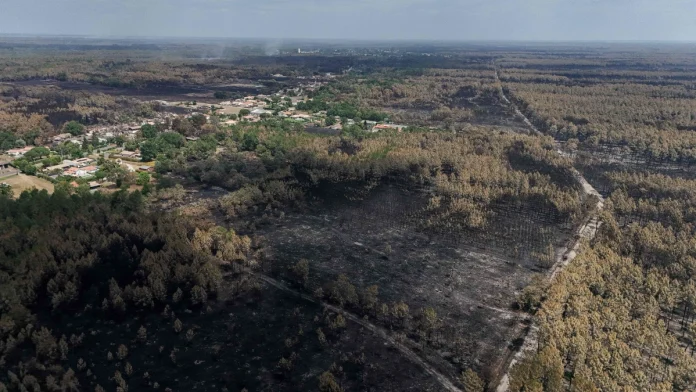
Hundreds of firefighters are battling blazes that have devastated more than 19,000 hectares (42,000 acres) of land — an area more than twice the size of Manhattan, across Portugal, Spain, France and Greece.

And temperatures are on the rise again, predicted to reach 40C in parts of a region still suffering the aftermath of a recent record-breaking heatwave.

In southwestern France near the city of Perpignan, 700 hundred firefighters backed by special aircraft battled to control a “gigantic” blaze spreading in a hard-to-reach remote area, with more than 10,000 local residents evacuated.

Fanned by wind, intense heat and exceptionally dry air, the fire has nearly tripled in size since early Sunday, devouring 4,600 hectares and leaving a firefighter and a resident injured, local authorities said.

“The fire came within 300 metres of the houses. We were taken aback by how fast it spread, it was staggering — bordering on panic,” said Patrice, a 53-year-old resident of the village of Trevillach, who did not wish to give his surname.

“We started seeing smoke around 10:30 pm, then it kept coming closer and closer. Someone from the town hall knocked on our door around 1:00 am to tell us to leave,” said Charlotte Pignol, 30, who was among the first to be evacuated from her home early on Sunday.

The blazes come shortly after a heatwave in June, one of Europe’s worst, during which thousands of excess deaths were registered and which would have been “virtually impossible” without climate change, the World Weather Attribution group of scientists said.

With the mercury set to rise again in the coming days, authorities expressed alarm that the annual summer wildfire season had started a month early.

“Climate change is here, we are living the consequences and it is only the start of July,” said French fire service Colonel Eric Belgioino as he appealed to people near the Pyrenees inferno to take precautions to avoid starting fires.

“The season is going to be long for the soldiers fighting fires. You have to help us,” he pleaded.

In France, officials announced that Monday’s third stage of the Tour de France cycling race through the Pyrenees would take place without spectators who normally line the routes of the storied competition.

The stage, which on Monday will see cyclists ride from Spain into France, “will be limited to the passage of the riders only and the vehicles essential to organizing the race” on French territory, the regional prefect Pierre Regnault de la Mothe told reporters.

“The public is asked not to go near the route or to the finish area,” he said.

“In other words, and I regret having to say this, it will be, in France at least, a stage of the Tour de France without spectators.”

In Greece, flames set off by a forest fire tore through two factories in Thessaloniki in the north of the country over the weekend, forcing authorities to evacuate the surrounding area and to warn households to keep their windows closed.

In Spain, a fire near the northeastern Costa Brava coast burned more than 2,200 hectares in two days and firefighters said their efforts would be “complicated” by rising temperatures and the many “smoking hotspots” within the fire’s perimeter.

In Portugal, emergency services said they had controlled “80 percent” of a wildfire that has devastated some 13,000 hectares of forest and scrub land in the north of the country.

Elsewhere, major fires also destroyed hundreds of hectares of forest, vineyards and scrub land on the Croatian island of Hvar and at Tale in Albania, authorities said.

Regions across Portugal, Spain and southern France have stepped up heat alerts for the coming days.

On Monday the latest heatwave was expected to move north, with forecasters saying it could last until next weekend.

Advertisment

Bellingham urges England to believe after Mexico win

England's midfielder #10 Jude Bellingham celebrates scoring his team's first goal during the 2026 World Cup round of 16 football match between Mexico and England at the Mexico City Stadium in Mexico City on July 5, 2026. - AFP filepic

Jude Bellingham tells his England teammates they can be world champions after a stunning 3-2 win over Mexico in the World Cup.

MEXICO CITY: Jude Bellingham told his England teammates they can be world champions after leading by example in a 3-2 win over Mexico that will go down as one of the Three Lions’ best ever World Cup triumphs.

The odds were stacked against Thomas Tuchel’s men as they entered the lion’s den of the Estadio Azteca, where Mexico had only lost twice in 89 previous matches and never in 10 outings at the World Cup.

On top of facing down a passionate 80,000 crowd, England also had to cope with playing at high altitude and over 45 minutes a man down after Jarell Quansah’s red card.

But by that point, Bellingham’s first half double, scored just 98 seconds apart, had given the visitors something to hold on to.

The Real Madrid midfielder stooped to silence the home crowd to open the scoring.

Bellingham then charged forward to convert Harry Kane’s cross for his fourth goal of the tournament.

“It’s the best night of my England career. Just unbelievable,” said Bellingham, who also performed heroics in his own box.

After Julian Quinones smashed Mexico back into the game, Cesar Montes looked certain to equalise before half-time until Bellingham stretched out a leg to clear.

At just 23, Bellingham is already into his fourth major tournament and assumed the role of a leader.

Alongside Kane, England’s two world class players have carried their nation into a last-eight clash with Norway despite far from flawless performances.

“I’m aware of the responsibility, I’m aware of the pressure that I carry along with all the other players,” said Bellingham.

“Each player has a different responsibility on the pitch in terms of their roles, but I know what I can offer to the team.”

‘Stay off school’

He is hoping his confidence rubs off on the rest of the squad in their quest to end a 60-year wait to win a major tournament.

“I’m convinced of it and I hope that a win like this can give them that same conviction that they’re top players and we shouldn’t fear anyone.

“We shouldn’t wait 40 minutes, 50 minutes, 60 minutes to realise that we’re a very good team.

“So I hope that this win instills that belief in the squad because they deserve to feel that way about themselves.”

Bellingham’s brilliance since touching down on the other side of the Atlantic has silenced doubts prior to the World Cup that he would not necessarily start under Thomas Tuchel.

A year ago Tuchel said that even his own mother found some of Bellingham’s antics “repulsive” and that he could intimidate his own teammates.

The German subsequently apologised and has put his faith in a player labelled a generational talent since he broke into the Birmingham team as a 16-year-old.

Bellingham has already experienced the pain of coming close, but ultimately missing out at major tournaments.

England have lost in both the last two finals of the European Championship and were narrowly beaten by France in the World Cup quarter-finals four years ago.

The final whistle in Mexico City went at just over 4:00 am (0300GMT) back in England, but Bellingham called on those at home to revel in the glory of a memorable night.

“To be a part of an England team that gives so much to the country that can give them these moments and nights like this means just as much as anything in my career and in my life really,” he added.

“Kids stay off school, parents don’t go to work, enjoy the day. Be with your friends, go down the pub again if you can.

“Enjoy it because these nights don’t come around often.”

England will hope Bellingham has three more nights like this in him to finally bring the World Cup home.

Advertisment

Khamenei funeral draws huge crowds in Tehran

Mourners gather on the day of a funeral procession for Iran's late Supreme Leader Ayatollah Ali Khamenei, who was killed on February 28 in Israeli and U.S. airstrikes, in Tehran, Iran, July 6, 2026. - REUTERS

Massive crowds gather in Tehran for the funeral of Iran’s late supreme leader Ali Khamenei as authorities prepare for security.

TEHRAN: The funeral procession for Iran’s late supreme leader Ali Khamenei began in Tehran on Monday, state television reported, as authorities prepared for crowds that could rival those that turned out for his predecessor nearly four decades ago.

The ceremonies offer Iran an opportunity to project resilience after five weeks of war with the United States and Israel, while attention remains focused on Khamenei’s successor, his son Mojtaba Khamenei, who has not appeared in public since taking power.

After lying in state for two days at Tehran’s Grand Mosalla religious complex, the body of Khamenei — who was killed on the first day of the Middle East war on February 28 — began its journey through the capital accompanied by massive crowds of mourners, state broadcaster IRIB reported.

Mourners gathered in Imam Hussein Square in eastern Tehran and hanged an effigy of US President Donald Trump, according to state media.

Authorities are hoping to avoid a repeat of the chaos that marred the 1989 funeral of Khamenei’s predecessor Ayatollah Ruhollah Khomeini, which drew an estimated 10 million people, according to state news agency IRNA.

Crowd surges in Khomeini’s funeral killed more than 10 people and injured over 10,000.

Thousands had filled the Grand Mosalla on Sunday to pay their respects to Khamenei and his four family members, all killed on February 28 in Israeli airstrikes based on US intelligence.

Massive concrete walls separated the public from the coffin to prevent stampedes.

It is unclear what level of access and proximity the public will have during the procession, but authorities are mindful that in 1989 they were forced to use a helicopter to transport Khomeini for burial after mourners stormed his vehicle, causing his burial shroud to tear and his body to fall to the ground.

As well as laying Khamenei — who ruled the Islamic republic for more than three-and-a-half decades — to rest, the funerals are a chance for Iran’s authorities to burnish their resilience after five weeks at war with Israel and the United States.

Mojtaba absent

Parliament speaker and chief negotiator with the US, Mohammad Bagher Ghalibaf, hailed on X the way the “proud and invincible nation of Islamic Iran unanimously” paid tribute to its “martyr”.

Monday’s procession will be followed by similar events in the clerical hub of Qom on Tuesday and in Iraq’s holy cities of Najaf and Karbala on Wednesday, culminating in Khamenei’s burial in his hometown of Mashhad in northeastern Iran on Thursday.

Three of Ali Khamenei’s sons made a rare public appearance at the funeral on Sunday, further highlighting the absence of Mojtaba Khamenei, who was named supreme leader shortly after his father’s killing but has yet to appear in public.

Officials have said he was wounded in the airstrikes but the severity of his injuries remains unclear.

The new commander of the powerful Revolutionary Guards, Ahmad Vahidi, whose predecessor was killed on February 28, appeared at the funerals for a second time on Sunday, this time in the open air, after he went unseen throughout the war.

Esmail Qaani, the shadowy head of the Guards’ Quds Force — responsible for its foreign operations — also made a rare appearance.

While Iranian authorities have been keen to present a united front, none of President Masoud Pezeshkian’s surviving predecessors, who had tensions in their relationship with Khamenei, have so far been seen at the ceremonies.

‘Demand revenge’

The government is also eager to tout the mass mobilisation in support of the authorities after mass protests in January that rights groups say were quelled by a crackdown that killed thousands of people.

The Middle East war is on hold following a ceasefire and an initial accord struck with the US. Both Washington and Tehran have warned they are ready to resume military action, and vengeance has been a major theme at the funerals.

“The killers (of Khamenei) must face punishment,” a 38-year-old man who gave his surname as Miremadi told AFP at the prayers on Sunday.

“We back our revolution and our leader, and we demand revenge for the blood of our loved ones,” said a woman, 39, with the surname Bakand.

Khamenei long pursued a course of confrontation with the West, and Tehran for years has provided support to anti-US and anti-Israel armed groups around the Middle East, including Palestinian Hamas and Lebanon’s Hezbollah, who both sent delegations to the ceremonies.

Advertisment

China conducts missile test-fire in the Pacific Ocean

Image for visual purposes - AFP filepic

Beijing confirms rare submarine-launched missile test in the Pacific, drawing condemnation from Japan and regional powers.

BEIJING: A Chinese submarine test fired a missile in the Pacific Ocean on Monday, Beijing said, after nations in the region warned that China was planning to test an intercontinental ballistic missile.

It was a rare show of Beijing’s military might in the strategically important South Pacific region, where the United States, Australia and New Zealand have long been the security partners of choice.

The launch drew immediate condemnation from nations in region, including Japan, which said it had urged China to reconsider proceeding with the launch.

“At 12:01 pm on July 6, a strategic nuclear submarine of China’s People’s Liberation Army Navy successfully launched a… strategic missile carrying a training simulation warhead into the relevant high seas of the Pacific Ocean, accurately landing in the designated sea area,” spokesperson Wang Xuemeng said in a statement posted on a Chinese navy WeChat account.

“This missile test launch is a routine arrangement of China’s annual military training, and relevant countries were informed in advance,” Wang said.

The launch came on the same day that China and Russia were due to begin their annual joint naval exercises off Qingdao, a major military port and seaside resort in China’s east.

It was not immediately clear if the missile launch was part of those drills.

Beijing has stepped up its nuclear development and boosted defence spending in recent years.

According to the Pentagon, China held more than 500 operational nuclear warheads as of May 2023 and is likely to have more than 1,000 by 2030.

Nations briefed

Papua New Guinea’s foreign minister and a New Zealand government source told AFP earlier on Monday that China was preparing to test-fire a nuclear-capable missile into the Pacific Ocean.

“Yes, China has briefed me. I was personally called by the Chinese ambassador,” Papua New Guinea Foreign Minister Justin Tkatchenko said when asked if he had been warned.

A New Zealand government source also told AFP China had alerted them about an upcoming intercontinental ballistic missile test.

They did not make clear where the missile was expected to land.

China’s elite Rocket Force fired a dummy warhead into the sea near French Polynesia in September 2024, its first long-range missile launch over international waters in more than 40 years.

It appeared to be one of China’s advanced Dong Feng-31 missiles, analysts said at the time, a weapon capable of delivering a thermonuclear warhead.

The long-range missile splashed into a patch of ocean long designated a nuclear-free zone under an international treaty.

New Zealand’s Defence Force has privately warned that Beijing’s naval forays and ballistic missile tests would become a “persistent” feature of the Pacific, according to an internal document obtained by AFP last month.

Pacific island nations remain deeply scarred by the nuclear tests that shook the region in the decades following World War II.

China has been seeking to increase its influence there, showering islands with new hospitals, freshly paved roads, and gleaming sports stadiums.

Advertisment

Kane says England found a way to win

Kane says England found a way to win
England's forward #09 Harry Kane shoots a penalty and scores his team's third goal from the penalty spot during the 2026 World Cup round of 16 football match between Mexico and England at the Mexico City Stadium in Mexico City on July 5, 2026. (Photo by Alfredo ESTRELLA / AFP)

Harry Kane hails England’s resilience after a dramatic World Cup last-16 win over Mexico, with Jude Bellingham scoring twice

MEXICO CITY: England captain Harry Kane said he was proud that his team had found a way to win a nerve-jangling World Cup last-16 match against Mexico in the Estadio Azteca.

The Three Lions were on the back foot for a third of the match after defender Jarell Quansah was sent off for a high challenge.

Kane, hoarse after celebrating with his teammates and England’s supporters, said: “It was a crazy game. We had to fight and we had to find something.

“I’ve just been singing, I can’t really talk. The occasion, the team, everything against us, we found a way.”

Jude Bellingham scored twice for England in the space of 98 seconds in the first half but then conceded a penalty that the referee awarded after checking VAR images. Kane then scored a penalty on the hour-mark.

“I thought I got to the ball first, it was one of those days,” Kane said. “The ref gave a lot against us. In the end it didn’t matter so I’m happy.”

Advertisment
WC26

World Cup 2026

Updates, Fixtures, Results & Standings