




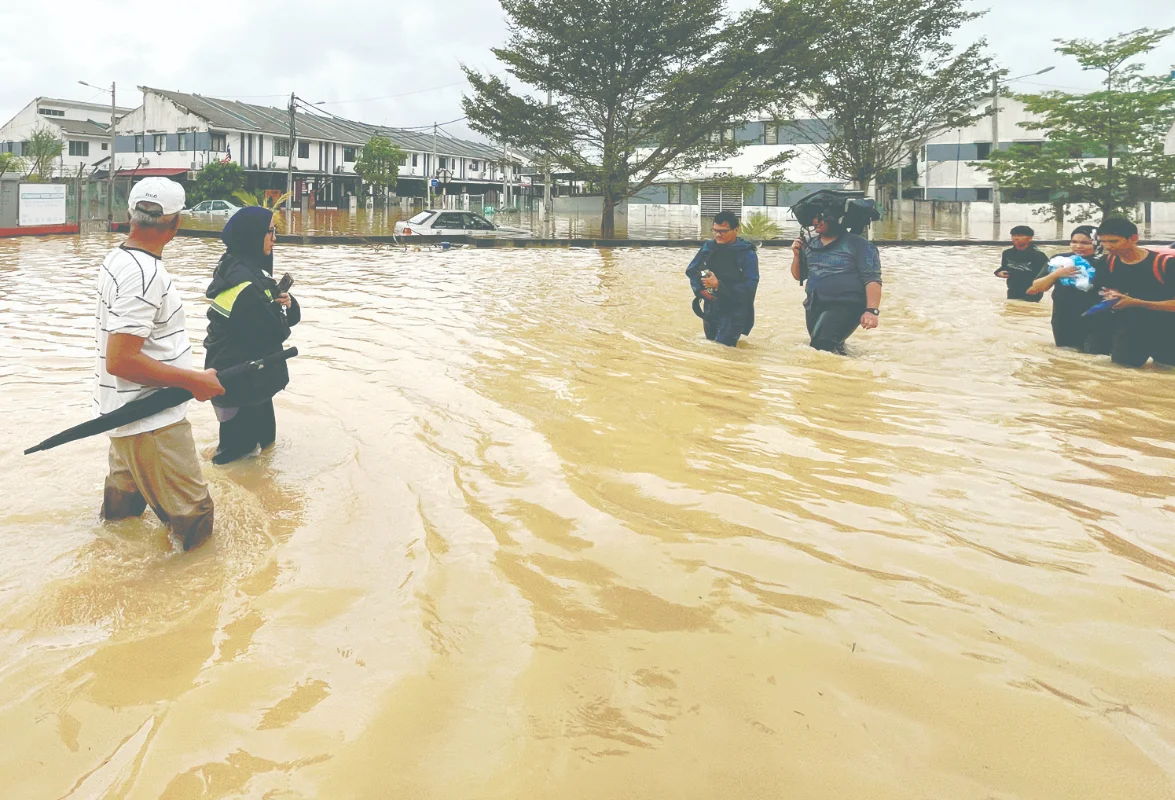
Experts urge detailed studies on drainage capacity and long-term flood mitigation
PETALING JAYA: Urban flooding in Malaysia is increasingly shaped by long-standing planning decisions and changing rainfall patterns rather than simple drainage blockages alone, experts told theSun.
Universiti Teknologi Mara urban and town planning expert Dr Noraini Omar Chong said recurring urban and roadside flooding reflects structural weaknesses in how developments were planned and managed over time, particularly in areas built under earlier drainage standards.
She explained that Malaysia’s stormwater management framework is anchored on the stormwater management master plan and the urban stormwater management manual, which were introduced to move flood mitigation away from merely widening drains towards managing stormwater runoff at the source.
Noraini said the master plan requires site-specific studies to identify flood-prone areas, assess drainage capacity and propose long-term mitigation measures, including stormwater retention and runoff control across entire catchments.
However, she noted that many flood-prone townships and road networks were approved and constructed before the manual was introduced in 2000, when drainage systems were designed using outdated rainfall assumptions and without modern stormwater control principles.
“Even with changes in stormwater management since 2000, flooding in urban areas remains particularly serious in developments approved prior to the enforcement of these frameworks,” she said.
On governance accountability, Noraini said local authorities are legally responsible for drainage upgrades under Section 53 of the Street, Drainage and Building Act 1974.
She added that the provision empowers local authorities to maintain, enlarge, alter, improve or discontinue surface and stormwater drains under their control.
“Legally, local authorities are responsible for drainage upgrades. But in practice, implementation depends heavily on financial capacity, manpower, land availability and coordination with other agencies.
“The cost of upgrading drainage in built-up areas varies depending on complexity and location. Currently, the Public Works Department has allocated RM772,900 to cover the upgrading of 700m of concrete drains in Kota Bharu,” she said.
Noraini also said cost and logistical constraints remain major challenges, adding that in Selangor alone, 12 completed studies under the master plan, excluding any construction or upgrading works, cost a combined RM13.4 million.
She said land acquisition issues, underground utilities, traffic disruption and overlapping agency jurisdictions often delay or complicate drainage upgrades, making large-scale restructuring difficult.
Meanwhile, Universiti Teknologi Malaysia environmental and water systems researcher Assoc Prof Dr Nor Eliza Alias said drainage systems that overflow despite being clear are often not flawed by poor maintenance but from designs that have become outdated.
“I would not describe this as a design failure if consultants followed the guidelines set by authorities at the time. However, those designs may now be obsolete due to present and future climate conditions.
“We are already experiencing the impacts of climate change. Increasing trends in rainfall intensity are clearly observed in research analyses,” she said.
She added that climate simulations from the Intergovernmental Panel on Climate Change models indicate rainfall could increase by up to 9% by the end of the century and about 5% by mid-century under worst-case scenarios.
Nor Eliza added that the Department of Irrigation and Drainage – based on studies by the National Water Research Institute of Malaysia – currently designs drainage and flood systems to accommodate rainfall volumes up to 30% higher than historical levels to account for climate change.
“Developed areas from 30 years ago were designed for past rainfall conditions.
“That is no longer sufficient given more extreme events, intense storm bursts and unexpected tropical cyclones.”



