



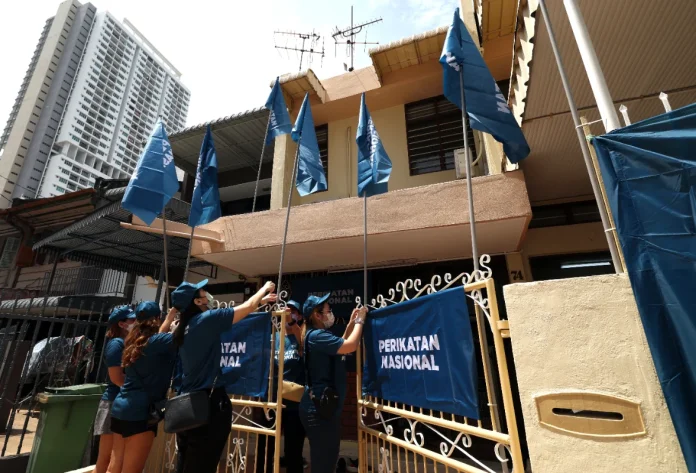
PETALING JAYA: Once seen as a formidable force in politics, Perikatan Nasional (PN) is now facing a crisis of its own making, weakened not by voters but by internal rivalries, leadership disputes and an inability to forge a long-term coalition strategy.
Nusantara Academy for Strategic Research senior fellow Dr Azmi Hassan said the coalition is no longer as formidable as it was during its peak as a rival to Pakatan Harapan (PH).
“At one point, it could seriously challenge PH. But if an election were to be held within the next 60 days, there is a strong possibility that PN would be wiped out by cooperation between Pakatan Harapan and Barisan Nasional,” he told theSun via WhatsApp.
Azmi described the situation as unfortunate, adding that PAS and Bersatu originally came together with distinct objectives that could have strengthened the Opposition.
“What is sad is that both parties appear to be pursuing their own agendas, prioritising party interests and ideological considerations without looking at the bigger picture of building an effective opposition,” he said.
He added that PN’s current weakness stems from the erosion of unity that once attracted voters to its image as a cohesive alternative to the ruling coalition.
International Islamic University Malaysia associate professor Dr Syaza Shukri echoed this view, adding that PN is increasingly perceived as disorganised and divided.
“At the moment, PN is clearly weakening because it is seen as chaotic. This undermines its narrative as a united Malay-Muslim coalition,” she said, adding that its earlier appeal rested on a perception of solidarity.
“Previously, it was viewed as a formidable opposition because it projected unity. I do not think PN will disappear entirely, but if leadership issues remain unresolved, gradual decay would not be surprising,” she said.
Syaza added that prolonged instability, compounded by the inability to name a single prime ministerial candidate and the Perlis menteri besar episode, could eventually lead to the emergence of a new opposition alignment.
Meanwhile, Universiti Malaya socio-political analyst Datuk Prof Dr Awang Azman Awang Pawi said PN’s future remains open, but only if the coalition undertakes serious reforms and adopts a long-term strategy.
“PN was once strong because it channelled voter anger towards the government and positioned itself as a national alternative,” he said, adding that its strength was largely reactive rather than rooted in trust, shared policies or stable leadership.
Awang Azman said unless PN resolves leadership contests, internal rivalry between PAS and Bersatu and the question of the coalition’s dominant force, it will remain a short-term alliance.
“In such a scenario, PN will be strong during crises but fragile when tested by governance.”
He added that rebuilding would require major corrections, including transparent leadership restructuring, the articulation of an inclusive ideological and policy direction beyond rhetoric, and an end to the culture of mutual suspicion between PAS and Bersatu.
He also said failure to implement such reforms risks repeating a familiar pattern in Malaysian opposition politics – being powerful on the campaign stage but weak in nation-building.
Awang Azman stressed that negative narratives surrounding PAS and Bersatu persist because PN has failed to manage public perception through consistent and principled action.
“PN’s future is not guaranteed. It would depend entirely on whether it matures into a resilient coalition or remains a temporary episode in Malaysia’s political history.”
All three analysts agreed that as long as PN is held together by short-term calculations rather than institutional trust and shared policy goals, perceptions of conflict and opportunism would persist.
“Without a shared vision and clear rules of engagement, ideological parties such as PAS and pragmatic parties like Bersatu will clash, and the public would continue to interpret these conflicts through narrow and often misleading labels,” said Awang Azman.



