




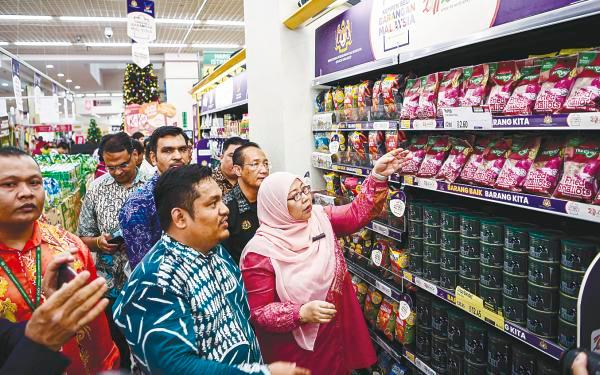
PUTRAJAYA: The escalating humanitarian crisis in Palestine since early October has ignited a global wave of boycotts against Israeli goods and international brands with alleged Zionist links. Malaysians have also rallied to boycott products and companies with ties to Israel as a symbol of solidarity with Palestine.
At the same time, Buy Malaysian campaigns are also gaining traction with lists of locally produced goods ranging from food products to essential items as well as household goods including Malaysian furniture brands flooding social media.
The situation is a blessing in disguise for local manufacturers as Malaysian consumers shifted their preference for local products which are on par with international brands, with many of them recognised globally.
Noting the positive development, the Domestic Trade and Costs of Living Ministry (KPDN) sees the situation as the best opportunity for local manufacturers to leverage the existing platforms to promote their products.
“The boycott issue is rather sensitive and it is within the consumer’s rights. The ministry has to take a neutral approach as we have a role to play in protecting (the interests of) local products as well as foreign goods; local businesses can seize the day by promoting their goods as substitutes for foreign products that are shunned by buyers,” KPDN Trade, Distribution and Business Sector senior director Datuk Rohaizi Bahari told Bernama in an exclusive interview recently.
Given the current scenario, he hopes demand for local products could be sustained and not seasonal, noting that local entrepreneurs should also improve the quality of their products and services to be comparable with foreign products and offer affordable prices.
There is no doubt the quality of local products has evolved over time especially in product development including packaging, design and product certification marks, which indicate the products have been tested and certified to meet specific standards or requirements, both locally qnd at the international level.
Against this backdrop, the ministry says encouraging the public to buy local goods has been an uphill battle as the products and services are not widely marketed and are not aggressively promoted.
Having gone through a long process of bringing the product to life and testing does not mean the local manufacturer’s journey is over. Getting it on store shelves or at major supermarkets as well as at premium areas is the next big leap. In a fast-paced and competitive world, manufacturers of unknown brands have to take a backseat as their products are not well positioned to attract local buyers.
It is no wonder that the Buy Malaysian Goods Campaign (KBBM), which entered its 39th year, has not achieved its target of fuelling the patriotic spirit among Malaysians to buy and use domestic products or services.
In fact, the campaign, which kicked off in 1984 and was rebranded in 2009, had introduced various strategic initiatives to stimulate domestic economic growth through boosting consumption of local goods.
“In Malaysia, given the choice between imported and local products, consumers tend to favour foreign items, a far cry from the situation in Thailand as patriotism is ingrained in the Thai society, which gives priority to its own products.
“In Thailand, many of their products are promoted and are placed at premium locations such as inside the airport, major supermarkets as well as at the entrance of shopping premises,” he said.
The high awareness among Thais in their preference for local products can be attributed to the country’s policy, which makes it compulsory for manufacturers and traders to give priority to local goods over imports.
In Malaysia, there is no specific policy in encouraging the use of local goods and to date, only the Buy Malaysian Products campaign is leveraged to raise awareness among the public as well as manufacturers.
KPDN is currently improving its marketing strategies and increasing the use of local products including collaborating with major supermarkets, convenience stores and retail outlets at petrol stations.
To date, said Rohaizi, the ministry has entered strategic partnership with 16 leading local retailers such as Lotus’s Malaysia, Mydin, KK Supermart, Petronas Mesra for the KBBM.
At the same time, the ministry has also established cooperation with online marketplace such as Shopee, Lazada and PG Mall to help revive the domestic economy and the people’s acceptance of Malaysian goods.
“We have taken our marketing strategies for local products and services to the next level with focus on premium places as consumers would have more confidence in products that are marketed at such locations. Prior to this, it was difficult for local products to penetrate premium supermarkets due to the stigma attached to local products.
“However, we can’t blame them (supermarket owners) as several aspects have to be weighed in among others, whether the local products in terms of quality are suitable for placements there; and can the local items be assured of their availability at the point of sale on a continuous basis,” he added.
Under a two-pronged strategy, marketing of local products at premium supermarkets is poised to improve product visibility given that major retailers such as AEON and Lulu serve as the gateway to the global market through their retail network which has its footprints in various countries.
In fact, many Malaysian brands have carved a niche for themselves and making their presence known globally with inroads in countries especially in the Middle East through such collaboration. As such, the ministry says it is looking at the situation from all angles, especially in terms of product development and quality improvement.



