




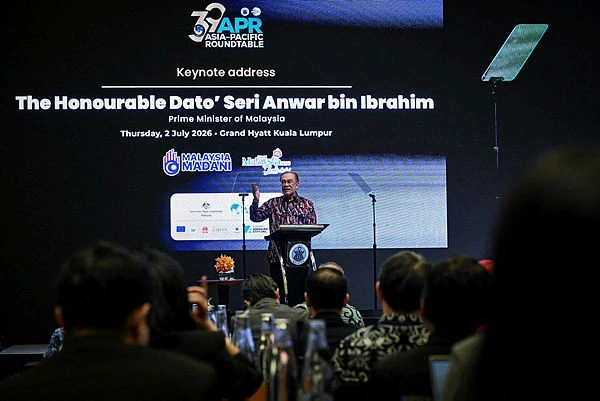
Malaysia will take principled positions on issues such as Palestine, Islamophobia and sovereignty without siding with major powers, says Anwar Ibrahim.
KUALA LUMPUR: Malaysia will not remain neutral on issues involving fundamental rights and its core national interests, even when engaging major powers such as China and the United States, Prime Minister Datuk Seri Anwar Ibrahim said today.
Speaking at the 39th Asia-Pacific Roundtable, he said Malaysia would continue to pursue a fiercely independent, proactive and non-aligned foreign policy, stressing that the country would take principled positions to protect its values, sovereignty and interests amid growing geopolitical and geo-economic uncertainty.
“We will not hesitate to adopt positions, cultivate relationships and support initiatives that advance our values, beliefs and interests.
“Malaysia cannot remain neutral on matters involving fundamental rights such as the Palestinian struggle, or in countering Islamophobia, or on our core national interests, including territorial sovereignty, even when it comes to powerful partners like China and the United States,” he said.
Anwar said Malaysia’s foreign policy was not about clinging to the past, but a deliberate approach that takes into account the country’s identity, history and the need to adapt to changing global realities.
He said Malaysia would continue to take “principled stances and positions, but not sides”, reaffirming its support for the peaceful resolution of disputes in accordance with international law.
“The use of force or coercion, military or economic, will only compound resentment and lead to unintended consequences,” he said.
He added that freedom of navigation, respect for sovereignty and adherence to established legal frameworks remained essential for regional and global stability.
Anwar also reaffirmed Malaysia’s commitment to multilateralism, saying the country would continue to champion collaborative and consultative approaches in relations among nations.
“We do not just support such mechanisms and approaches; we endeavour to do what we can to defend them,” he said.
Calling for reforms to global governance, Anwar said developing countries should be given greater representation in international decision-making, with the voices of Asia, Africa, Latin America and the Pacific carrying greater weight.
“Global rules should be shaped with, not merely for, developing nations,” he said.
He said stronger multilateral cooperation, rather than weaker international institutions, was needed to tackle common challenges such as climate change, pandemics, food security and cyber threats, which no country can address alone.
Anwar also said Malaysia’s rich heritage and diversity placed it in a unique position to foster greater understanding across regions, cultures and civilisations.
He said Malaysia would continue to engage actively with the Islamic world while strengthening partnerships across the wider Global South.



