




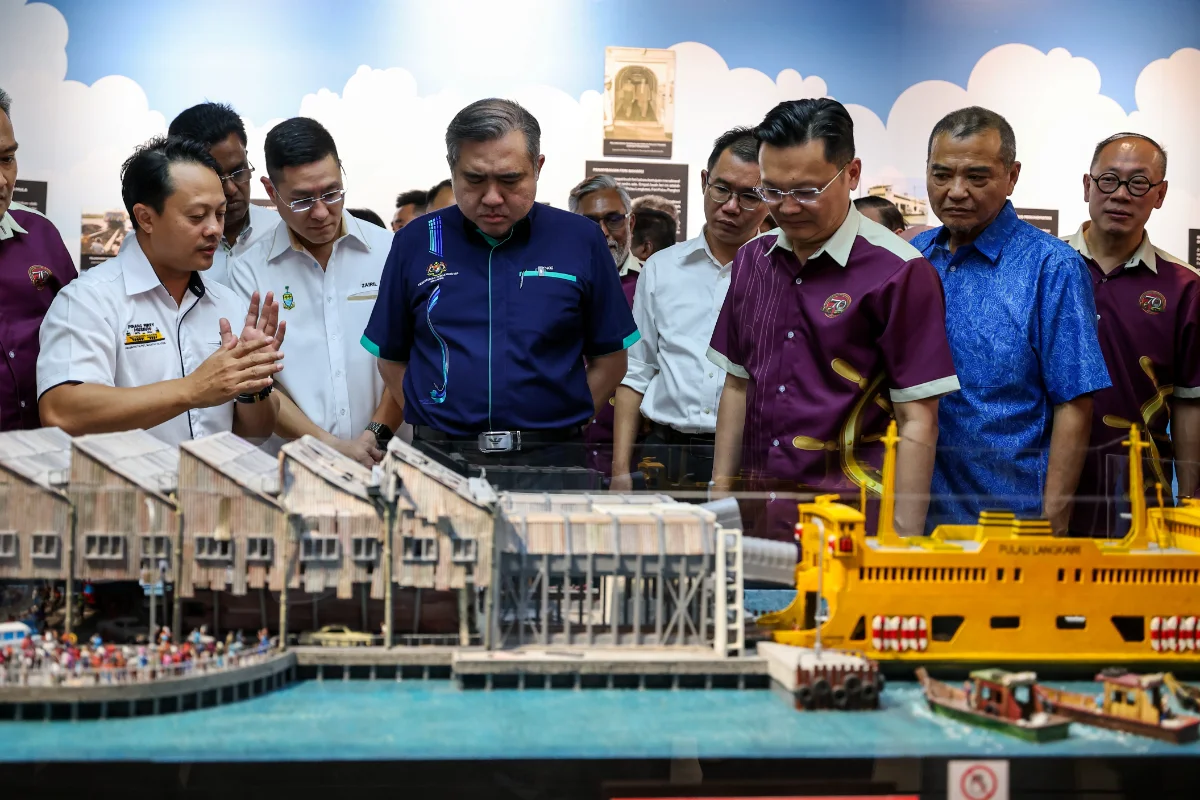
Transport Minister Anthony Loke says Penang Port will evolve from a transshipment hub to the north’s main homeport, boosting maritime services and local economic spillovers.
GEORGE TOWN: The government aims to transform Penang Port into the northern region’s main homeport.
Transport Minister Anthony Loke said this move goes beyond its current role as a transshipment port.
He stated the shift will strengthen the national maritime ecosystem and increase port activities.
“This will expand the range of maritime services and strengthen local economic spillover effects,” Loke said.
He was speaking at the launch of the 70th anniversary of the Penang Port Commission.
Loke emphasised that transport and maritime sectors are main pillars of national development.
He said they facilitate international trade and act as catalysts for industrial growth.
“The Ministry of Transport is always emphasising integrated policy planning and infrastructure development,” he added.
This is to ensure the national port system remains efficient, competitive and sustainable.
Loke said Penang Port is a key gateway for trade and cargo in the northern region.
Its consistent and safe operation boosts investor confidence and smooths goods movement.
He cited the strong performance of Port Klang and Port of Tanjung Pelepas as a benchmark.
Port Klang is the world’s 10th busiest container port, while PTP ranks 15th.
Cruise shipping is also a high-potential growth area for further development.
The Swettenham Pier Cruise Terminal handled over 700,000 passengers last year.
Loke noted the country’s main transshipment hub is currently PTP.
About 95% of its container handling is for transshipment purposes.
Port Klang remains the nation’s primary gateway port.
Its capacity is expected to increase to 28 million TEUs following expansion.
“Penang Port will continue to receive attention and undergo development,” Loke said.
He stressed this is vital due to the significant industrial base in the north.
The port also handles substantial cargo volumes linked to southern Thailand.
Penang Port’s current capacity stands at 2.3 million TEUs.
This is expected to increase to 6.8 million TEUs after expansion.
The expansion plan spans 30 years until 2053.
The 6.8 million TEUs is set as the ultimate target capacity.



