



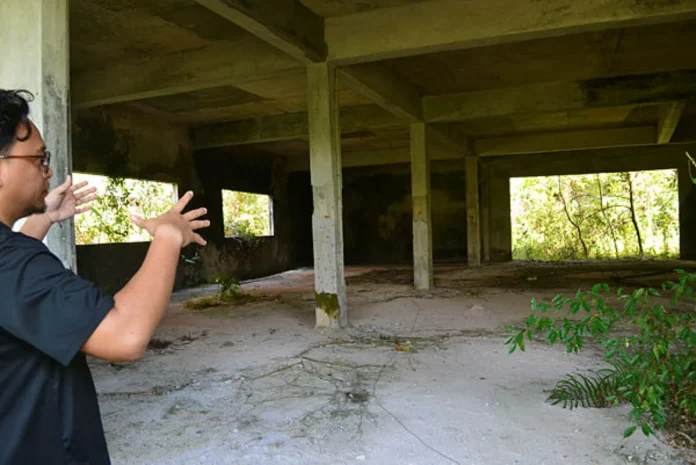
Abandoned homes, illegal dumping, poor street lighting raise safety concerns among nearby residents
HULU SELANGOR: “When it’s dark, you can’t see who goes in or out. Anything can happen.”
For residents of Lembah Beringin, Hulu Selangor, this is a daily reality. Large stretches of abandoned homes and shoplots remain overgrown, unfenced and poorly lit, raising safety concerns for families, business owners and the wider community.
Several unfinished houses along Jalan Lembah Beringin 5 and Jalan Chamar 1 are accessible to the public, with discarded cables and debris visible inside, while vegetation has overtaken much of the surrounding area.
Community committee member Siti Alviah Sheikh Mustafar, 54, who runs a small mart-cafe along Jalan Lembah Beringin 1, said residents have repeatedly raised concerns over unauthorised entry.
“There have been police reports about trespassing in these areas and there was illegal dumping. We reported it to the council and they came to clear it. Then it happened again and we reported it again, even to the police,” she told theSun in a recent interview.
Siti Alviah said poor street lighting worsened the problem.
“If the lights near my cafe are off, the whole area is completely dark. Only here is bright. Everywhere else is pitch black. When people try to make a U-turn, many of them hit the divider because they can’t see properly.”
She added that the darkness makes it difficult for residents to monitor movement at night.
“When it’s dark like this, you can’t see who goes in or out. The houses are left open, unattended and there are no lights. Anything can happen.
“We’ve written letters and made complaints to district councils and Tenaga Nasional Berhad but this is all we get.”
The abandoned properties date back to a township development that collapsed in the late 1990s, widely linked to the Asian financial crisis of 1997. Lembah Beringin’s early appeal had been bolstered by expectations that the Kuala Lumpur International airport (KLIA) would be sited near Hulu Selangor, prompting developers to launch large-scale housing projects in the area.
When KLIA was eventually built in Sepang, these plans lost a key economic driver. The 1997 financial crisis further compounded the setbacks, halting construction and leaving hundreds of homes and shoplots incomplete.
“These houses already belong to someone. So if the owner doesn’t take action, what can be done? Because the developer did not finish the project properly, the ownership (is difficult to transfer). The properties are still under the liquidator,” Alviah said, highlighting the difficulty in attracting new developers or resolving the matter administratively.
Meanwhile, construction of the Chery Smart Auto Industrial Park, a RM2.2 billion project at Beringin High-Tech Auto Valley, began in February 2025 following a groundbreaking ceremony with state officials and project partners.
Targeted for completion in 2026, the development is expected to produce up to 300,000 vehicles annually and create between 3,000 and 5,000 jobs for residents, potentially revitalising the township.
Alviah estimated that 200 to 300 homes, originally priced at RM98,000 to RM188,000, were never completed with some buyers reportedly receiving partial refunds through banks.
Her son, senior business analyst Nik Al-Zawier Nik Mohd Zaim, 31, said the abandoned buildings have long been part of the township’s landscape.
“Some people prefer these places to stay untouched because it’s peaceful and quiet. But it can also be dangerous, especially when it’s dark and visibility is poor.”
Another long-time resident, Zulhanafiah, 35, said while the abandoned homes were generally not considered dangerous, neglect had drawn wildlife into residential areas.
“We see wild boars often, sometimes sun bears, once in a while tigers and recently we caught a snake nearby a resident’s home.”
He added that property prices had risen over the years despite the unfinished developments, now ranging from RM250,000 to RM300,000.



