



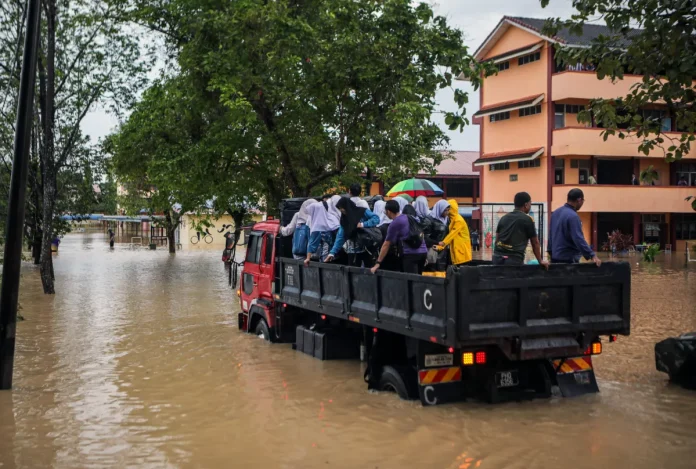
306 SPM candidates from four Perak schools moved to new exam centres after floods made their original locations unsafe.
IPOH: A total of 306 Sijil Pelajaran Malaysia (SPM) candidates from four schools in Perak have been relocated to new examination centres due to ongoing floods.
Perak Education, Higher Education, Youth and Sports Committee chairman Datuk Khairudin Abu Hanipah said the affected candidates comprise 275 school candidates and 31 private candidates.
“They are candidates at Sekolah Menengah Kebangsaan (SMK) Abdul Rahman Talib, Teluk Intan, involving 67 school candidates and 11 private candidates who have been relocated to SMK Seri Perak,” he said during an oral question-and-answer session at the State Legislative Assembly.
He added that candidates at SMK Seri Kandi, Teluk Intan, involving 59 school candidates, will sit for their examinations at SMK Seri Setia.
Candidates at SMK Tun Abdul Razak, Selekoh, Bagan Datuk, comprising 93 school candidates and 20 private candidates, will be moved to Dewan Masjid Tuminah Hamidi.
Fifty-six school candidates from SMK Datul Idris, Pantai Remis, Manjung, will be relocated to SMK Pantai Remis.
Khairudin was responding to a supplementary question by Jason Ng Thien Yeong (PH-Astaka), who asked what measures the state government was taking to assist students in flood-affected schools.
He also said 20 candidates from Sekolah Menengah Tahfiz Darul Ridzuan, Pangkor, were relocated to SMK Pangkor after a nearby slope failure.
As of 8 am today, Perak remains one of the worst-hit states with 4,766 evacuees from 1,447 families still at 30 relief centres across five districts.
Responding to Ng’s original question on school safety, Khairudin said the government continuously prioritises cleanliness, health and safety in schools.
“Among the key measures implemented are policies, guidelines, circulars and directives related to student safety management,” he said.
These measures cover activities conducted within and outside school premises and control of infectious and non-infectious diseases.
Safety enforcement is also strengthened through the installation of closed-circuit cameras in school hostels and monitoring of security guards’ responsibilities.
Additional financial allocations are provided for infrastructure repairs and safety upgrades at high-risk schools.
Continuous monitoring and safety audits are also being conducted, where schools must complete an annual self-assessment under the School Safety Rating System.
“This also includes cooperation with agencies and preventive education through collaboration with the Fire and Rescue Department,” he said. – Bernama



