



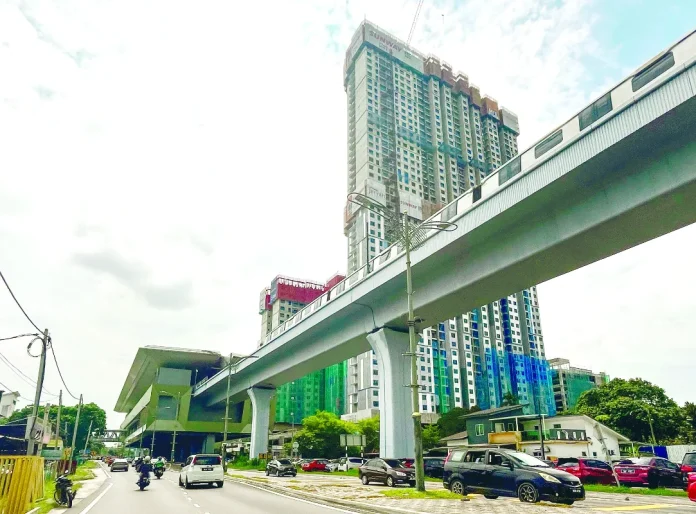
Road safety researcher says reducing bays near LRT and MRT stations without efficient alternatives could worsen congestion and create new safety risks
PETALING JAYA: Malaysia’s ambition to cut parking requirements for new residential developments near public transport hubs could backfire unless the nation first delivers a system that is genuinely reliable, convenient and affordable, warns a road safety researcher.
While the initiative reflects global urban planning trends, Universiti Putra Malaysia Road Safety Research Centre head Assoc Prof Dr Law Teik Hwa cautioned that limiting parking without first strengthening public transport may worsen congestion and create new safety risks.
“In principle, the proposal is strategically sound and aligns with global best practices in urban planning,” Law said.
“It reflects the core principle of transit-oriented development (TOD): if you build high-density housing directly adjacent to high-quality public transport, you should design it for people, not for cars.”
Transport Minister Anthony Loke recently proposed that developers reduce the number of parking bays for projects near LRT or MRT stations, arguing that the current requirement of one or two spaces per unit drives up property prices and entrenches car dependency.
Law said reducing mandatory parking spaces could lower construction costs, potentially making homes more affordable, while signalling a shift away from car-centric development. However, he stressed that success hinges on balancing incentives and restrictions.
“This is a carrot-and-stick approach. The ‘carrot’ must be an exceptionally convenient, reliable and affordable public transport system.”
Law warned that rolling out parking reductions where public transport connectivity remains weak could produce negative short-term outcomes including increased congestion and unsafe conditions in surrounding neighbourhoods.
“If implemented alone, the short-term effect will be negligible to negative. Drivers will preserve their vehicles and park in the vicinity instead – in side streets, commercial areas or nearby villages.”
This phenomenon, known as parking spillover, can worsen congestion and compromise safety, particularly in areas intended to be more walkable.
“Residents will hunt for parking in the very areas where walkability and safety should be prioritised,” Law said, adding that dissatisfaction among residents would likely rise.
According to him, TOD benefits only materialise when a critical mass of residents genuinely chooses not to drive, reducing total vehicle kilometres travelled.
Limiting parking prematurely also risks failing to change commuter behaviour and undermining the appeal of new developments.
“Residents with the means will still buy cars, leading to creative – and often illegal or disruptive – parking solutions.”
Comparing Malaysia with Singapore and Japan, he highlighted the importance of sequencing.
“Singapore and Japan did not just reduce parking – they invested in and prioritised public transport first, for decades. Malaysia’s TOD efforts are promising, but we are playing catch-up. Feeder bus networks, service frequency, pedestrian connectivity and fare integration are not yet at the level needed to replicate those models.”
Law urged the government to prioritise strengthening public transport before implementing widespread parking reductions, emphasising that the policy itself should not be abandoned.
“The government must first prove that public transport is a viable and superior choice for daily life.”



