




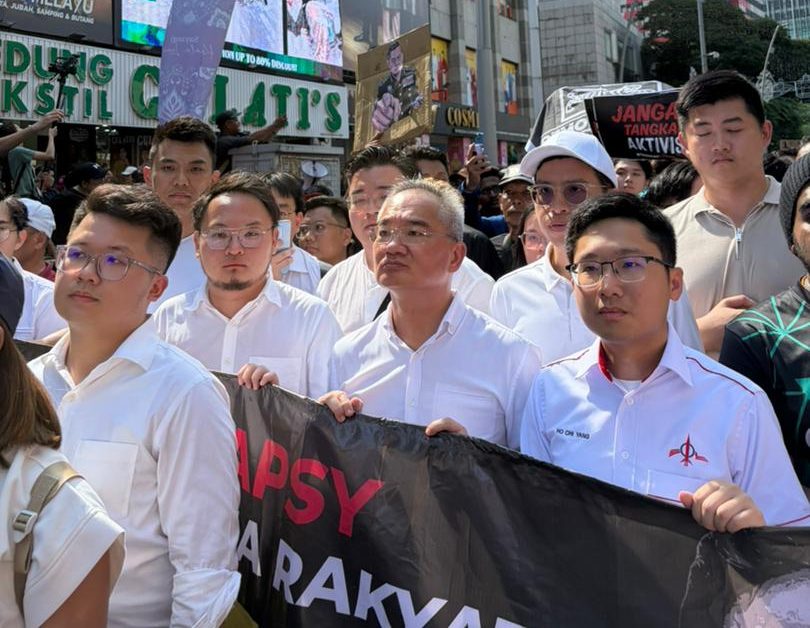
DAP’s Khoo Poay Tiong urges an RCI into MACC allegations, saying leadership changes should not halt efforts to restore public confidence.
KUALA LUMPUR: The demand for a Royal Commission of Inquiry (RCI) into alleged misconduct within the Malaysian Anti-Corruption Commission (MACC) must persist regardless of leadership transitions, Kota Melaka MP Khoo Poay Tiong said today.
Making a rare appearance at an anti-corruption rally, the senior DAP leader and Melaka DAP Chairman stated that the party’s position has remained steadfast since the allegations first surfaced.
He emphasised that the call for an RCI is a matter of institutional integrity rather than a grievance against any specific individual.
READ MORE: Fireworks, tensions mark rally as authorities block march towards Dataran Merdeka
“We have always maintained that an RCI must be established to investigate the Bloomberg report. Our position has never changed.
“Even though there has been a change in the MACC leadership, we will not stop here. We must seek the truth to restore public confidence in the commission,” Khoo told reporters.
Khoo highlighted that DAP ministers have repeatedly raised the matter during Cabinet meetings, while the party’s MPs have consistently pushed the issue through Parliamentary debates and official statements.
He questioned whether the government had formally addressed the request for an RCI, noting that the Prime Minister had previously indicated the administration was awaiting the outcome of investigations into allegations involving outgoing chief Tan Sri Azam Baki.
“However, we remain firm. The RCI must be established as soon as possible,” he insisted.
Khoo argued that the demand now extends beyond the immediate investigation, calling for broader institutional safeguards to prevent a recurrence of past controversies.
“We do not want a second Azam Baki. We need a better and more comprehensive system, especially regarding the appointment process of the MACC Chief Commissioner.
“It must be more transparent and include robust accountability mechanisms,” the lawmaker said.
He further suggested that Parliament should be granted a more significant role in overseeing key appointments to reduce executive dominance over enforcement institutions, ensuring they remain independent and answerable to the public.



