




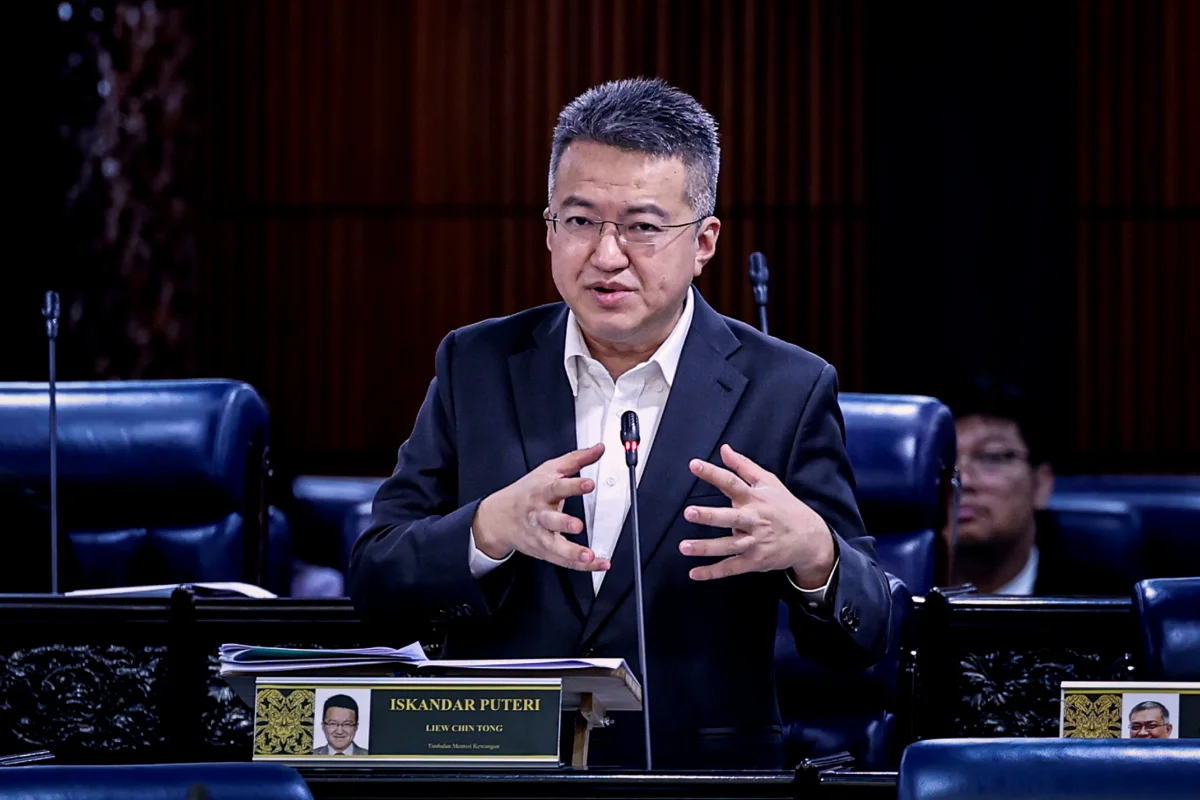
Section 103 of the Income Tax Act 1967 is designed for orderly tax collection, not punishment, says Deputy Finance Minister Liew Chin Tong.
KUALA LUMPUR: The provisions of Section 103 of the Income Tax Act 1967 are not punitive in nature but are intended to ensure the orderly collection of tax revenue to finance national development, said Deputy Finance Minister Liew Chin Tong.
He said perceptions that Section 103 grants excessive powers to the Inland Revenue Board (IRB) and places undue pressure on taxpayers are inaccurate.
Section 103 governs the payment period and penalties for taxes that are not settled with the IRB within the prescribed timeframe. It covers three key provisions: the due date for payment, a 10% late-payment penalty, and an additional 5% penalty.
Liew said the provision is not new, having been in force since 1968, and reflects an international taxation principle adopted by tax authorities in other countries.
“The principle has also been recognised and upheld through rulings by the Court of Appeal and the Federal Court.
“Although tax assessments issued by the IRB must be settled within the prescribed period regardless of the status of any appeal, taxpayers’ legal right to lodge an appeal after payment remains fully protected,” he said during a special session of the Dewan Rakyat today.
Liew was responding to a motion by V. Ganabatirau (PH-Klang) regarding the implementation of Section 103, which was alleged to create an imbalance of power between the tax authority and taxpayers.
He stated that the pay first, appeal later principle does not function in isolation. It is supported by instalment payment options, refund provisions, and interest payments to ensure that any excess tax paid is refunded to eligible taxpayers.
Without such a mechanism, Liew said, certain parties could exploit the appeals process solely to delay tax payments without valid justification.
“Out of 6,122,290 income tax returns received in 2025, only 606 appeal cases were recorded. Of these, 148 cases were resolved through proceedings by the Tax Resolution Department, while 458 cases were registered with the Special Commissioners of Income Tax.
“The number of appeal cases in 2025 accounted for less than 0.01% of total returns received,” said Liew.
He emphasised that the principle is also intended to safeguard taxpayers’ rights and ensure fairness for those who pay their taxes on time.
“The government remains committed to improving governance and internal review processes to ensure that all tax assessments are fair, transparent and do not adversely affect taxpayers’ welfare or national revenue,” said Liew.
On the issue of serving assessment notices, he said delivery by ordinary post or registered mail is expressly provided for under the Income Tax Act 1967.
Liew said claims that notices can be served without strict proof of delivery are inaccurate.
For Additional Assessments, Estimated Assessments and Composite Assessments, the IRB is required to provide valid proof of postal delivery when applying for summary judgment in court.
He said that the judiciary consistently examines evidence of service based on the civil standard of proof, namely “on the balance of probabilities”.
Accordingly, Liew reminded taxpayers to keep their address details updated with the IRB to ensure assessment notices can be delivered properly.



