



“Childhood does not unfold on a fixed timeline, no matter how neat policy frameworks try to make it.”
AT 11, my son still struggles with mornings, maths homework and occasionally remembering which day of the week it is.
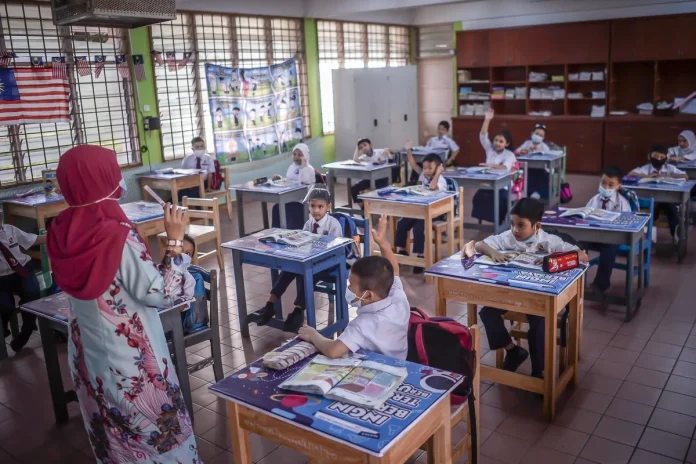
Yet soon, children in Malaysia will start Year One at six, facing textbooks, homework and national assessments before they’ve had a chance to simply play.
The new reforms – early school entry, Year Four and Form Three assessments under the Malaysian Learning Matrix and diagnostic tests to catch learning gaps – promise efficiency. But childhood is rarely that neat.
I asked my son what he thought about the Year Four assessments.
“Amma, if it’s not an exam, why does it still sound like one?”
He has a point. Catching learning gaps early is laudable in theory. In practice, it risks turning curious, playful learners into exam-conscious children long before they discover that science can be fun or that reading can transport you to other worlds.
Then there’s the mixed-age classroom dilemma. With children entering Year One at six, classrooms may become an odd academic sandwich – younger children sitting beside older peers, learning at different developmental speeds.
Teachers will need superhero-level patience and training to make this work without tears, tantrums or quiet trauma. For parents, it’s a cocktail of excitement and anxiety: early socialisation on one hand and the nagging question of readiness on the other.
And readiness matters. Starting school earlier may look like a productivity hack – more years of formal education before adulthood.
But is a six-year-old emotionally and cognitively ready for structured learning, homework and looming assessments? Or will we see more morning meltdowns and silent struggles that never quite make it into diagnostic charts? Childhood does not unfold on a fixed timeline, no matter how neat policy frameworks try to make it.
The Year Four and Form Three assessments under the Malaysian Learning Matrix are meant to flag learning gaps early – more like a check-up than a judgement – though whether they stay low-pressure in reality remains to be seen.
Yet exams, by their very nature, shape behaviour. Once marks enter the picture so does comparison, anxiety and the familiar Malaysian obsession with performance.
In a decade where AI can write essays, solve equations and compose music, are we still measuring learning with grades on paper? My son’s generation isn’t just entering school earlier – they’re entering a world where the rules of work and knowledge are already shifting.
There’s also the economic ripple effect. Private pre-schools and kindergartens may see enrolment changes.
Parents might skip a year or rush to “prepare” their children earlier, adding cost and pressure to households already stretched thin.
Education, once again, risks becoming a race – not just for children but also for families.
To be fair, I see the intent. Early intervention can help students who might otherwise be left behind.
Done well, diagnostic tests could make education more equitable. But execution is everything.
Curriculum design, teacher support and classroom realities will decide whether this is a meaningful reform or simply new paperwork in modern packaging.
As a parent and journalist who has watched Malaysian children navigate a system that often reacts faster than it reflects, my hope is simple – that these reforms do not forget the heart of education.
Exams and age benchmarks are tools, not goals. Children are not production lines.
My 11-year-old is already navigating the world of tests with a sharp eye – figuring out how to “game” the system, spot patterns and ask the right questions.
It’s a skill that, frankly, may outlast any exam syllabus, even as Malaysia introduces the Malaysian Learning Matrix in Year Four and Form Three to track learning gaps early.
At the end of the day, reforms are only as good as the world they prepare our children for.
And if we’re not careful, we may end up preparing them not for life – but for the next test.
Hashini Kavishtri Kannan is the assistant news editor at theSun. Comments: letters@thesundaily.com



