




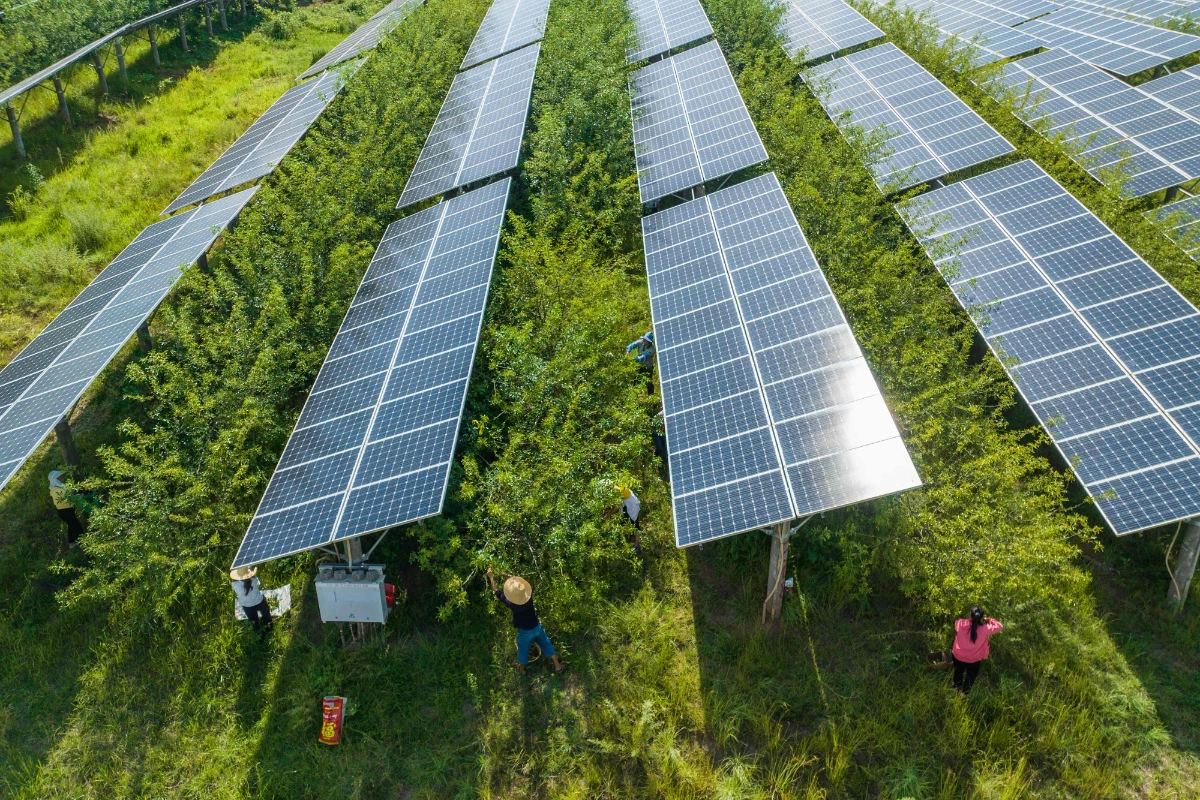
Western heatwaves expose self-defeating tariffs on Chinese renewable tech, raising costs and slowing climate action.
THE current heatwave in Europe and North America is seen by scientists as evidence of the accelerating impact of climate change.
With temperatures across a wide swath of eastern US and northern Europe topping historical highs and heat domes persisting beyond normal trends, several hundred million people are suffering from the government’s failure to prioritise a more rapid transition to renewable and clean energy technology in their national development strategies.
Missing or lost amid the furore generated by the mounting heat-related deaths and other impact caused by the heatwave and the search for relief from a weather phenomenon, which is likely to become more frequent and widespread, is the war that the West is waging on the renewable technology front against China.
This policy war has been intensifying with an emphasis on actively “de-risking” and protecting domestic markets from what is being sold to the Western public as “China Shock 2.0”.
Key strategies in this war for now include high tariffs, strict procurement rules and supply chain security bans targeting electric vehicles, batteries, solar panels and inverters.
United States initiatives
Targeted inverter bans: The US is currently drafting regulations to restrict the import of Chinese energy inverters, citing national security threats to electrical grids.
National Defence restrictions: The US updated the National Defence Authorisation Act to prohibit the Department of Defence from procuring solar equipment and inverters manufactured by Chinese entities of concern.
Heavy tariffs: The US continues to enforce major Section 301 tariffs on Chinese electric vehicles, batteries, solar cells, steel and aluminum.
European Union initiatives
Trade defence instruments: The EU is heavily utilising anti-dumping investigations and countervailing duties against Chinese electric vehicles, steel and industrial manufacturing.
Industrial Accelerator Act: The EU has proposed the Industrial Accelerator Act, which prioritises EU-made clean-tech and low-carbon products in projects that use public funds, aiming to reduce reliance on third-country supply chains .
G7 alignment: European leaders and the G7 bloc have collectively agreed to map and reduce critical mineral dependencies. This will affect supply chains, including for renewable energy products.
Next on the renewable technology war front
Western nations are currently implementing tariffs, stricter local content requirements and anti-subsidy investigations on Chinese solar panels, EVs and batteries.
The primary-stated goals are to protect domestic manufacturing and address concerns over China’s alleged overcapacity. As these barriers increase the cost of imported equipment, they will raise upfront prices for consumers and slow down the adoption rate of renewable and clean technology.
The uncomfortable and indisputable reality is that China is a market leader and perhaps even a role model for the West in renewable energy. Hence, it is counter-productive on the energy and climate change fronts to fight rather than work with China.
The other reality is that China’s scaling of renewable energy manufacturing has created significant price efficiencies. Solar panel prices declined by 89% between 2010 and 2023, largely due to Chinese production scale. This price effect has accelerated global, including Western, adoption of renewable technology.
China’s new long march in development
China’s “New Long March” – a phrase frequently invoked by Chinese leadership – can be seen also to be referencing the nation’s coordinated, state-driven pivot away from cheap, scale-led manufacturing towards technological self-reliance, green and clean energy adoption and industrial modernisation.
This transition has been responded to by the West through a lens of intense geopolitical friction, treating it as a zero-sum conflict. In the past, opposition to China was justified on security, human rights, labour concerns and other governance related grounds. This strategy no longer works.
When reapplied to the renewable energy front, it misjudges how the global and Chinese economy works. If structured and integrated constructively, China’s economic and technological evolution, including in the green revolution, can yield massive dividends for the West and the rest of the world.
Areas of mutual benefit
The global community stands to gain significantly from China’s upgraded industrial model, provided both sides maintain open economic pipelines, free of the ideological battles that Western leaders have foisted on the world.
The clearest example for now is the demand by Western consumers for Chinese air conditioners and other cooling appliances during this heat wave episode.
This is a policy lesson for critics attempting to justify restrictions on Chinese imports on the basis of the reflexive and protectionist “overcapacity” charge regularly trotted out by senior European lawmakers and politicians.
Accelerating the global green transition
China has essentially built the supply-chain backbone for the world’s decarbonisation efforts. In recent years, its expansion in renewable energy capacity has been unprecedented, adding more solar and wind power than almost the rest of the world combined.
The benefit: By leveraging China’s massive manufacturing efficiencies in EVs, lithium-ion batteries and solar photovoltaics, Western countries can lower the capital cost of hitting their own net-zero climate goals.
Driving global scientific breakthroughs
China’s 15th Five-Year Plan (2026–2030) centres on foundational research, artificial intelligence and frontier sciences. According to trackers from groups like the Australian Strategic Policy Institute, China now leads global research output in a vast majority of critical technologies.
The benefit: Rather than treating scientific advancement as a closed loop, encouraging academic transparency and cross-border scientific collaboration will allow Western researchers and corporations to build upon these foundational breakthroughs. This can speed up global innovation cycles that can help in mitigating the impact of climate change.
Stabilising global supply chains
The upgraded version of China’s economic model focuses on industrial resilience and preventing catastrophic bottlenecks.
The benefit: A highly organised, high-tech manufacturing sector will reduce the risk of global supply chain shocks. While the West is actively “de-risking” or friend-shoring critical components, a robust, highly productive Chinese industrial base keeps a floor under global manufacturing capacity, curbing inflationary pressures.
How the West can encourage a productive outcome
For China’s “New Long March” to benefit everyone, the global response needs to shift from purely defensive isolation and protectionism to engagement and partnership.
An emphasis on “de-risking” and protecting domestic markets from a perceived “China Shock 2.0” will only hurt the West or other countries attempting similar policy measures.
“At what cost?” – the conundrum frequently used to describe and criticise China’s development is one that the West needs to apply to itself in this and many more of the ways that it approaches the challenges of our time.
Lim Teck Ghee’s Another Take is aimed at demystifying social orthodoxy. Comments: [email protected]



