




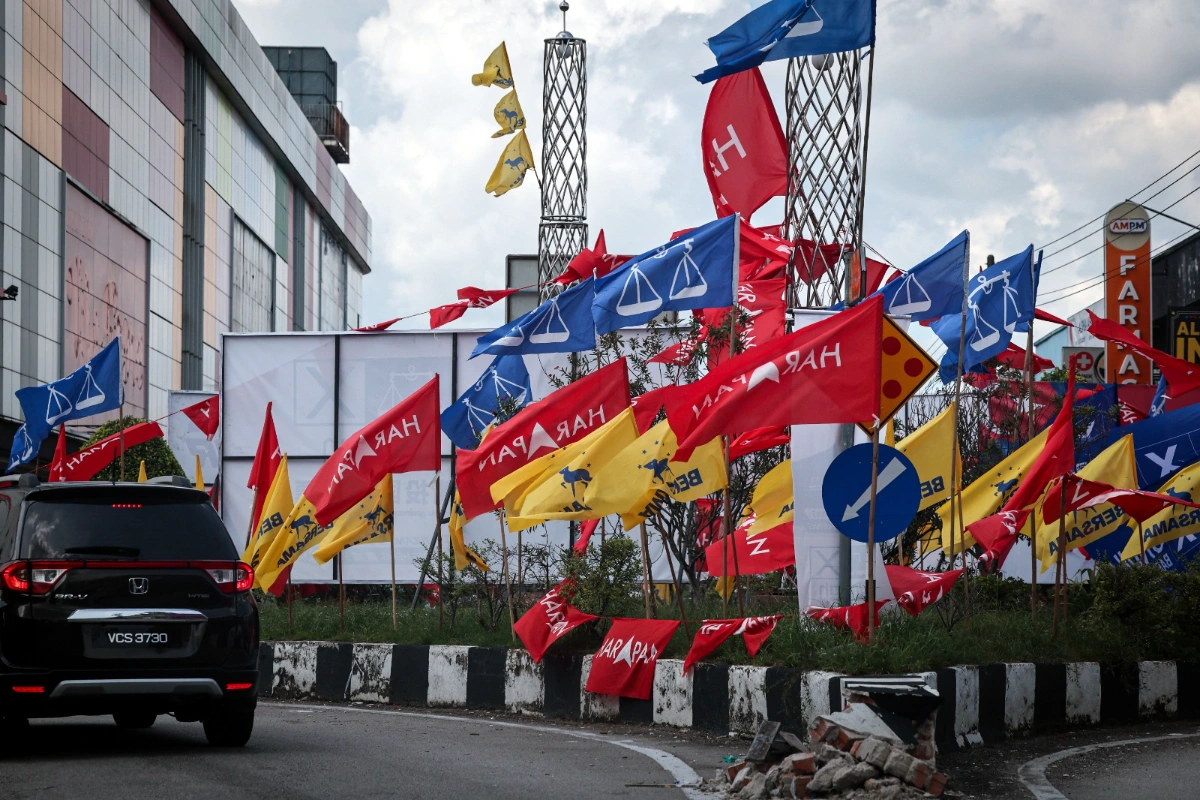
THE Negeri Sembilan state election scheduled for Aug 1 will be an important test of whether Barisan Nasional’s recent electoral success in Johor can be transformed into a broader political resurgence.
Negeri Sembilan has 36 state constituencies; therefore, a coalition requires at least 19 seats to form a simple-majority government. In the 2023 state election, Pakatan Harapan (PH) won 17 seats, Barisan Nasional (BN) secured 14, and Perikatan Nasional (PN) captured five. Although PH and BN subsequently governed the state together, the two coalitions will contest the forthcoming election separately.
Nomination day is scheduled for July 18, making any present forecast provisional until the candidates are confirmed.
BN enters the Negeri Sembilan campaign with considerable momentum. In the Johor election on July 11, BN won 48 of the 56 state seats, increasing its representation from 40 seats.
PH obtained only eight seats, down from 12 previously, while PN and the newly established Bersama party failed to win representation.
The Johor result was therefore more than a routine victory: it demonstrated BN’s ability to defend its traditional Malay-majority constituencies while capturing several seats previously held by PH, including Johor Jaya, Perling, Bukit Batu, Jementah and Tangkak.
Several factors contributed to BN’s success in Johor. The first was the popularity of Menteri Besar Onn Hafiz Ghazi, who projected an image of administrative competence, political stability and development-oriented leadership.
The second was BN’s extensive grassroots machinery, particularly in UMNO-dominated areas. Average turnout in Johor was approximately 68.73 percent, but several UMNO strongholds recorded participation exceeding 70 per cent.
By contrast, turnout was below 60 percent in several constituencies with large ethnic-minority populations.
This difference suggests that BN successfully mobilised its core supporters while a proportion of PH’s traditional supporters either abstained or shifted their votes.
The Johor outcome provides BN with three advantages in Negeri Sembilan. First, electoral momentum can strengthen campaign workers’ morale and persuade undecided voters that BN is capable of forming the next government.
Second, the Johor victory validates the effectiveness of BN’s constituency-level organisation. UMNO’s established local branches are particularly valuable in identifying supporters, conducting house-to-house campaigning and ensuring that voters reach polling stations.
Third, the victories of MCA and MIC candidates over PH representatives in Johor suggest that BN may once again compete for some Chinese and Indian support, particularly among voters dissatisfied with PH’s reform record or internal divisions.
Nevertheless, the Johor result cannot be transferred automatically to Negeri Sembilan.
BN was already the incumbent government in Johor, whereas Negeri Sembilan has been led by PH’s Aminuddin Harun since 2018.
PH consequently possesses the advantages of incumbency, administrative visibility, and an established state-government record. Negeri Sembilan’s electoral geography also differs from Johor.
PH has comparatively strong support in the urban and ethnically diverse western constituencies surrounding Seremban, Rasah and parts of Port Dickson.
BN, meanwhile, traditionally performs better in rural and semi-urban constituencies. The decisive contests are therefore likely to be marginal mixed seats located between PH’s urban base and BN’s rural strongholds.
Voter turnout will be the first major determinant of the result. BN will benefit if rural Malay turnout resembles the high participation recorded in Johor, while disillusioned PH supporters remain at home.
PH’s strongest defensive strategy is therefore to mobilise urban, younger and ethnic-minority voters. A relatively small difference in participation may determine several marginal constituencies.
Candidate selection and leadership credibility will constitute the second factor. Locally respected candidates with visible service records may perform better than their coalition’s overall popularity would suggest.
BN must avoid internal sabotage by unsuccessful aspirants, while PH must balance introducing new candidates with retaining effective incumbents. Aminuddin’s administrative record will be compared with BN’s proposed candidate for Menteri Besar, making leadership an important component of the campaign.
Economic and governance concerns will be the third determinant. Cost-of-living pressures, employment opportunities, housing, infrastructure, flood mitigation, and local-government services are likely to carry greater weight than abstract ideological debates.
PH will present itself as the coalition of administrative continuity and defend its record since 2018. BN will argue that its development-oriented approach, stronger electoral machinery and federal influence can deliver projects more effectively. Finally, the division of the Malay vote among BN, PH and PN will influence the result.
PN won five Negeri Sembilan seats in 2023, but its complete defeat in Johor and internal disagreements have weakened its momentum. PN may nevertheless retain selected Malay majority constituencies or split votes that would otherwise go to BN.
Smaller parties such as Bersama and MUDA are unlikely to win many seats, although they could reduce PH’s margins in urban constituencies. The most reasonable pre-nomination forecast is therefore a narrow BN victory rather than a Johor-style landslide.
BN may secure approximately 19–21 seats, PH 12–15 seats, PN 2–4 seats, and smaller parties or independents no more than 1 seat. BN is presently the slight favourite because of its Johor momentum, grassroots organisation, and opportunity to capture marginal PH and PN constituencies.
However, strong PH turnout, credible candidates and a convincing defence of Aminuddin’s governing record could still produce a hung assembly or allow PH to remain the largest coalition.
Ultimately, the election will be determined not merely by the existence of a “blue wave”, but by whether BN can translate psychological momentum into disciplined constituency-level mobilisation.
Afi Roshezry Abu Bakar
Adi Wira Mohd Zin
Universiti Tunku Abdul Rahman (Kampar Campus)



