



SHAH ALAM: Residential and commercial property developer I-Berhad (I-Bhd) believes the future of cities would be shaped by digital technology, with connectivity and the smart-city concept at the core.
I-Bhd chairman Tan Sri Lim Kim Hong said that at a time when property development was still largely defined by bricks, mortar, and location, smart cities have already taken shape, and the company is working closely with leading global technology partners to embed these innovations directly into the urban environment.
“Information, communication and technology (ICT) became a regional reference point for what was then the world’s first connected real estate.
“Today, we find ourselves at another pivotal moment. Once again, ICT is applying the same playbook, but this time the frontier is AI and robotics.
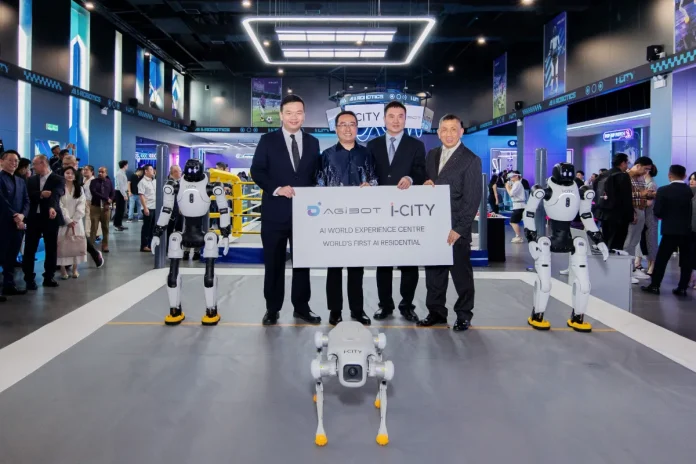
“Just as connectivity defined how cities functioned 25 years ago, AI and robotics will define how we work, live, and interact with our environment in the years ahead,“ he said at the launch of AgiBot AI World Experience Centre, in i-City here today.
AgiBot, a Chinese robotics technology company, established the centre in partnership with I-Bhd, the master developer of i-City.
As a part of the strategic alliance, AgiBot’s robotics and embodied AI are deployed across property, hospitality, tourism and day-to-day urban life in i-City, Malaysia’s leading digital city.
In parallel, the collaboration introduces a strong focus on human wellness and longevity, where AI and robotics are applied not only to productivity and automation, but also to health optimisation and quality of life.
AI World represents the first stage of a broader, long-term partnership between AgiBot and I-Bhd.
“We are deeply honoured to be working with AgiBot on this journey. The opening of the AI World Experience Centre is not merely a launch event; it marks the first chapter of a much larger vision,” Lim said.
He said this milestone also marks the start of ICT’s transformation into an AI- and robotics-enabled urban ecosystem, with the development of its first AI- and robotics-integrated residences, targeted for completion in 2030, and conceived from the ground up to seamlessly embed these technologies into everyday home life.
“Our vision is simple yet ambitious: to create a living, breathing urban system where technology genuinely serves its people.
“With AgiBot as our partner, we believe ICT can become the world’s first fully integrated AI and robotics urban centre, and we extend our congratulations to AgiBot on this brand launch, along with our appreciation to all partners and stakeholders who share this journey with us,“ Lim said.
Last year, AgiBot reached several major milestones that underscored its leadership in humanoid robotics and embodied intelligence. Achievements include rolling out its 5,000th mass-produced humanoid in December, demonstrating industrial-grade manufacturing capability and large-scale commercial readiness.
AgiBot also advanced embodied AI through real-world reinforcement learning, enabling its robots to be trained and deployed directly in physical production environments.
AgiBot founder, chairman and CEO Deng Taihua said the company made significant strides in improving mass production and the practical use of embodied robotics last year.
“This was capped off at the end of last year when we rolled out our 5,000th mass-produced humanoid robots. This milestone, along with others, puts AgiBot in a strong position as we start 2026. Today’s AgiBot launch event in Malaysia is an example of our commitment to bring mass production and the practical use of embodied robotics to customers in this region.”
AgiBot’s robots are focused on eight key commercial applications, including reception and hospitality, entertainment and commercial performances, industrial intelligent manufacturing, logistics sorting, security inspection and patrol, data collection and training, scientific research and education.
Through widespread adoption across multiple industries, AgiBot brings the potential of embodied AI to reality by driving industrial upgrades, transforming service and production processes, and supporting broader digital transformation efforts.



