



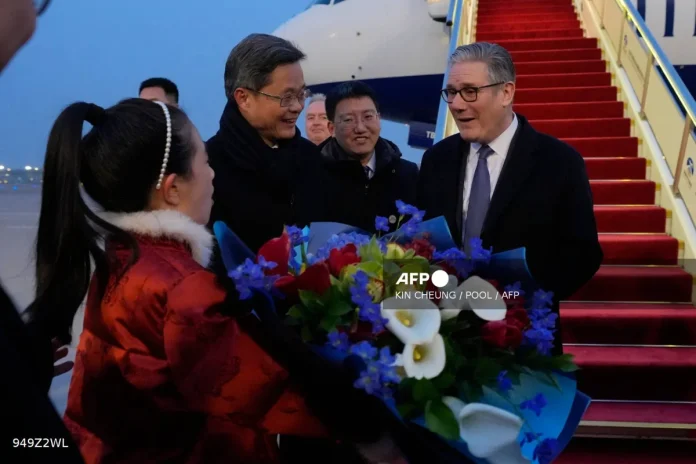
Britain and China sign an agreement to curb Channel migrant smuggling and combat synthetic opioid trafficking
BEIJING: Britain and China are set to sign a cooperation agreement targeting the supply chains used by migrant smugglers.
The deal, announced by Downing Street, will focus on intelligence sharing and direct engagement with Chinese manufacturers of boat parts.
It aims to ensure these components are not exploited by organised crime groups facilitating Channel crossings.
More than half of the small boat engines used by people smugglers crossing the English Channel are manufactured in China, according to a British government statement.
The agreement also seeks to boost cooperation on combatting the trafficking of synthetic opioids like nitazenes, known to be produced in China and exported to the UK.
Prime Minister Keir Starmer arrived in Beijing for the first visit by a British prime minister to China since 2018.
He is seeking to promote what he called a “pragmatic” partnership with the Asian giant after years of fraught relations.
The issue of irregular migrants is highly sensitive for Starmer, who has promised to crack down on people smugglers.
Last year, nearly 42,000 migrants landed on England’s southern coast after making the perilous Channel crossing from northern France.
Starmer told a delegation of business and cultural leaders accompanying him that “it is in our national interest to engage with China.”
He urged them to seize the “opportunities” offered by China and said the visit was “making history.”
The two leaders are due to meet for lunch in Beijing, when Starmer will also sit down with Premier Li Qiang.
The trip has been lauded by Downing Street as a chance to boost trade and investment ties while raising thorny issues such as national security and human rights.
Starmer follows a string of Western leaders courting Beijing in recent weeks, pivoting from a mercurial United States.
Britain has faced a rift with its closest ally following President Donald Trump’s bid to seize Greenland and his brief threat of tariffs against the UK and other NATO allies.



