



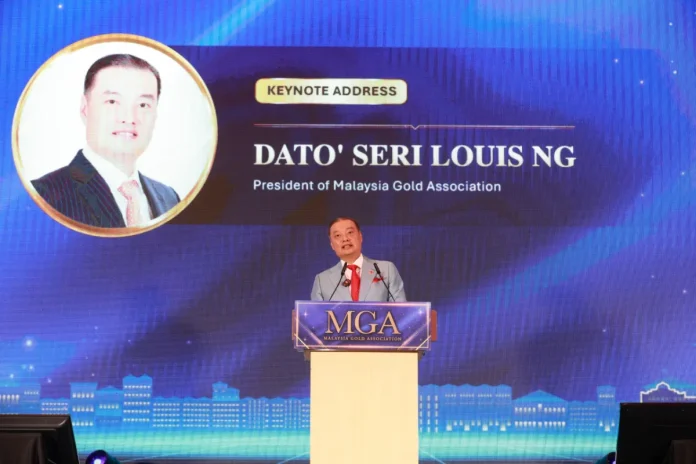
KUALA LUMPUR: Malaysia is on a trajectory to become a global physical gold trading hub, supported by government policies, integrated precious metals ecosystem and the upcoming industry governance framework, Malaysia Gold Industry Principles (MGIP).
Malaysia Gold Association (MGA) president Datuk Seri Louis Ng said, Malaysia is structured, capable and future-oriented to position itself as a key player in the global gold market.
“The precious metals industry is expanding rapidly and currently employs about 250,000 people nationwide. Our government is always setting the right policies for the healthy growth of the precious metals industry in Malaysia, especially the gold sector,” he said at the Malaysia Gold Conference 2026 here today.
Ng said these policies include zero import and export duties on gold bullion, no domestic consumption tax on investment-grade gold bars, as well as efficient and transparent customs processes.
“These features make Malaysia a cost-effective and efficient market for refiners, traders, jewellery manufacturers, logistics providers and investment institutions,” he said, adding that Malaysia’s gold and precious metals industry aligns its practices, quality controls and trading systems with international standards that are already trusted by global investors, refiners and institutions.
He emphasised that Malaysia actively participates and trades in compliance with London Bullion Market Association (LBMA) Good Delivery standards, Shanghai Gold Exchange (SGE) standards and UAE Good Delivery.
Ng said Malaysia has built a complete, end-to-end precious metals ecosystem, from upstream to downstream, all operating within the country and aligned with international standards. “Malaysia is among the few countries in the region with a fully integrated precious metals value chain, spanning upstream mining, refining and bullion minting, as well as jewellery design and manufacturing.”
He noted that the ecosystem encompasses wholesale and regional distribution, a strong retail network, micro-financing including syariah-compliant pawnbroking, as well as responsible recycling and metal recovery.
“This comprehensive capability differentiates Malaysia from well-known global financial centres such as Hong Kong, Singapore, Dubai, Switzerland, London and New York,” Ng said. “It demonstrates that Malaysia possesses a complete and mature ecosystem, something that is difficult to find elsewhere.”
Malaysia, he said, already has international credibility and leadership in Islamic finance, and this gives it a natural advantage in developing syariah-compliant gold and precious metals products.
“Malaysia is internationally recognised as a world-class halal certification leader, a pioneer in Islamic finance governance, a global reference for syariah-compliant investment structures and a long-standing leader in standard-setting.”
To strengthen syariah compliance within the precious metals industry, Ng said, Malaysia has established the world’s first institutional Syariah Advisory Board dedicated specifically to the sector, under the auspices of MGA.
“This initiative positions Malaysia as the global hub of choice for syariah-compliant precious metals solutions.”
Ng said MGA will introduce MGIP to enhance and strengthen the country’s gold trading landscape, amid rising gold prices and heightened regulatory scrutiny.
He noted that enforcement authorities recently conducted raids on certain gold shops found to have quality compliance issues.
“With MGIP in place, one of the key modules will focus on quality control and member compliance. Although participation in MGIP is voluntary, it will set clear standards for responsible practices,” he said.
Participating retail outlets are expected to display an MGIP logo or certification mark to indicate compliance.
“This will gradually help shape a more trustworthy and transparent gold trading ecosystem for the nation,” Ng said.
MGIP was developed in collaboration with key industry players and inspired by international best practices.
The framework references the World Gold Council’s Retail Gold Investment Principles, as well as regulatory models from India, the UAE Bluebook and relevant Sirim standards, and covers eight key areas.
“MGIP will serve as the foundation for self-regulation within Malaysia’s gold industry to ensure responsible sourcing, ethical practices, transparency and anti-fraud protection,” Ng said, adding that it also emphasises product integrity, anti-counterfeiting controls and alignment with global compliance expectations, providing stronger protection for consumers and investors.
MGIP is also expected to support the expansion of Malaysia’s jewellery manufacturing and export sector into developed markets. “In addition, this initiative can stimulate the growth of syariah-compliant gold investments, digital gold and innovative financing models,” Ng said.
He added that deeper alignment with global institutions such as LBMA, SGE, Dubai Multi Commodities Centre and UAE Good Delivery will position Malaysia as a regional centre for certification, education and gold industry technology.
The MGIP is scheduled to be published and launched in the third quarter of this year.



