




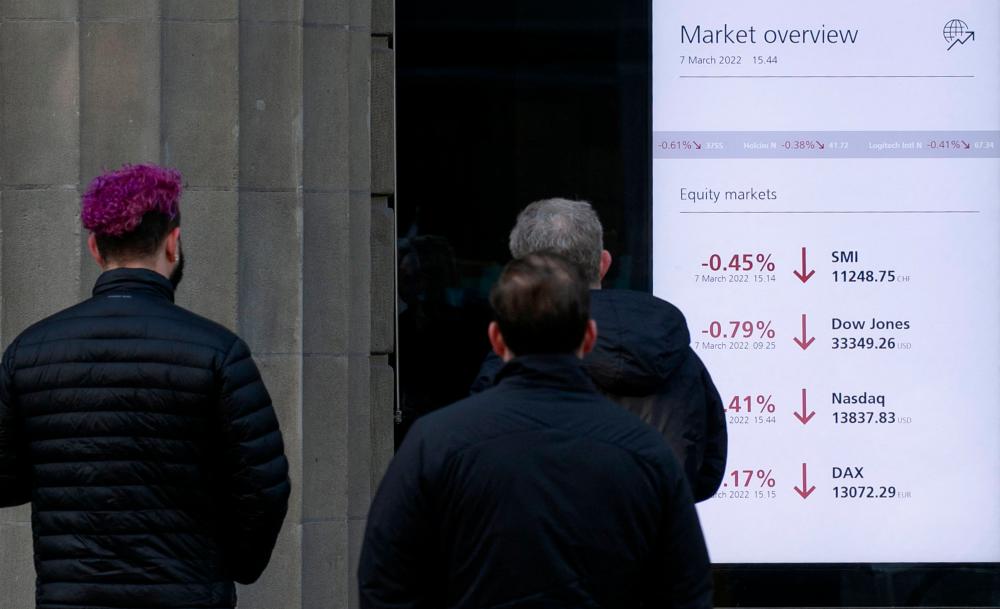
LONDON/NEW YORK: Global financial stocks tumbled yesterday on mounting investor fears about the potential for economic damage and pressure on consumer spending as the price of oil soars following Russia’s invasion of Ukraine.
Lenders, investors and payment companies with links to Russia have been cutting ties to the country. These moves come amid Western sanctions against Russia. While United States sanctions have been aimed at limiting the flow of Western money and damage Russia’s economy, Ukraine has called for the boycott of Russian energy exports.
Deloitte and EY said yesterday they would sever links with Russia, mirroring moves by fellow Big Four accounting and consultancy firms KPMG and PwC. These firms audit blue-chip company accounts and their work is often key to businesses obtaining international investor backing.
European asset managers Carmignac and Fidelity International said they would not buy Russian securities.
S&P 500 banks fell 4.8% yesterday and the broader S&P 500 financial sector closed down 3.7% as the yield curve – the difference between longer- and shorter-dated US Treasuries – narrowed, suggesting pressure on US banks’ profitability. The bank index has fallen more than 10% since the conflict escalated on Feb 24.
Another consideration for bank investors could be the dilemma over whether to keep business ties with Russia. Closing shop could be an arduous and costly process, according to banking sources and experts.
Shares in US payment companies tumbled yesterday with American Express Co closing down 8.0% after it said on Sunday it was suspending all operations in Russia and Belarus, joining Visa Inc, which fell 4.8% and Mastercard Inc which fell 5.4% after their similar announcements the previous day, as well as payments company PayPal Holdings Inc, which fell 6.3%.
Investor concerns about the global economy have been exacerbated by signs of rising prices at the petrol pump over the weekend. The United States and Europe said they were mulling a Russian oil import ban, which could further stoke energy prices and inflation and dampen any recovery.
“You’re starting to hear more of the drumbeat from investors about the possibility of a recession due to inflationary conditions,” said R.J. Grant, head of trading at Keefe, Bruyette & Woods in New York.
“The market needs some sort of near-term resolution with the Russia-Ukraine conflict because there is too much uncertainty in the macro picture for folks to get comfortable putting money to work.”
Shares in other financial companies were also slammed yesterday due to fears about consumer spending. Capital One Financial finished down almost 7% and Discover Financial closed down 8%. Discover said at a conference last week that the conflict should have virtually no impact on its fundamentals, according to an event transcript.
However, strategists at JPMorgan were advising clients to pick up some beaten-down Russian assets on the cheap, touting the bonds of Russian companies that are not on the sanctions list and have significant international operations as the best way to profit from distressed pricing.
Russian bond prices have fallen to record lows since Moscow invaded Ukraine as investors fret over their ability to pay as a result of coordinated Western sanctions.
JPMorgan said in a statement yesterday that Russia will be excluded from all of the bank’s fixed income indices from March 31.
JPMorgan had placed Russia on index watch on March 1 after sanctions were imposed on the country.
The Wall Street bank runs the widely followed family of sovereign hard-currency indices EMBI, as well as a corporate debt counterpart CEMBI. It also has the GBI-EM benchmark for local debt in emerging currencies and the JESG index governed by environmental, social and governance (ESG) factors.
Russia will be excluded from the EMBI indices, including the investment grade and other credit bucket sub-indexes, the bank said.
Local-currency denominated Russian bonds will be excluded from the GBI-EM indices and accrued interest for such bonds will be set to zero and suspended as of March 7, it said.
Russia and Belarus will be excluded from the JESG EMBI, JESG GBI-EM, and JESG CEMBI indices, it added.
Global assets worth US$842 billion (RM3.5 trillion) are benchmarked against JPMorgan’s indices, according to the bank. Russia has a weighting of 0.89% in the EMBIG Diversified index, and a 1.03% weighting in the ESG version of the index.
Russian banks targeted by sanctions have been scrambling to adapt. VTB’s consumer digital bank in Europe has turned off its phone lines due to high call volumes, according to a notice on its website yesterday.
France’s Credit Agricole, said its exposure to Russia and Ukraine, was around €6.4 billion (RM29 billion) in on and off balance sheet items but that this would not impact distribution of its 2021 dividend.
Swiss banking giant UBS, in its annual report, had pegged its direct exposure to Russia at US$634 million for the end of 2021. It said the exposure had been reduced since, but could be affected by sanctions.
The eurozone banking share index closed down 4.1% yesterday after dropping by as much as 9.6% to a 13-month low earlier, before paring losses.
Shares in lenders with operations in Russia suffered with Austria’s Raiffeisen, Italy’s UniCredit and France’s Societe Generale falling in the double-digit percentage range early yesterday although they regained ground later. – Reuters



