




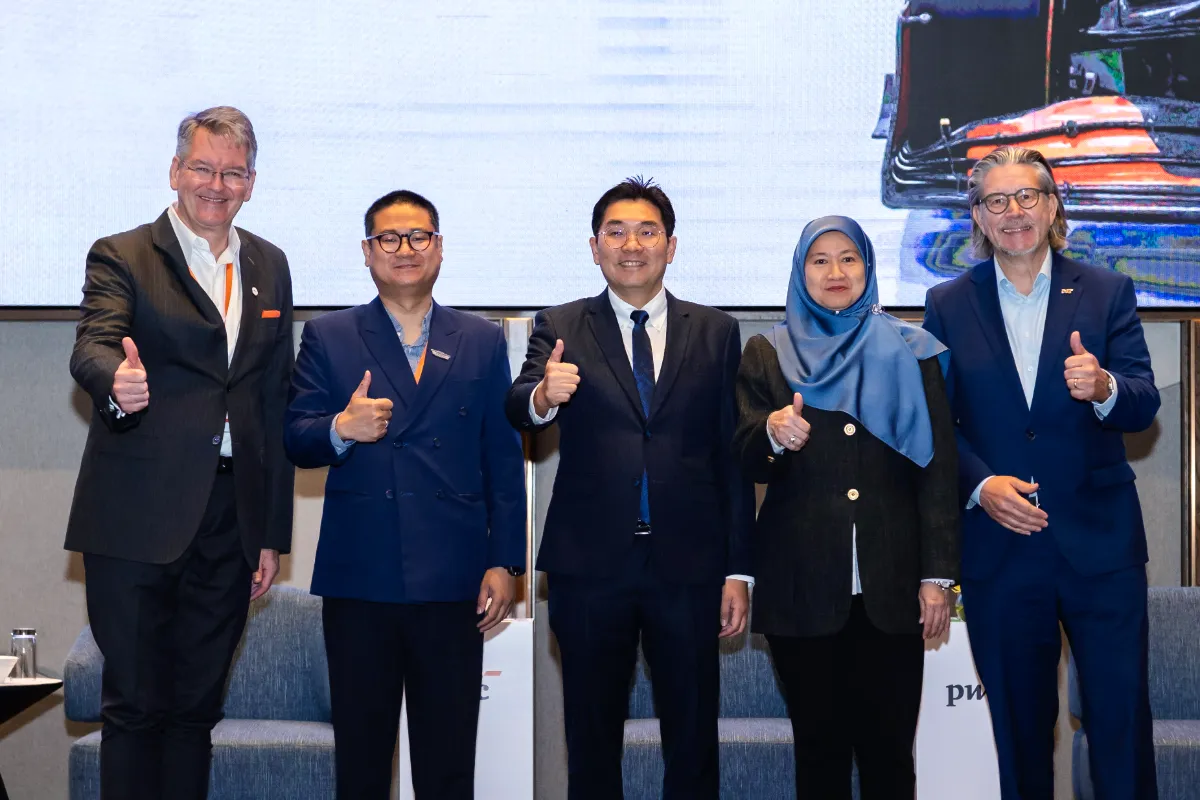
PETALING JAYA: Malaysia is stepping up efforts to position itself as a regional electric vehicle (EV) manufacturing hub, with the government encouraging global original equipment manufacturers (OEM) to tap into the country’s underutilised contract manufacturing capacity.
Investment, Trade and Industry (Miti) Deputy Minister Sim Tze Tzin said Malaysia’s automotive ecosystem is ready to support the growing wave of EV and battery electric vehicle (BEV) brands entering the market, particularly through partnerships with local assemblers and manufacturers.
“The government welcomes OEMs to come here and set up local assembly lines. We already have contract manufacturers with sufficient capacity to work together with them,” he told reporters at the sidelines at PwC Malaysia’s 2nd Asean Automotive and Mobility Conference today.
Sim said the government’s policy aims to attract more EV, BEV and hybrid vehicle players to localise their operations in Malaysia, either through joint ventures with established local firms or by setting up their own facilities.
He pointed to companies such as Inokom Corporation Sdn Bhd and DRB-HICOM Bhd as among the contract manufacturers capable of supporting international brands seeking a foothold in the country.
“We hope they come here, localise, and partner with local companies or contract manufacturers. That will help them offer vehicles at more competitive prices,” Sim said.
At the same time, he stressed that foreign automakers are also free to establish their own manufacturing operations if they prefer not to work with local partners.
Addressing concerns over whether Malaysia has enough industrial capacity to meet rising EV demand, Sim said the country remains well-positioned to absorb new investments. “Our contract manufacturers are currently operating at around 70% capacity, so there is still room for expansion. I think we have enough capacity for all brands to come in and collaborate with us.”
He added that the government is not favouring any particular EV brand, amid concerns that Malaysia’s RM200,000 minimum price threshold for fully imported EVs could restrict consumer access to more affordable foreign models.
Sim said Malaysia’s push to attract more EV makers is not simply about bringing in new brands or protecting local car companies, but about strengthening the country’s wider automotive supply chain and manufacturing ecosystem.
Foreign OEMs looking to enter the mass-market EV segment can lower costs by working with Malaysian contract manufacturers and suppliers. “If they want to price vehicles between RM100,000 and RM200,000, they can work together with contract manufacturers here and produce those models locally,” he said, describing the segment as the ‘mass-market EV’ space.
Sim said the government’s broader objective is to encourage deeper collaboration between foreign automakers and Malaysia’s existing automotive ecosystem, rather than focusing on individual companies.
“We want OEMs to collaborate with our local vendors and our local ecosystem. A lot of people think the government is trying to protect certain local manufacturers, but the objective is much bigger than that. We want overseas car manufacturers to help build our ecosystem.”
Malaysia already has a sizeable automotive vendor base, including between 150 and 180 Tier 1 vendors, as well as about 640 Tier 2 and Tier 3 component and parts manufacturers, Sim said.
The government hopes that greater participation by foreign EV players will help local suppliers improve their technical capabilities and move further up the value chain.
“We want foreign manufacturers to collaborate with them so they can enhance their capabilities, move the value chain up, and prepare Malaysia to become a components and parts exporter in the future,” Sim said.
He added that the long-term goal is also to prepare the local industry for next-generation technologies, including autonomous vehicles.
“That is the objective – to lift the whole ecosystem. The ecosystem is not serving just two companies. It is not only about Perusahaan Otomobil Kedua Sdn Bhd (Perodua) or Proton Holdings Bhd,” the deputy minister said.
Sim said Malaysia’s biggest opportunity in the EV transition lies in semiconductors, an area he believes is often overlooked in discussions of the automotive industry.
“Previously, people only viewed cars as vehicles. In the internal combustion engine (ICE) era, cars used very few semiconductor chips. But EVs, battery electric vehicles, plug-in hybrid electric vehicles and future autonomous vehicles require thousands of chips. This is where Malaysia has the greatest opportunity in Asean.”
According to Sim, Malaysia already has a strong semiconductor ecosystem spanning the full supply chain, including integrated circuit (IC) design, wafer fabrication, assembly and testing. “We have upstream to downstream capabilities. We have IC design, fabs, assembly and test. We hope to build the entire value chain for automotive chips here.”
Sim pointed to the global chip shortage during the Covid-19 pandemic as an example of Malaysia’s importance in the sector.
“If you remember, during Covid, the global automotive industry faced shortages partly because of disruptions in chip production in Malaysia,” he said, citing operations by STMicroelectronics, a leading European multinational semiconductor contract manufacturing and design company based in Muar, Johor.
“That is why we want more foreign car manufacturers to collaborate with Malaysia, especially in semiconductors. Our objective is to strengthen the entire ecosystem through these partnerships,” he added.
Sim also said Malaysia has yet to begin discussions on autonomous driving, but stressed that preparations need to start now as the technology is advancing rapidly worldwide.
“Autonomous driving will involve major changes across the entire ecosystem,” he said. “It is not just about manufacturing cars. It involves chips, software, sensors, and new engineering capabilities.
“Our local vendors will need to upgrade their skills, while authorities such as local councils and the Public Works Department will also need to improve road infrastructure, signage and related systems. This is a whole-of-nation effort.”
Sim said autonomous driving adoption is accelerating globally, particularly in the United States, where deployment is expanding rapidly. One of the priorities now is to establish an organisation or platform to begin coordinating standards, industry readiness and broader policy discussions on autonomous mobility.



