




Table of Contents
Malaysian workers are embracing AI faster than organisations can adapt, creating a growing gap between capability and workplace readiness
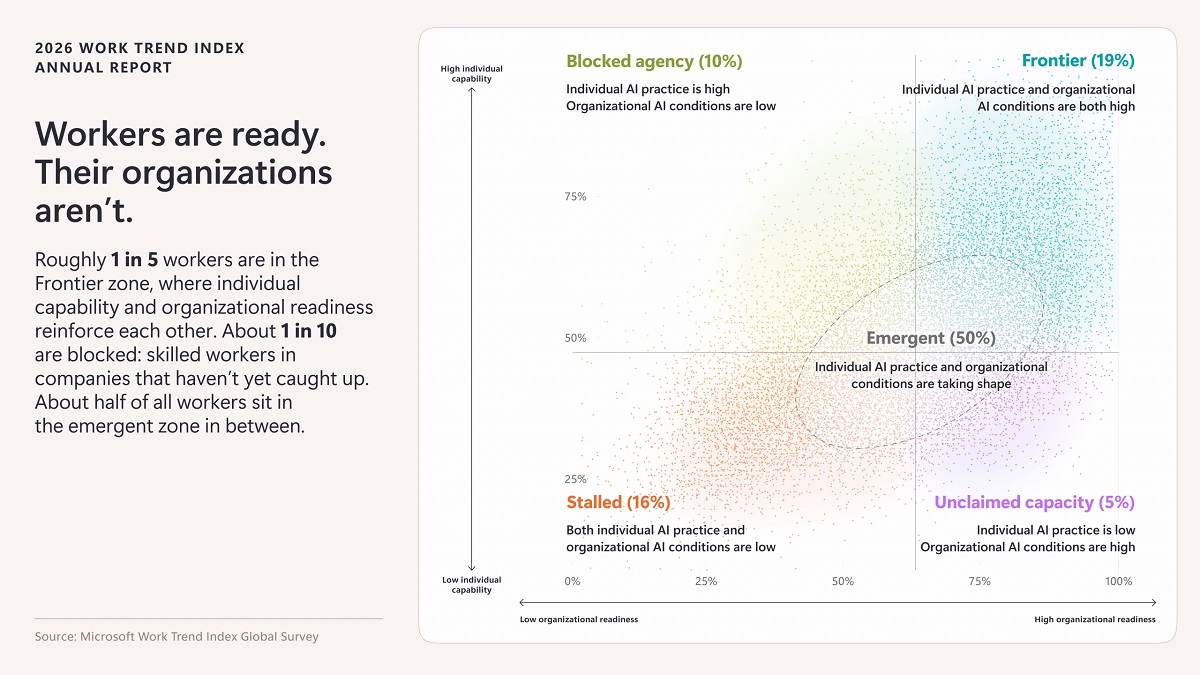
Outpacing the global average in advanced artificial intelligence (AI) adoption, nearly 25% of Malaysian workers are already emerging as “Frontier Professionals” compared to just 16% globally. However, as it turns out, employees are moving so fast forward that their organisations are struggling to keep up.
Essentially, Malaysian workers are adopting it in more advanced ways, producing higher value work and reshaping how work gets done as leadership alignment and workplace systems struggle to keep pace, according to Microsoft’s 2026 Work Trend Index.
It further highlights the fundamental shift that when AI agents take on more execution, human agency expands with it, giving people more room to direct work, make judgments and own outcomes.
The constraint then is not incumbent on individual capability, but rather how work is designed around people, teams and systems.
AI lifts the ceiling
The study was conducted by analysing trillions of anonymised Microsoft 365 productivity signals and surveyed 2,000 full-time employed and self-employed knowledge workers in Malaysia and revealed Malaysian workers are showing a more mature relationship with AI, one where productivity gains are balanced with accountability, capability-building and judgement.
Rather than replacing human judgment, it is reshaping it. 92% of AI users in Malaysia said they treat its output as a starting point instead of the final answer and they still stay responsible for the thinking.
These workers are not only adopting it quickly but also using it in more sophisticated ways to analyse information, solve problems, evaluate and think creatively.
That capability is translating into tangible outcomes: 69% of Malaysian users said they are producing work they could not have created a year ago, rising to 80% among Frontier Professionals.
However, Frontier Professionals in Malaysia also refuse to outsource their thinking to the machines.
Compared with non-Frontier Professionals, they are more likely to deliberately do some work without it to keep their skills sharp (42% vs 33%) and more likely to pause before starting work to decide what should be done by a human versus an AI (57% vs 39%).
Leaders to rearchitect work
While employees are moving quickly, the research showed leadership and organisational systems are struggling to keep pace. Globally, only 19% of organisations fall into the Frontier category, where individual AI capability and organisational readiness are high.
Meanwhile, the majority of organisations sit in an “emergent” stage, where the tech adoption is underway but individual capability and organisational conditions are still taking shape.
In Malaysia, the gap is particularly visible. Only 32% of users in Malaysia said their leadership is clearly and consistently aligned on AI. Even fewer, just 19%, said they are rewarded for reinventing how work gets done when those efforts do not immediately produce results.
This creates something Microsoft calls “Transformation Paradox’, where employees feel pressure to adopt the growing tech quickly to keep up but the systems around them in terms of metrics, incentives and norms continue to reinforce the old way of working.
Every firm is a learning system
The strongest signal from the 2026 Work Trend Index is that organisational factors matter more than individual behaviour. Culture, manager support and talent practices account for more than twice the AI impact of individual mindset and usage.
Frontier Firms do this by focusing on their absorption and not just adoption by redesigning how work gets done and turning output into insight.
When those insights are captured, shared and embedded into everyday operations, they become Owned Intelligence: institutional knowledge, processes and standards that compound over time and are hard to replicate.
This is where Frontier Professionals stand out. They are more likely to report that agent workflows, human handoffs and quality standards are documented and repeatable compared with non-Frontier Professionals (26% vs. 18%). By turning individual progress into shared practice, Frontier Firms build learning systems that scale and gain a competitive advantage.
As AI becomes an execution layer across work, competitive advantage will belong to leaders who redesign how work gets done and to organisations that empower people to learn, adapt and lead alongside it.
Turning that shift into sustained impact requires systems that bring people and AI agents into the same flow of work, supported by connected data and clear governance.



