



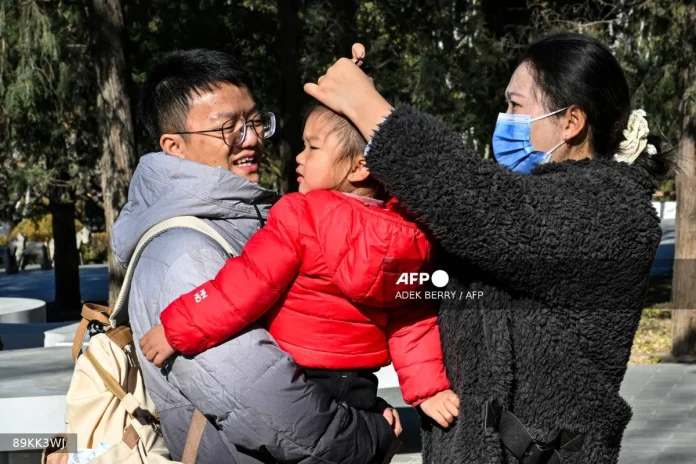
Young Chinese couples resist pressure to have children, citing high costs and career focus, as the nation’s birth rate continues to decline sharply
BEIJING: Young couples in China are increasingly choosing to remain child-free, resisting societal pressure as the country struggles to reverse its declining birth rate.
A decade after replacing its one-child policy with a two-child rule, China faces a looming demographic crisis with a population shrinking for three consecutive years.
The United Nations projects China’s population could fall from 1.4 billion to 633 million by 2100.
Only 9.54 million babies were born in China in 2024, half the number recorded in 2016, as couples move away from traditional family norms.
More young people now identify as DINKs, or “dual income no kids”, either swearing off children entirely or delaying parenthood for years.
Their reasons range from prohibitive child-rearing costs to intense career concerns.
Grace, a 25-year-old content creator, said she needs a decent income and substantial savings before considering starting a family.
“If I were to widely publicise the fact that I’m a DINK and talk about how comfortable my life is, there would definitely be many people who wouldn’t be happy about it,” she told AFP.
Chinese authorities have rolled out pronatalist incentives, including subsidies for parents and a value-added tax on contraceptives.
Experts say China still faces significant hurdles in boosting its birth rate after being overtaken by India as the world’s most populous nation in 2023.
“The number of people choosing not to marry or not to have children is increasing, and fertility intentions among the younger generation are weak,” independent demographer He Yafu told AFP.
Associate Professor Pan Wang from Australia’s University of New South Wales said the one-child policy fundamentally reshaped family norms and lifestyles.
“The one-child policy fundamentally reshaped family norms and also people’s lifestyles, because many people, especially the one-child generation, were used to and often prefer smaller family sizes,” Wang told AFP.
Rising living costs and economic uncertainty continue to deter childbearing, she added.
Beijing resident Wang Zibo, 29, said he and his wife are waiting for the economy to stabilise before having children.
“Looking at things in China right now, the main reason (why young couples are not having children) is still that the economy is somewhat weak,” he told AFP.
Many employees work long hours under a gruelling “996” culture, from 9am to 9pm, six days a week, leaving little time to consider starting a family.
China relaxed its controls further in 2021 to allow three children, but many urban couples remain reluctant.
Demographer He warned that a persistent fertility rate of around 1.0 will lead to a continued population decline and rapid ageing.
“This will increase the future burden of elderly care, weaken China’s overall national strength, and drag on economic development,” he added.



