




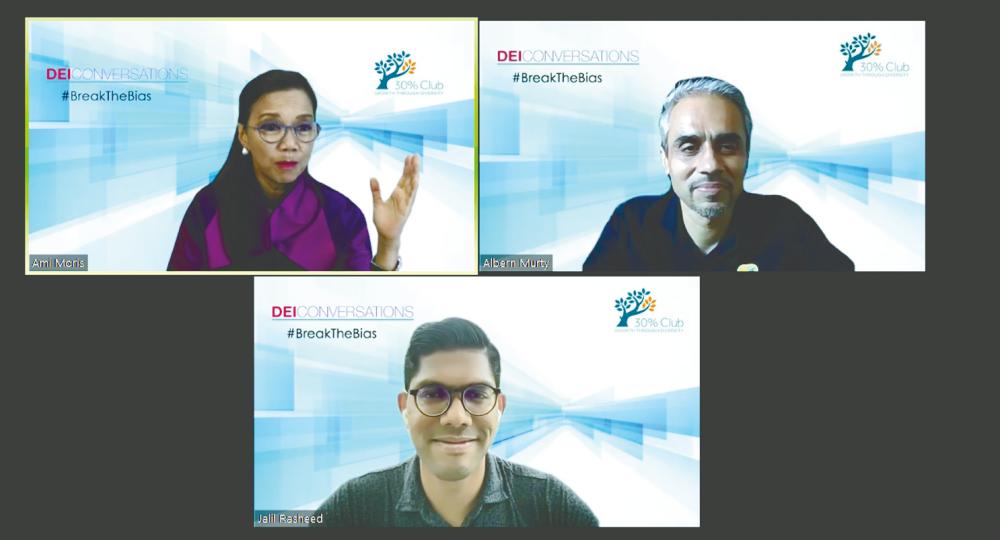
PETALING JAYA: Choice of words and unconscious bias are parts of complex corporate decisions in a social setting that influence how women are appointed to boards of directors, according to Berjaya Corporation Bhd CEO Jalil Rasheed.
Jalil advised people to be mindful of words used in the workplace and said there is a need to change behaviours to move away from biases.
“(On words used, for example) it is difficult to tell people to not use the word ‘bro’ at work. (To transform) it involves a lot of education. As a leader, the words that I use are very important.
“When I was a fund manager, I used to ask this question – ‘how do you appoint people to the board?’. We need to have a structured way to how we analyse that,” he told a panel discussion on “Men-Who-Pause, #BreakTheBias” at the 30% Club Diversity, Equity & Inclusion Conversations: Elevating Investability yesterday.
Jalil said the reason only 10% of businesses in Malaysia are run by women chief executive officers or managing directors is the one-dimensional approach towards getting women on the board.
“When it comes to getting women to be involved, for example, from my discussions (with the board) previously, consumer products companies must get someone with consumer products experience. That whittles down the talents considerably and I do not agree with that.
“You need to be asking the right questions to bring a person on board. One does not need to be a consumer specialist knowing how everything works. You just need to be asking ‘why are we doing this?’. This is an opportunity to broaden the spectrum of female talents on the board. There needs to be a rethink about how we look at that from an experienced perspective,” he said.
Jalil said Malaysian companies need to move out from the chock-a-block approach on female directors’ appointments.
“That is where this whole topic of male allies should come in. We need to be supportive and I am a big fan of male mentorship. (For instance) I purposely pair a female (manager) on the verge of being promoted to C-suite with a male so that they understand how each other operates and also the male worker can break his biases as well. Over time, this will become a culture across the organisation.
“We have 57% of female directors on the board, 50% of senior management are female, 49% or 10,000 of our total workforce are female. Naturally, we have built a culture where we do not (stereotype) male and female (employees and directors). We have done that quite well,” he said, adding that companies with a diverse composition do much better.
Jalil said the board’s make-up must be people who can ask the right questions rather than people who are trying to get involved in the business operations.



