




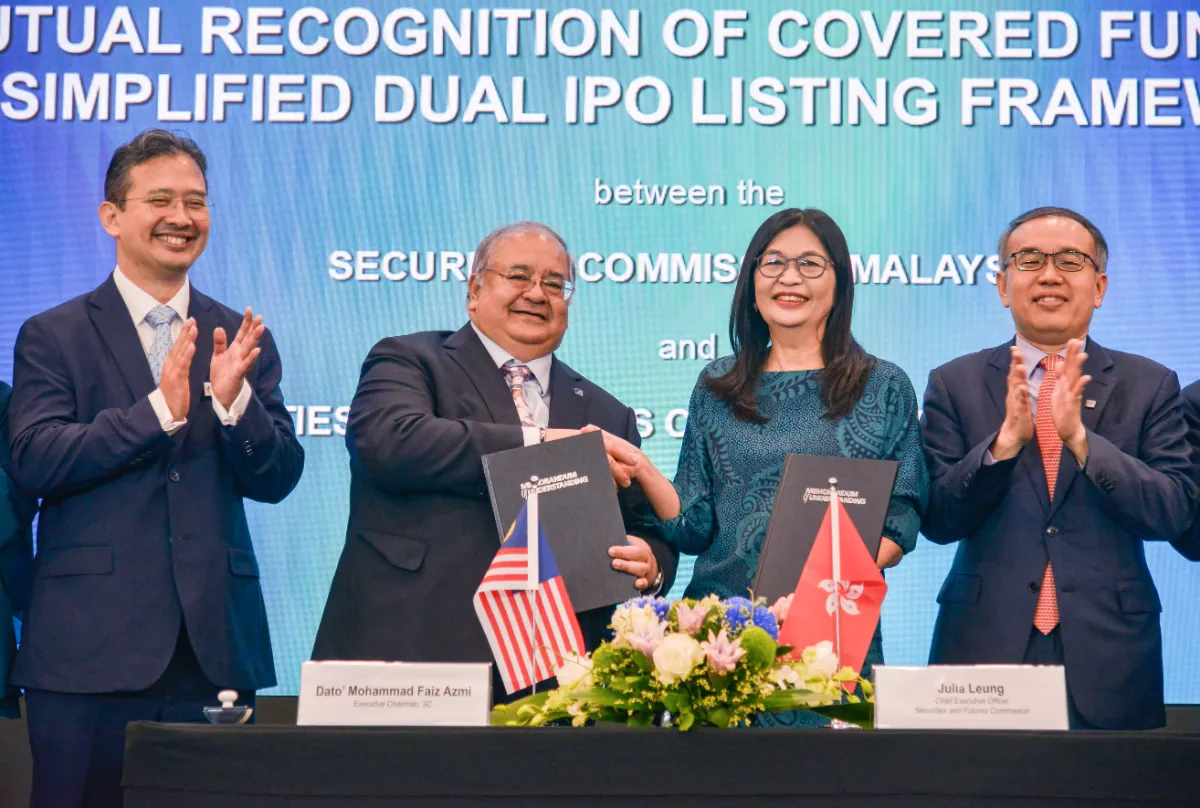
KUALA LUMPUR: Malaysia sees its capital market partnership with Hong Kong as a catalyst for developing more high-value industries, attracting international investment and expanding financing options for homegrown companies.
Treasury Secretary-General Tan Sri Johan Mahmood Merican said the collaboration comes as Malaysia advances structural reforms under the Madani Economy framework to strengthen its macroeconomic performance and transform its economy.
“We recognise Hong Kong as a top leading financial centre in the world. With more high-tech, high-growth, high-value companies, certainly access into Hong Kong capital markets is a very important gateway, particularly for the sort of companies that we do want to grow in Malaysia,“ he said at a memorandum of understanding (MoU) signing ceremony between the Securities Commission Malaysia (SC) and the Hong Kong Securities and Futures Commission (SFC) today.
The MoU paves the way for a framework to facilitate dual initial public offering (IPO) listings between Malaysia and Hong Kong, while also collaborating on mutual recognition and cross-listing of covered funds.
The framework covers investment products such as exchange-traded funds and real estate investment trusts, and is aimed at encouraging greater cross-border investment, broadening access to both capital markets and expanding investment opportunities.
Johan said Malaysia is shifting from its traditional role as a manufacturing and assembly hub towards higher value-added activities such as integrated circuit (IC) design and advanced technology.
“Our ambitions include the electronics sector, which is trying to migrate from what was historically manufacturing or assembly to more design. From the 60 listings that we have, including SkyeChip, which is into IC design, that reflects the ambition and the transition of the Malaysian economy,“ he added.
Johan said stronger capital market collaboration with Hong Kong would support companies operating in these sectors. “With more high-tech, high-growth, high-value companies, certainly access into Hong Kong capital markets is a very important gateway, particularly for the sort of companies that we do want to grow in Malaysia.”
Malaysia also has ambitious plans in energy transition, including the Asean Power Grid initiative, where large-scale cross-border electricity infrastructure would require significant capital, Johan said.
“These are large green energy infrastructure projects which again would benefit from deepening capital market collaborations to support this growth. I think that complementarity with the economic ambitions and the ability to leverage on Hong Kong as a global financial centre certainly is one that will help our economic ambitions.”
He added that closer ties would not only benefit companies seeking to raise capital, but also investors.
“Beyond that, even just for the Malaysian population, to have easy access to a broader set of products … and also the opportunity for Hong Kong to invest in the diversity of companies that we have here,” Johan said.
“I think partnership always works best when there is a win-win proposition, and there’s complementarity in what each of us has to offer.”
Looking ahead, Johan said one of the long-term goals of the partnership is to improve the efficiency of cross-border capital-raising by aligning regulatory requirements between Malaysia and Hong Kong.
The ultimate ambition is for companies seeking dual listings to submit a single application that would be accepted by both regulators, reducing duplication and simplifying the listing process, he added.
“One of the ambitions should be not just cross-listings but being able to even do a single submission that will be accepted by both the regulators. That would be an efficiency that we look forward to, where companies can do one submission and basically simultaneously list,“ Johan said.
The government, he added, has recognised that past investment incentives placed too much emphasis on attracting large capital investments and is now focusing on projects that generate higher-value economic outcomes.
“I think we perhaps overdid the red carpet for data centres. If we just provide incentives based on large capital expenditure, that may not be completely aligned with our national objectives, given that the vanilla data centre does not necessarily offer much in terms of employment or business linkages.”
Johan pointed out that the Ministry of Finance is developing a new investment incentive framework that will assess projects based on broader criteria. “It’s like almost a scorecard that links to whether it contributes to economic complexity, creates higher value-added jobs and strengthens linkages to domestic businesses.”
Financial Services and Treasury of Hong Kong Secretary Christopher Hui said the relationship between Malaysia and Hong Kong extends well beyond finance, underpinned by deep trade and investment links.
He noted that Malaysia is Hong Kong’s third-largest trading partner within Asean, while Hong Kong is Malaysia’s fourth-largest export market. “Last year, in terms of trade volume, we saw more than 27% growth. It’s a testament to the deeply embedded economic partnership between the two economies.”
Hui said changing global economic dynamics are making closer Asian cooperation increasingly important.
“One of the takeaways from Covid is that Asean as a whole already overtook the US as our second-largest trading partner. Among the Asian economies, we trade more among ourselves. We can’t work alone. We have to work together and ensure that we can leverage the advantages and the synergies that can be created among us.”
He described Hong Kong as “a global financial hub” and Malaysia as “a strategic economic hub”, saying the two economies are well positioned to benefit from “the global shift of economic gravity from west to east”.
Hui also highlighted opportunities for Hong Kong to help internationalise Malaysia’s Islamic finance sector. “Malaysia is already very strong in Islamic finance in terms of products, investors and global reach. It’s an area that Hong Kong can facilitate.”
He said Hong Kong currently hosts 29 Malaysian-listed companies with a combined market capitalisation exceeding US$5 billion, while about 120 companies with Malaysian parentage operate in the city based on government estimates.
“I’m sure there are more. It’s just that it’s not being captured in our survey,“ he added.
Hui said the cooperation extends beyond encouraging more listings and investment products to strengthening regulatory and accounting standards.
“Financial centres are built on trust and credibility. Standards and consistency are of paramount importance. The connectivity is not just at the money level, but also deeper at the regulatory and standard level,“ he added.



