




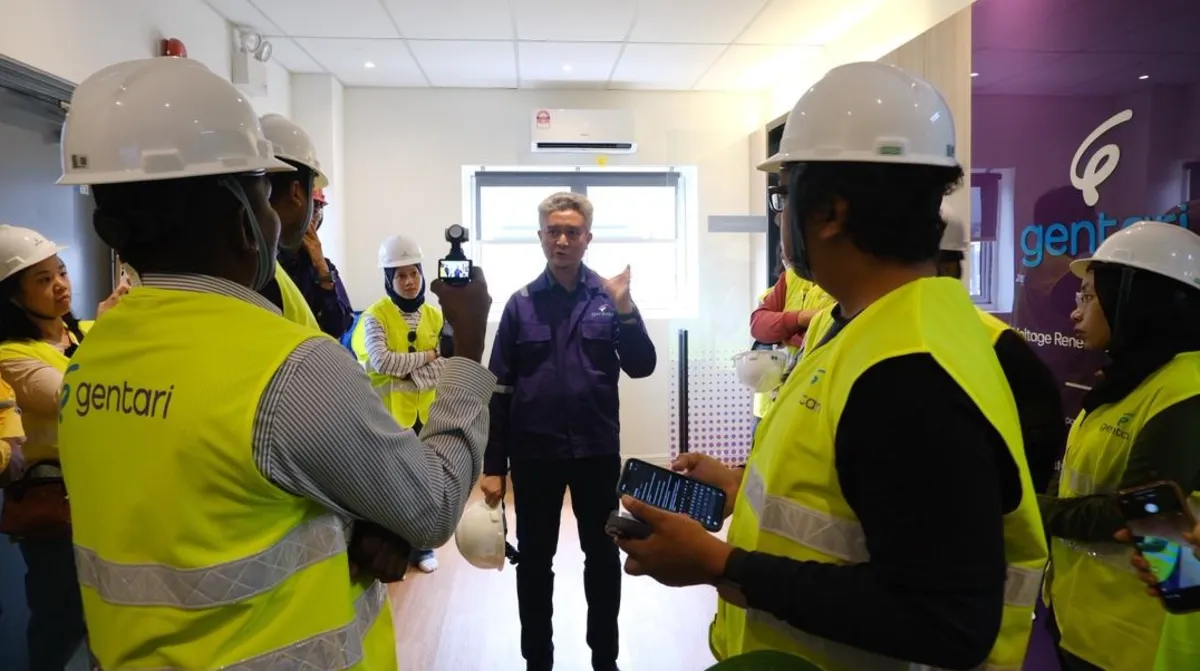
KUANTAN: Gentari Sdn Bhd, the wholly owned clean energy arm of national oil company Petroliam Nasional Bhd (Petronas), is positioning its solar farm in the Gebeng Industrial Area as proof of concept as it scales up its presence in Malaysia’s renewable energy market.
The facility, commissioned in January 2014 under Malaysia’s Feed-in Tariff (FiT) mechanism, comprises 29,960 solar modules spread across 50,569 square metres.
Since commercial operation began, it has generated more than 125 million kWh of clean electricity, the equivalent of reducing an estimated 83,745 tonnes of carbon dioxide emissions and powering roughly 44,147 homes annually.
Gentari head of renewables for Malaysia Syed Malek Faisal Syed Mohamad said that with its FiT contract set to expire in about eight years, Gentari is already planning how to repurpose the site under newer policy frameworks.
“This site is still usable. We can look into other programmes, such as CRESS, or even future programmes that the government will introduce. There is still a lot of potential for this site,“ he said during a media visit to the Voltage Renewables Sdn Bhd (VRSB) facility in Gebeng recently.
To note, the Gebeng Industrial Area in Kuantan, Pahang, became home to one of Malaysia’s earliest utility-scale solar farms a decade ago.
At 10 megawatts, it was notable at the time. Today, though modest by current standards, the project remains significant as an early example of solar deployment in Malaysia, laying the groundwork for an energy transition that is now gaining momentum, driven by stronger policy support and rising demand.
Syed Malek said the emergence of new policy instruments is central to the growth case Gentari is making for Malaysia.
“Beyond the existing Large-Scale Solar Programme under which Gentari is developing a 150MWp (megawatt-peak) facility in Kuala Muda, Kedah, under LSS5, the government has rolled out several mechanisms in recent years designed to pull more renewable energy into the system,“ he added.
CRESS, or the Corporate Renewable Energy Supply Scheme, allows developers to supply green electricity directly to commercial and industrial customers, including data centres.
CREAM, the Community Renewable Energy Aggregation Mechanism, enables aggregated solar generation, for instance, from residential installations, to be channelled to nearby commercial users within a 5km radius.
Solar ATAP or Solar Accelerated Transition Action Programme, the most recently announced scheme, replaces the previous Net Energy Metering Scheme for the residential segment.
Meanwhile, a utility-scale battery energy storage system programme has been introduced to support grid stabilisation as intermittent renewable sources account for a larger share of generation.
“I think from a policy standpoint, the government has started to introduce quite a number of programmes. That encourages even developers like us to do more here in Malaysia,“ Syed Malek said.
However, he acknowledged that grid capacity remains the most pressing near-term constraint on solar expansion.
However, he pointed to Tenaga Nasional Bhd’s (TNB) RM43 billion commitment to modernise Malaysia’s grid between 2025 and 2027 as a signal that the infrastructure bottleneck is being addressed.
“As soon as we have more RE, the grid will be stabilised, and this grid upgrade will enable greater penetration of RE in the total system,“ Syed Malek said.
Gentari’s growth thesis for Malaysia rests heavily on the surge in data centre development and the green energy procurement requirements that hyperscalers bring.
He said TNB has indicated that data centres could require at least five gigawatts (GW) of capacity by 2030, a figure Syed Malek described as transformative for the renewable energy supply side.
“Because of all these hyperscalers, they have certain sustainability targets. A significant portion of their power generation must come from a green source. There is strong demand from that. And with all this strong demand, definitely there will be a lot of growth from the supply side.”
The commercial and industrial segment, served through CRESS, is expected to account for a substantial portion of Gentari’s future project pipeline in Malaysia, with data centres as a major, though not exclusive, component.
Petronas’ own decarbonisation commitments also represent a captive demand base.
Gentari has already installed a 40MW ground-mounted solar facility at the Pengerang Integrated Petroleum Complex in Johor, developed on buffer zone land that would otherwise have remained idle.
“We have about 100MW capacity now that covers Petronas’ property significantly,“ Syed Malek said.
Gentari has accumulated 9.1GW of installed and under-construction renewable energy capacity globally, with India accounting for the largest share at 7.5GW, followed by Australia at 1GW.
Malaysia currently contributes 257MW, with the LSS5 project in Kedah set to add 150MWp upon completion.
Syed Malek said he expects Malaysia’s contribution to grow to between 10% and 20% of Gentari’s total capacity as the company scales activity here, up from less than 3% currently.
“India is the biggest region. But now, with the programmes I mentioned earlier, we can definitely do more projects here in Malaysia. And for that reason, I think we are projecting a much bigger growth,“ he said.
Syed Malek said Gentari’s largest operating solar installation in India is 380MW at a single facility, more than double the size of the 15 MWp LSS5 project under development in Kedah.
India’s policy environment, which allows mechanisms comparable to CRESS, has driven rapid capacity growth, with the country targeting 500GW of renewable energy capacity by 2030.
Solar is expected to remain Gentari’s primary technology in Malaysia, with wind largely ruled out by the country’s low average wind speeds.
Syed Malek said locations in Sabah’s Kudat area have been studied for potential wind development, but that assessments remain ongoing. Offshore wind faces similar speed constraints in Malaysian waters.
Floating solar presents a different opportunity. Gentari is jointly studying a large-scale floating solar project at the Murum Hydroelectric Plant reservoir in Sarawak with Abu Dhabi Future Energy Company (Masdar) and Sarawak Energy, though Syed Malek said the project remains in the feasibility phase.
On a technical level, the Gebeng facility offers a data point on the durability of solar investments.
Panel degradation rates, a key variable in long-term return projections, have improved significantly with advances in module technology.
Where annual degradation once ran at around 0.8%, current technology delivers about 0.45%.
“More than 10 years ago, the technology evolved, and the structure and everything have been optimised for a new design,“ Syed Malek said.
Project returns remain bankable over a 20-year contract horizon, with advances in panel technology and lower annual degradation rates helping to sustain performance over time. “The return will definitely hold for over 20 years, Syed Malek said.
Gentari was established in September 2022 as Petronas’ dedicated clean energy vehicle, with a mandate spanning renewable energy, hydrogen and green mobility.
Its electric vehicle charging network currently covers more than 600 charging points in Malaysia, with roaming access to over 10,000 points across Malaysia, Singapore and Thailand through the Gentari Go platform.
The group’s renewable energy portfolio spans solar and wind assets across Malaysia, India, Taiwan and Australia, with the VRSB facility in Gebeng representing the earliest milestone in a portfolio that has grown considerably since Petronas first commissioned the site.
“This was the beginning, many, many years back. LSS5 is another project that we are embarking on. And, hopefully, we plan to do more here in Malaysia,“ Syed Malek said.
The challenge now is not just building more solar, but ensuring the grid and market structures can keep pace with rapidly rising demand, he added.



