




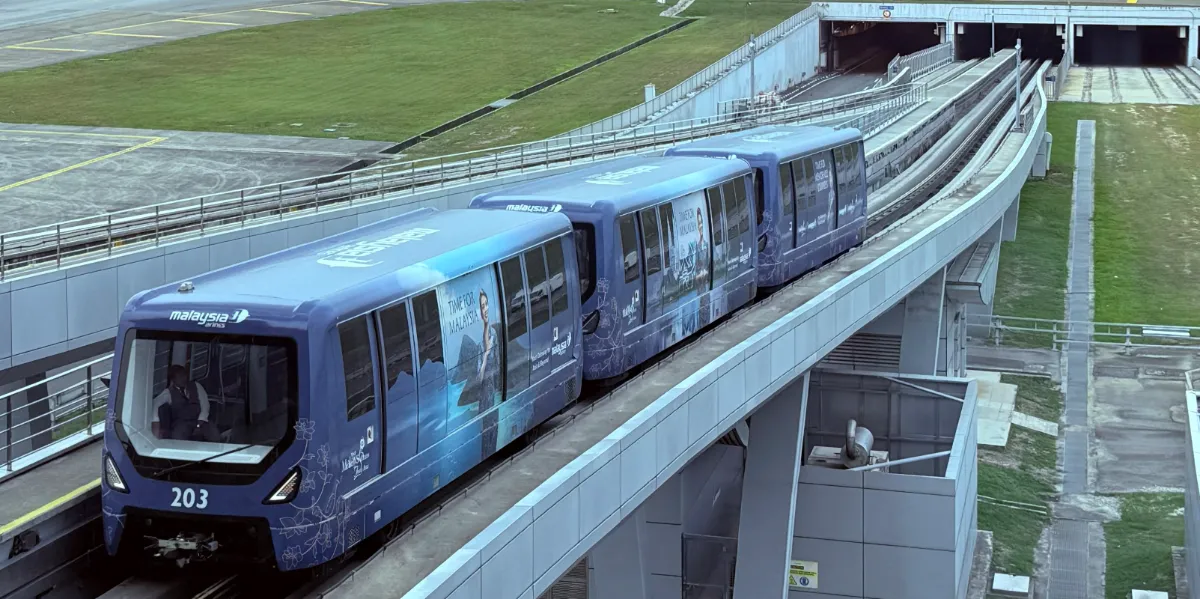
SEPANG: Kuala Lumpur International Airport (KLIA) has restored its Aerotrain to round-the-clock service, the most visible part of a broader push to make the country’s main gateway faster and friendlier to navigate.
The shuttle, which links the terminal to the satellite building, returned to 24/7 service on June 1, after completion of its Comprehensive Action Plan.
Malaysia Airports Holdings Bhd (MAHB) managing director Datuk Mohd Izani Ghani said teething problems are not unusual for a system this new.
“When I spoke to Alstom, the tech provider, they said it’s quite common for the first few months, which I can understand. “But the Malaysian public is not so forgiving,“ he told SunBiz.
MAHB brought in an independent consultant to draw up a comprehensive action plan, which wrapped up recently. The fixes, worked through with contractors Pestec and Alstom, included software upgrades.
“There are certain things we should have done better in terms of implementation,“ Mohd Izani said.
Once the plan closed out the outstanding issues, the Asia-Pacific aviation regulator conducted a final inspection and endorsement and the case went to the Ministry of Transport for sign-off.
The Aerotrain is now back in service 24 hours a day.
A cautious approach has carried into the smallest details, Mohd Izani said, adding that even at midnight, teams were still running scenario tests and simulations so that staff would know exactly how to respond and what to tell passengers if anything went wrong again.
“The SOP (standard operating procedure) is important, the communication is important. It is being trained every time to make sure consistency is there,“ Mohd Izani said.
KLIA has also been reworking how passengers flow through the airport.
One change that has been a win for airlines is a guaranteed 60-minute minimum connecting time for connecting flights between Terminal 1 and Terminal 2.
In practice, Mohd Izani said, the KLIA team has streamlined the process so travellers can make their connection in as little as 60 minutes. “This has benefited airlines a lot. Their ticket sales are better because people don’t have to wait too long.”
Meanwhile, the airport operator has leaned into digital convenience, rolling out online parking at KLIA in February, which received a strong response, as part of a broader move towards a cashless parking system.
Further, there is the introduction of the Butterfly Effect Initiative at KLIA Terminal 1 – a complimentary service designed to support travellers throughout their journey with complimentary access to a Calm Room.
There is a service that Mohd Izani believes sets KLIA apart – support for families travelling with autistic children and others who find airports overwhelming.
He said KLIA staff are trained to help calm children, and there is a dedicated quiet room. Families who register online are given a tag on arrival so they can be identified and ushered through.
“Not many airports provide this. Families with children of this nature really appreciate it, because it eases the travel for them,“ he added.
However, the change passengers may have felt most is at the kerb. In December, after a three-month trial, KLIA introduced the Vehicle Access Management System that reads number plates and grants 10 minutes of free access for drop-offs and pick-ups.
Getting there took months of discussions and, Mohd Izani admitted, political will.
He said MAHB presented its proof-of-concept findings to the Ministry of Transport, down to how long each passenger took to be dropped off or collected. “Ten minutes is more than enough to drop off or pick up someone. By right, it should just be drop-off and pick-up.”
He admitted that the airport had wanted a heftier penalty, since the fee is meant to deter loitering rather than function as parking.
However, Mohd Izani said the ministry capped it at RM100, with the amount applied in stages up to that maximum.
The system has since been extended to Terminal 2, where it is working well, and the early reaction from netizens has been largely positive on the efficiency, with the occasional complaint from drivers who expected more time.
Izani said the kerbside system is one of several ideas KLIA has put through its proof-of-concept route, where new ideas are trialled before being adopted or dropped.
The current trial at Terminal 2 is central screening, which consolidates security checks so passengers can move freely once they have cleared. That proof-of-concept ended in May.
Taken together, Mohd Izani said, the changes underscore the ambition to keep KLIA the most connected airport in the Asia-Pacific region.
Moving on, he said the business around the airport matters as much as the airport itself, and MAHB is now positioning the land surrounding KLIA to attract aviation investments.
The Aeropolis plan had been on the table for years, and the stumbling block was the land lease, which was too short to attract long-term commitment.
Mohd Izani said that changed last year, when the company secured a 99-year lease agreement with the government. “With that now, we have a lot more interest from investors to do MRO business around KLIA.”
The most prominent of those is General Electric (GE). Work is already unde way on an MRO (maintenance, repair and overhaul) facility beside Sepang Circuit, anchored by the GE contract and expected to be completed next year.
Izani hopes it will set the tone for others to follow.
“That will hopefully be a good catalyst for other MRO players to come to KLIA as well,“ he said.
The development is located within Selangor Aeropark, a joint venture between MAHB (through Aeropolis) and Selangor MB Inc.
Touching on capacity expansion, Mohd Izani said the airport operator is leaning on the scalable proof-of-concept work that is already under way.
The open-gate concept at Terminal 2’s Gate L is a case in point. Passengers are screened once at the entrance and can then head straight to their gate, rather than being checked again at each one.
“Those days, you had to be checked at each gate. But now people can roam around the whole pier, because they’ve been checked earlier already,“ Mohd Izani said.
The shift has opened up the commercial layout. Travellers can now sit anywhere within the pier, an arrangement Mohd Izani said is working well, and one MAHB intends to extend to other piers.



