



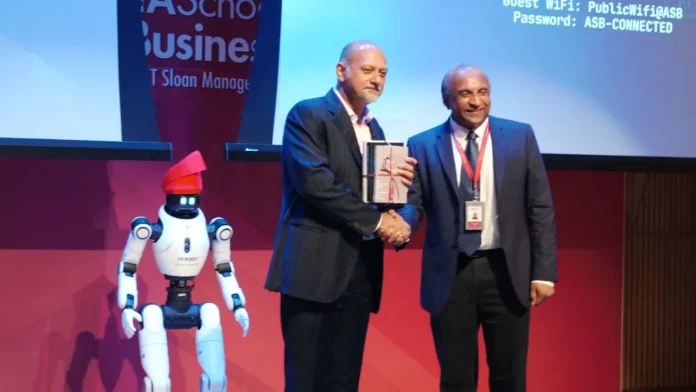
KUALA LUMPUR: Malaysia must confront an urgent question of whether its institutions, regulatory systems and workforce are prepared for an artificial intelligence-driven global economy, said Digital Minister Gobind Singh Deo, who warned that the country will fall behind its competitors if the government does not evolve as quickly as industry.
Speaking at the Asia School of Business’ (ASB) inaugural AI-Powered Leadership Conference yesterday, Gobind said Malaysia has entered a phase where economic outcomes will depend on the nation’s ability to lead responsibly and adopt AI at scale, rather than simply investing in hardware or infrastructure.
He noted that while Malaysia had made impressive progress in building data centre capacity and strengthening digital foundations, the next challenge would be far more complex and human-driven.
He illustrated this with a recent conversation in Penang, where a local innovator demonstrated an AI-powered wearable capable of predicting health indicators such as diabetes risk and blood pressure fluctuations.
Gobind said such innovations could transform the healthcare system by reducing congestion in hospitals, improving early detection and lowering treatment costs, but only if the technology reaches everyday Malaysians.
“Innovation that does not reach the public does not create impact,” he said. “If we keep these solutions in labs or pilot projects, the country gains nothing.”
Gobind stressed that Malaysia is now facing what he described as the rise of a new divide not a divide of connectivity, but one of AI readiness.
“We solved the problem of digital access,” he said. “Now we must solve the problem of AI adoption. Those who are able to adopt artificial intelligence will move forward much faster than those who cannot.”
He acknowledged the industry’s long-standing concern that while companies are aggressively modernising, government agencies have remained slow to change.
“Many in the industry have told us: ‘We are adapting, but government still works the same way.’ After 60 years of doing things a certain way, ministries think they know best. But this is a new world and we have to ask whether our structures still make sense,” he said.
Gobind described a fundamental internal challenge: many ministries still store massive volumes of information in analogue or poorly structured formats, making meaningful AI integration impossible.
“You cannot ask industry players for AI solutions when your data is not digitised, not structured, not secure,” he said. “This is a new layer of talent, a new layer of expertise and we must build it fast.”
To accelerate institutional capability, the Digital Ministry has created the Government Innovation and Innovative Initiative under Malaysia Digital Economy Corporation to help ministries frame clear problem statements and invite private sector partners to co-develop solutions.
He said this was necessary because traditional procurement methods frequently resulted in mismatched solutions. “If the problem is defined wrongly, the solution will never fit. This is a real issue today.”
Gobind emphasised that Malaysia’s path forward would be anchored in trust, leadership capability and human-centred transformation.
He said leaders must treat investments in people as seriously as investments in technology, and that responsible AI deployment required clarity, transparency and security.
“People must trust the platforms and the systems that are being built,” he said. “If they cannot trust them, adoption fails. Leadership in the age of intelligence demands that technology must enhance the human touch, not erode it.”
The ASB conference, supported by TRX City Sdn Bhd, brought together AI pioneers, industry leaders and policymakers.
ASB CEO, president and dean professor Joe Cherian said the institution has invested heavily in developing leaders who can navigate the ethical and strategic challenges of AI.
He highlighted ASB’s Micro-Credential in AI for Business Leaders, as well as its Certified AI Leader and Certified AI Practitioner programmes, emphasising that “leaders today must pair technical literacy with sound judgment and ethical clarity.”
TRX City CEO Datuk Azmar Talib said Malaysia’s financial sector must prepare for rapid technological disruption.
AI-ready leadership, he added, would underpin competitiveness in the coming decade and added that TRX’s partnership with ASB reflected the organisation’s commitment to nurturing talent capable of driving innovation within Malaysia’s international financial centre.
Gobind closed by reminding leaders that the pace of AI development is outstripping traditional planning cycles, noting that “solutions today often become outdated before they even reach the market”.
He said Malaysia must therefore rethink how quickly it builds the structures, policies and talent needed for an AI-driven future. “It is a race against time. If we do not adapt, others will and they will move ahead much faster.”



