



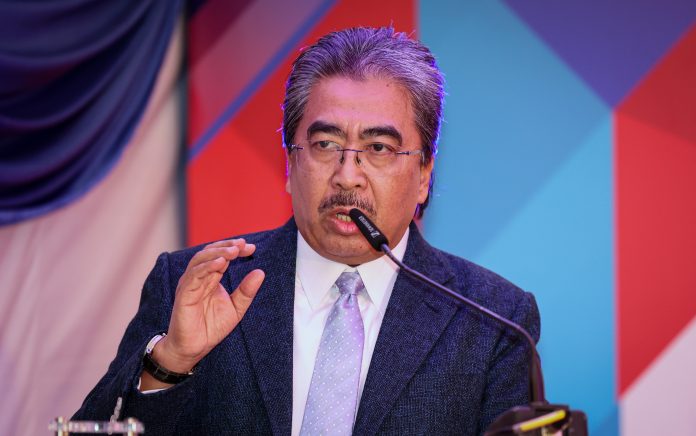
PETALING JAYA: Fluctuations in the ringgit are a normal part of today’s global economic landscape, and Malaysian businesses must adapt their strategies rather than react defensively, said Investment, Trade and Industry Minister Datuk Seri Johari Abdul Ghani.
Speaking at the official launch of GD Xchange Experience Centre today, Johari said currency movements create both winners and losers across sectors, depending on the nature of their operations, cost structures and market exposure.
“The ringgit going up or down will benefit some sectors while affecting others,” he said, adding that there is no one-size-fits-all response for businesses facing currency volatility.
Johari stressed that companies must adopt tailored risk-management strategies, including hedging mechanisms, supply chain planning and pricing adjustments, to protect both operations and customers.
Export-oriented firms, particularly those dealing in commodities, would require a different approach compared with consumer-focused businesses or companies producing finished goods,” he added.
“As a business entity, there are many ways to manage risk such as how you hedge, how you protect your supply chain and how you protect your customers. It depends on the type of business you are in,” he said.
The minister’s remarks come amid heightened global economic uncertainty, driven largely by geopolitical tensions, rising protectionism and aggressive tariff policies by major economies. These external pressures have had a direct impact on currency markets, including the ringgit, which has seen periods of volatility against the US dollar.
Johari highlighted that Malaysia, as a highly open economy, remains particularly sensitive to global trade developments. Trade accounts for about 157% of the country’s gross domestic product, underscoring the importance of maintaining competitiveness and stability in the external sector.
In 2025, Malaysia’s total trade surpassed RM3 trillion for the first time, supported by a 6.5% growth in merchandise exports to RM1.6 trillion, despite challenging global conditions. However, Johari noted that recent tariff actions by the United States and ongoing trade tensions between major economies have added further complexity to the operating environment for Malaysian businesses.
“The most important thing is to make sure any business that operates in Malaysia is not affected by tariffs,” he said, noting that currency movements, tariffs and trade policies are increasingly interconnected.
Johari explained that Malaysia’s approach to managing these challenges is rooted in balance and pragmatism. While the country maintains strong trade ties with both the US and China, decisions are made based on economic outcomes rather than political alignment.
He pointed out that over the past decade, Malaysia has recorded a significant trade surplus with the US, while experiencing a trade deficit with China. These dynamics, he said, must be carefully weighed when assessing the broader impact of currency movements and trade agreements on the domestic economy.
Against this backdrop, Johari emphasised that improving productivity and efficiency is critical to cushioning the effects of external shocks, including ringgit volatility.
Digitalisation, automation and technology adoption play a key role in enabling businesses to extract greater value from their operations and remain resilient.
Initiatives such as GD Xchange, he said, support this objective by lowering barriers to technology adoption, particularly for SMEs that may lack the resources to invest in advanced systems independently.
“Digital solutions are no longer optional. They are foundational,” Johari said, adding that technology adoption helps businesses become more efficient, less reliant on foreign labour and better positioned to navigate cost pressures arising from currency fluctuations.
As global uncertainties persist, Johari reiterated that Malaysian businesses must focus on adaptability rather than attempting to predict currency movements. “The ringgit will move. What matters is how prepared businesses are to manage the impact,” he said.
GD Xchange is the technology arm of GDEX Bhd.



