



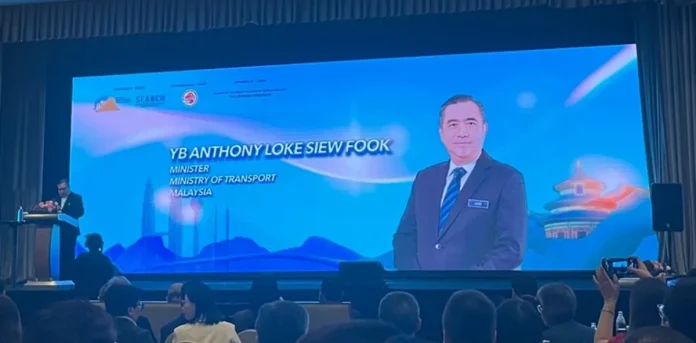
KUALA LUMPUR: Malaysia is set to sign a 30-year government-to-government rail leasing agreement with China in the next couple of months, Transport Minister Anthony Loke Siew Fook said.
He said the proposed government rail leasing programme aims to strengthen Malaysia’s passenger rail capacity by leveraging expertise from Chinese state-owned and publicly listed rolling stock manufacturers (CRCC), while working closely with local partners.
“We are looking forward to signing a 30-year lease agreement between Malaysia and China in the next couple of months. This is one industry where we look forward to long-term, sustainable cooperation between Malaysia and China,” he said at the High-Level Strategic Malaysia-China Destiny-Sharing Community Building Forum today.
In the past, Loke said, rail fleet expansion in Malaysia has been constrained by budget limitations, as rolling stock procurement has traditionally depended on development expenditure allocations.
“Because of these constraints, more than a year ago we began discussions with China under a government-to-government mechanism to increase capacity more quickly, improve reliability and strengthen maintenance capabilities,” he disclosed.
Discussions with China have resulted in an understanding to implement a government-to-government leasing programme to accelerate fleet expansion.
“We have set up a special purpose vehicle to work with CRRC to develop the leasing programme,” Loke said.
It was previously reported that Malaysia is in talks with China to set up an SPV to lease passenger trains. The Malaysian entity is expected to hold a majority stake (51%) in the proposed SPV for local control and industry empowerment.
Loke said Malaysia hopes that through this cooperation there will be further collaboration in rail development with China.
“Not only will Malaysia procure or lease trains, but technology transfer from China to Malaysia will take place through localisation, with more components and supply chains sourced from local companies,” he said, adding that the leasing programme builds on Malaysia’s existing rail cooperation with China, including the East Coast Rail Link, which is nearing completion.
“Construction of the East Coast Rail Link is almost complete, and we are looking forward to the first train running next January. Hari Raya next year passengers should be able to use the East Coast Rail Link to balik kampung,” he added.
Loke said rail development must be viewed from a strategic perspective rather than solely as a passenger transport service.
“Rail is not just about transporting people from one place to another. It is a strategic asset for the country and for the region. Along railway corridors, we want to develop more industrial areas, industrial parks and manufacturing activity so that rail becomes a catalyst for broader economic development.”
Loke said Malaysia could also strengthen connectivity, expand rail-based trade and position itself within future Asia-Europe rail corridors by linking regional networks.
He outlined a longer-term vision to integrate Malaysia into a continental rail network linking Southeast Asia to China and eventually Europe through Thailand and Laos.
“From Padang Besar we are connected to Thailand, from Thailand to Laos, and from Laos to China. Once you reach Kunming, you can travel to any part of China and even onwards to Europe. Malaysia must think big and think long term,“ Loke concluded.



