


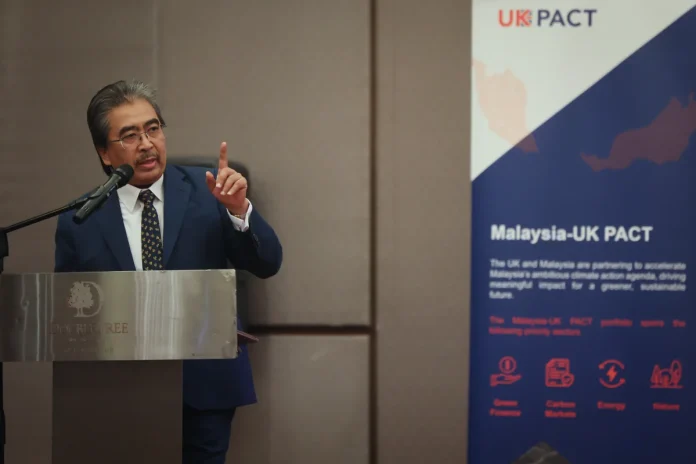
Minister Johari says palm oil industry is well-positioned for carbon markets with its sustainability and circular economy practices already in place
KUALA LUMPUR: The palm oil sector is well-positioned to participate in the carbon market, having already embedded sustainability and circular-economy practices across its value chain.
Minister of Plantation and Commodities Datuk Seri Johari Abdul Ghani said the government has introduced measures to account for industry-wide emission reductions.
“For the palm oil sector, I immediately instructed that there be no deforestation as part of our sustainability commitment,“ he said after launching the second phase of the Malaysia-United Kingdom Partnering for Accelerated Climate Transitions (UK PACT) fund.
He noted that palm oil does not yet have a standalone carbon credit system.
Johari said the sector has begun maximising resource efficiency by converting palm oil mill effluent into biogas.
Used cooking oil is increasingly collected and processed as feedstock for sustainable aviation fuel.
Oil palm trunks from replanting are now utilised for furniture production.
Empty fruit bunches are being converted into pellets for green energy.
“These are key circular economy initiatives within the plantation sector,“ he added.
The minister said the government has not made a final decision on implementing a carbon tax.
It will first pass Malaysia’s Climate Change Bill (RUUPIN) and conduct comprehensive engagements with industry.
“We will brief them thoroughly,“ Johari stated.
The Ministry of Finance and all relevant stakeholders will then drive the process.
The mechanism will evolve based on market supply dynamics.
The RUUPIN is expected to be tabled for its first reading in Parliament next year.
It will provide the legal framework for companies to record, reduce and trade their carbon emissions.
British High Commissioner to Malaysia Ajay Sharma presided over the UK PACT launch. – Bernama



