



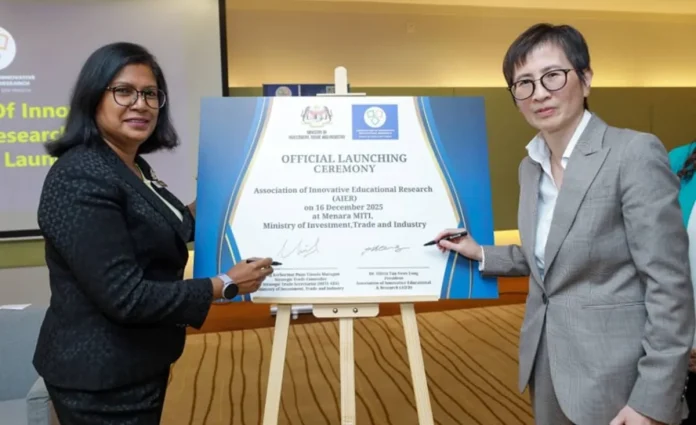
KUALA LUMPUR: The Ministry of Investment, Trade and Industry (Miti) is sharpening its focus on intangible technology transfers under the Strategic Trade Act 2010, as growing geopolitical risks blur the lines between research, commercialisation and national security.
Speaking at the official launch of the Association of Innovative Educational Research (AIER) today, Miti Strategic Trade Controller Vimala Murugan said while controls on manufactured and physical dual-use goods are relatively established, intangible technology transfer (ITT) remains a complex and under-regulated area.
“It was easy when it came to manufactured goods, military items and dual-use items. When it comes to intangible technology transfer, ethical research and who the final recipient is, that’s where it’s always a grey area,” she said.
ITT refers to the transfer of non-physical technologies such as research data, software, designs, technical know-how and training, areas increasingly embedded in academic research, cross-border collaboration and commercialisation efforts.
Vimala said Malaysia’s openness as an education and research hub, coupled with shifting global geopolitics, has heightened the need for stronger safeguards without undermining innovation.
“Malaysia has always been an open country when it comes to students and private education. We have students coming from various countries, undertaking research and moving on. Even that has become something we have to look at carefully.”
She added that Miti plans to work more closely with the Ministry of Higher Education and the Ministry of Education from 2026 to strengthen awareness and governance around ITT in universities and research institutions.
The launch of AIER is expected to support this effort by acting as a bridge between policymakers, academia and industry, particularly in translating regulatory expectations into research and innovation practices.
Vimala said Miti relies heavily on academic collaboration to address ITT risks, noting that the ministry is more familiar with manufacturing-sector controls than research environments.
“When it comes to ITT, we really need the academicians’ support in creating awareness, and to speak the language that researchers are familiar with.”
She also highlighted the reputational risks Malaysia faces if strategic trade controls are not properly managed, noting that the country has previously drawn international attention for manufactured goods-related cases.
“I hope we continue working effectively so that ITT doesn’t go into the headlines for the wrong reasons,” she said, adding that Malaysia should aim to become a benchmark for responsible technology management.
Meanwhile, in her opening remarks, AIER founding member Dr Olivia Tan Swee Leng said the association was established on July 24 2024 to promote safe, ethical and secure research while enabling productive collaboration with industry. “Our mission is to enable rigorous, high-quality research that pushes the boundaries of knowledge, while ensuring safety, ethics and security are embedded from the outset.”
Tan said AIER aims to facilitate responsible technology transfer that safeguards national interests, protects critical capabilities and accelerates beneficial applications to market.
She stressed that national security should not be seen as a barrier to innovation but as an enabler of sustainable growth.
“National security is not a constraint on innovation. It is a guardrail that enables a sustainable approach,” she said, adding that security considerations must be integrated into research design from inception rather than treated as an afterthought.
According to Tan, a key challenge lies in balancing curiosity-driven fundamental research with applied, industry-relevant innovation, particularly when emerging technologies such as artificial intelligence, quantum computing, biotechnology and advanced sensing increasingly carry dual-use risks.
“We do not want to kill off fundamental research. At the same time, we need to protect national security when it comes to technology transfer,” she said.
AIER’s collaboration with Miti’s Strategic Trade Secretariat will focus on promoting risk-aware research design, dual-use screening, security-conscious publishing and responsible commercialisation pathways.
Tan said AIER would also promote transparent governance and measurable impact indicators to track safety outcomes and societal benefits, while nurturing a talent ecosystem that protects sensitive information and sustains long-term national capability.
“Today is a starting point, not a conclusion,” she said. “We invite all stakeholders to pursue research that is rigorous, safe and ethically grounded, while championing responsible innovation that respects national security and public trust.”
The AIER launch marks a growing shift in Malaysia’s innovation landscape, where research excellence and strategic trade compliance are increasingly expected to move in tandem, rather than on parallel tracks.
To that end, AIER plans to roll out capacity-building programmes, workshops, fellowships and certifications to equip researchers and professionals with skills in dual-use risk assessment, cybersecurity, data ethics and governance.



