



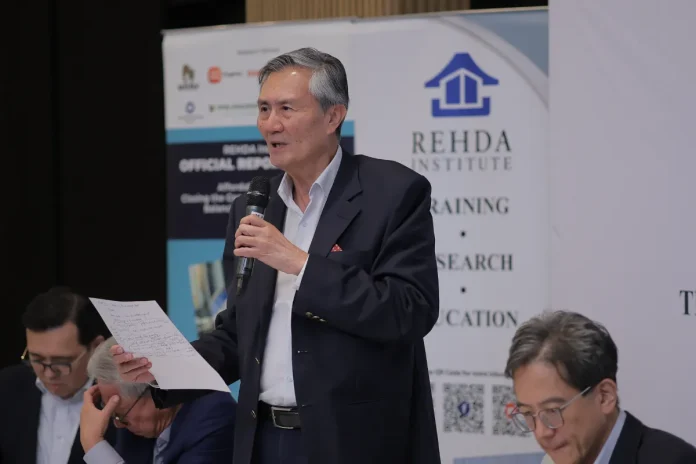
PETALING JAYA: Rehda Institute has reinforced calls for a fundamental rethink and comprehensive review of Malaysia’s housing policies, particularly focusing on the “Housing for All” agenda.
This urgent statement follows a roundtable discussion held on Wednesday, which brought together over 100 housing stakeholders, comprising a diverse array of professionals, academics, bankers, corporates, NGOs, think tanks and government authorities.
The session was designed to foster constructive dialogue and featured presentations by Rehda Institute research and education director Malathi Thevendran. It was moderated by Rehda Malaysia immediate past president Datuk NK Tong and its roundtable groups facilitated by senior academic staff from Universiti Malaya.
The event saw diverse participation, underscoring its collaborative nature, and included representatives from various key sectors, federal government agencies, a senior housing representative from the Negeri Sembilan state government, state housing boards from Pahang, Perak, Penang and Selangor, as well as local authorities from Klang, Petaling Jaya, Shah Alam, Kuantan, Pasir Gudang and Seberang Perai.
Drawing upon the insights and collective views from the 100 stakeholders in the roundtable, Rehda Institute chairman Datuk Jeffrey Ng Tiong Lip, in his concluding remarks, emphasised the critical need for dynamic, data-driven and collaborative strategies to effectively address the nation’s housing challenges.
He also highlighted the necessity for regular review of the existing housing quota policy.
“The intent is not to dismantle the quota system, but rather to adjust it responsibly as market and socio-economic forces shift,“ he clarified, stressing that a uniform, one-size-fits-all approach across all states and districts has proven ineffective, often resulting in mismatches between supply and demand.
The institute advocates for policies that are contextualised and tailored to the socio-economic and market conditions of each locality. Furthermore, it was emphasized that net disposable income, rather than gross household income, offers a more accurate and meaningful indicator for affordability assessments, providing a clearer reflection of actual spending capacity.
The institute underscored that social housing is a shared responsibility, requiring joint support from the government and all stakeholders, moving beyond the current perception that it is solely the developer’s burden.
Ng affirmed that stronger collaboration across the industry is vital for sustainable and impactful implementation. A key area for immediate action, he added, is the unlocking and utilisation of idle land, especially parcels initially designated for schools, facilities or public amenities but which remain underutilised or oversupplied.
In a significant proposal, Ng put forward the concept of sharing the burden of cross-subsidy more broadly across the industry.
The Institute proposed a detailed study to ascertain how other stakeholders, including financial institutions such as banks, could contribute – for instance, by offering special quotas or preferential interest rates for social housing. Additionally, the current policy framework, often perceived as punitive, should evolve.
Rehda Institute called for the government to explore innovative strategies that offer positive reinforcement and reward good compliance and responsible delivery, moving towards a more collaborative environment.
Ng also stressed the crucial role of data sharing and integration for effective policymaking.
Rehda Institute advocates for stronger enforcement at all levels of government and systematic analysis of data by qualified research bodies to translate information into actionable insights. To overcome the fragmentation in data management, the establishment of a centralised data agency, equipped with skilled analysts and supported by coordinated intergovernmental collaboration, should be explored as a backbone for consistent, reliable and data-driven housing policy.
The insights from the workshop will contribute to Rehda Institute’s ongoing research report, Housing for All: Co-Creating a Needs-Driven Framework, which is scheduled for launch next year.



